
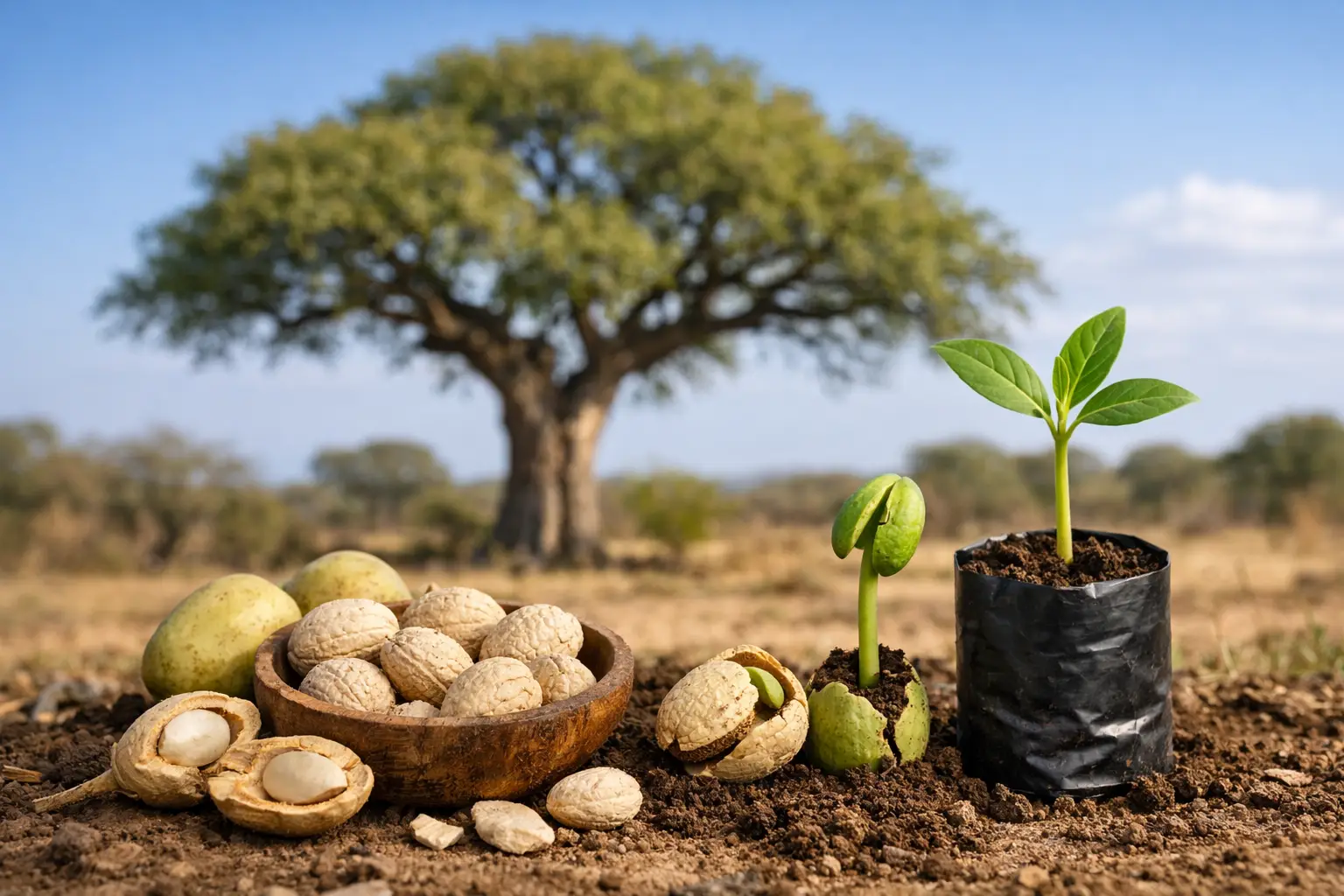
Marula tree seeds offer something far more consequential than a novelty tropical plant. They are the beginning of Sclerocarya birrea, a long-lived African tree with an unusually rich relationship to food, landscape, and local tradition. For growers building a collection around edible or ethnobotanical species, marula belongs in the category of plants chosen for patience, presence, and botanical distinction.
Native across broad areas of sub-Saharan Africa, marula is best understood as a warm-climate tree that demands room and time. It is not a quick container specimen, nor is it a practical orchard choice for every American garden. In the right setting, however, its rounded, spreading canopy, compound foliage, and fragrant fruit make it a memorable specimen with genuine cultural and horticultural depth.
Sclerocarya birrea belongs to the Anacardiaceae, or cashew family, alongside mango, pistachio, and cashew. That relationship gives useful context: marula is adapted to warmth, bright light, and a seasonal rhythm that differs from the needs of temperate fruit trees. Mature trees can become substantial, with a broad crown and a trunk that gains character with age.
The species is often associated with dry savanna and woodland conditions rather than dense tropical forest. This does not mean a young plant should be treated as drought-proof. Seedlings need consistent care while their root systems establish. It does mean that mature marula generally favors drainage, sun, and a period of relative dryness over constantly wet soil.
Marula is also usually dioecious. Male and female flowers occur on separate trees, so a fruiting female requires pollen from a male flowering nearby. A seed-grown plant cannot reliably be identified as male or female until it reaches flowering age. For collectors, this uncertainty is part of the proposition. For anyone focused specifically on fruit production, it is an important practical limitation to plan around from the start.
The term “seed” can be slightly misleading with marula. The fruit contains a hard, stone-like endocarp, and viable seed material is protected within that structure. This durable covering helps explain why germination can be slow and uneven. It also helps explain why fresh, properly handled material matters more than elaborate shortcuts.
Expect variation. One viable marula seed may germinate promptly under favorable warmth, while another may take considerably longer. This is not necessarily a sign of failure. The species has evolved for conditions where moisture arrives seasonally and unpredictably, and its germination behavior reflects that background.
Before sowing, inspect material for obvious damage, mold, or softness. If seeds were stored dry, a period of soaking can help rehydrate the outer structure before planting. Some experienced growers carefully scarify or open part of the hard covering, but this is a trade-off rather than a requirement. Excessive force can damage the embryo within, turning a promising seed into a lost one. For most home growers, patient sowing in warmth is preferable to aggressive mechanical treatment.
Use a deep container rather than a shallow seed tray. Marula develops a strong root system and benefits from early vertical space. A free-draining medium is essential: a quality seed-starting mix amended with coarse mineral material, such as perlite, pumice, or coarse sand, is often suitable. The aim is moisture retention without stagnant conditions around the seed.
Sow the seed covering sufficiently deep that it remains evenly moist, then place the container in warm, bright conditions. Bottom heat can be useful where indoor temperatures are modest. Keep the medium lightly moist, never saturated. A clear humidity cover may help in dry indoor air, but remove or vent it regularly to avoid fungal growth.
The most useful skill during marula germination is restraint. Repeatedly digging up seeds to check progress disrupts the planting medium and can damage a newly emerging root. Instead, watch the surface, maintain warmth, and allow time beyond the germination window expected for familiar annuals or vegetables.
If a container remains inactive after an extended period, assess conditions before assuming the seed is nonviable. Cool temperatures, dense media, and repeated wet-dry extremes are more common causes of disappointment than a lack of effort. A warm, stable environment is especially valuable during the first phase of growth.
Once a seedling emerges, increase light gradually. Bright light is necessary for compact, durable growth, but a plant raised under weak indoor light should not be moved abruptly into intense outdoor sun. Acclimate it over several days or weeks, especially if it has been grown beneath lamps or near a window.
Water young plants deeply, then let the upper portion of the medium begin to dry before watering again. The exact interval depends on container size, temperature, airflow, and growing medium. The better question is not how many days have passed, but whether the root zone has enough air as well as moisture. Marula does not reward a permanently wet pot.
A modest, balanced fertilizer during active growth is usually sufficient. Overfeeding can produce soft, overly lush growth that is less prepared for bright sun and variable conditions. The goal in the early years is a sound root system and woody structure, not rapid, forced size.
Repot only when necessary. A young marula can grow steadily in a deep, well-proportioned container, and frequent disturbance offers little advantage. When roots have clearly occupied the existing pot, shift the plant into a slightly larger vessel with equally good drainage. Avoid oversized containers that remain wet for too long after watering.
For most of the United States, marula is a greenhouse, conservatory, or protected container subject. It is not frost tolerant, and even cool, damp conditions can be stressful. Gardeners in genuinely frost-free subtropical climates may be able to establish it outdoors, provided they have a sunny, well-drained position and adequate long-term space.
Elsewhere, summer outdoors can be beneficial once nights are consistently warm. A protected patio, warm courtyard, or greenhouse bench gives seedlings strong light and air movement. Bring plants indoors well before cold weather arrives. A bright, warm overwintering location is preferable to a dim room where growth becomes weak and elongated.
The central trade-off is simple: marula can be grown as a young collector’s tree in many climates, but it can reach its full landscape potential only where warmth is sustained year after year. This should not discourage the serious grower. It should shape expectations. A well-grown juvenile specimen remains botanically rewarding even where mature fruiting is unlikely.
Marula fruit is valued for its aromatic, tangy pulp, which is used fresh and in juices, fermented drinks, preserves, and other regional preparations. The kernels found inside the hard stone are also edible and valued for their rich oil. The tree has further practical associations, including wood use and traditional applications across its native range.
These uses deserve appreciation without reducing the species to a single product story. Marula’s significance comes from its place in living landscapes and cultural food systems, not merely from its rarity in a northern greenhouse collection. Growing it from seed can be a way to study that botanical lineage with greater care.
For growers who choose marula tree seeds, the reward is measured less by speed than by stewardship. Give Sclerocarya birrea warmth, drainage, room for its roots, and time enough to show its character. The result is a tree that asks for intention from the beginning and earns its place in a considered collection.