
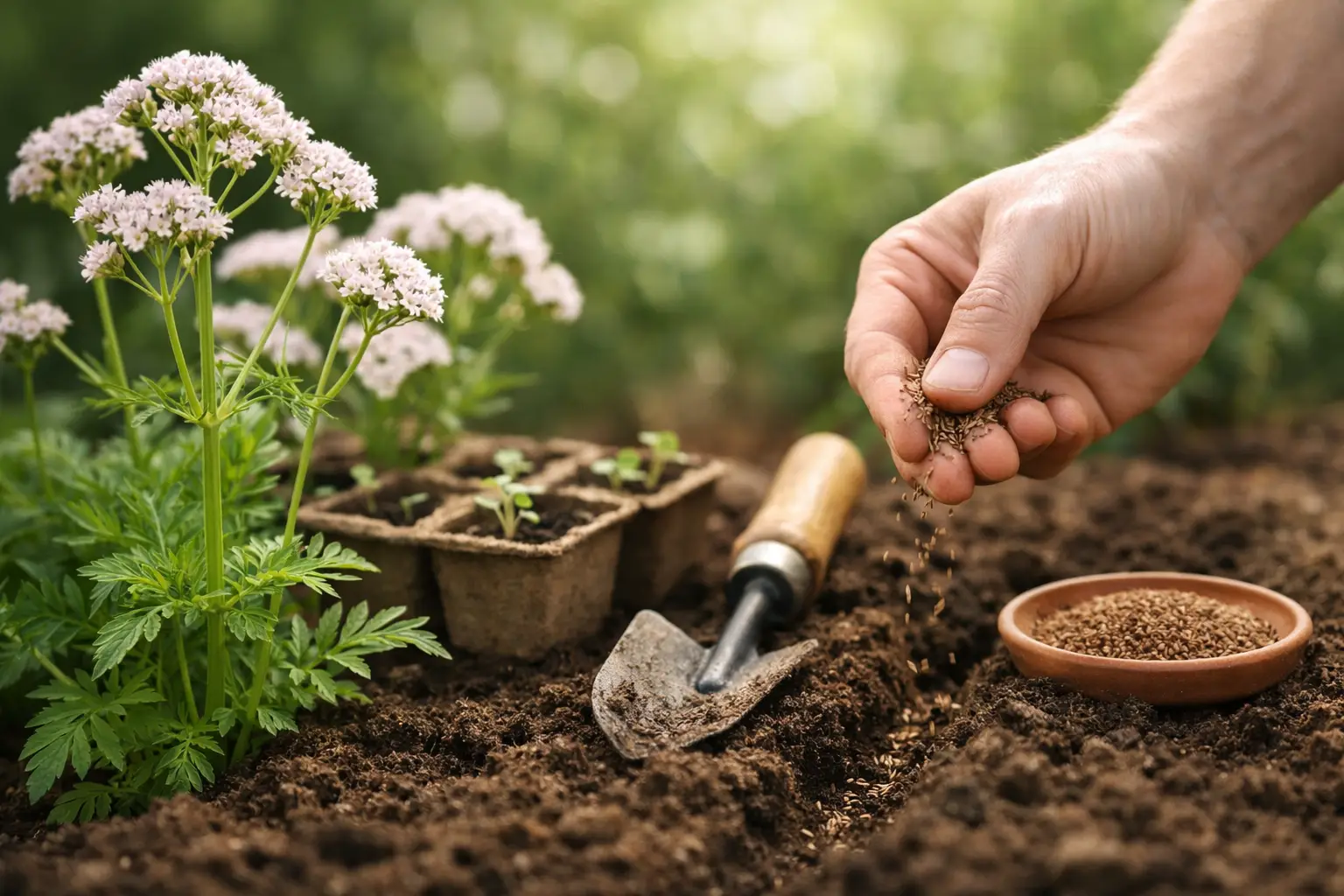
Valeriana officinalis seeds reward a grower who pays attention to small details. True valerian begins as a fine, light-sensitive seed, yet develops into a substantial herbaceous perennial with fragrant roots, handsome divided foliage, and airy clusters of pale pink to white flowers. It is an especially satisfying species for gardeners building a medicinal plant border, a naturalistic perennial planting, or a collection shaped by botanical purpose rather than novelty alone.
Known commonly as true valerian or garden heliotrope, Valeriana officinalis is native across parts of Europe and western Asia and has a long history in European herbal practice. Its botanical identity matters. The name valerian is used for several species, but V. officinalis is the classic medicinal valerian valued for its aromatic root system.
In the garden, it earns its place on more than historical association. Mature plants form upright clumps, commonly reaching 3 to 5 feet in flower, and their branched flower heads bring a soft, meadow-like texture to summer borders. The blooms are also visited by pollinating insects. This is not a compact windowsill herb or a plant chosen for clipped formality. It is a perennial with presence, best suited to growers who can give it a considered position and let it establish.
Seed-grown plants also offer a different kind of satisfaction from purchasing a finished crown. They allow the grower to observe the species from its earliest stage, select the strongest individuals for a collection, and establish plants adapted to the particular conditions of a garden or nursery bed.
The first consideration is freshness. Valerian seed does not hold peak viability indefinitely, so careful storage and reasonably fresh seed can make a noticeable difference. Keep unopened seed cool, dry, and away from direct light until the sowing window. If a packet has been stored for an extended period, sowing a few extra seeds is sensible rather than assuming every seed will germinate.
A short period of cold, moist stratification often improves the timing and uniformity of germination. Mix the seeds gently with barely moist sterile medium, place them in a labeled sealed container, and refrigerate them for roughly 2 to 4 weeks. The medium should feel damp but should not release water when pressed. Excess moisture encourages fungal problems and can compromise very small seed.
Stratification is useful, not an absolute ritual. Some fresh seed may germinate without it, particularly when conditions are stable. For a collector or specialty grower seeking a more even tray, however, the small investment of time is usually worthwhile.
After stratification, sow in a clean tray or small pots filled with a fine, free-draining seed-starting mix. Firm the surface, scatter the seeds sparingly, and press them into contact with the medium. Do not bury them deeply. Valerian seed benefits from light exposure, and a heavy covering can reduce germination.
Mist carefully or water from below so the seed is not displaced. A clear humidity cover can help maintain consistent moisture during the first stage, but it should be vented regularly and removed once seedlings emerge. Stagnant, overly humid air is an invitation to damping-off.
Place the tray in bright light at a moderate temperature, generally around 60 to 70°F. Germination may begin in 10 to 21 days, though a tray can be uneven and should not be discarded too soon. Continue to keep the surface evenly moist, never saturated. The distinction is significant: young valerian wants reliable moisture, but it does not want to sit in airless compost.
Once seedlings have formed true leaves and are sturdy enough to handle, transplant them individually into small pots. Lift each plant by a leaf rather than the stem and settle it at the same depth it occupied in the seed tray. Provide bright light, good airflow, and measured watering while the roots fill their new containers.
If several seedlings arise close together, separate them early. Crowding produces stretched, weak plants and makes later root disturbance more difficult. A small number of well-grown young plants is more useful than a crowded tray of compromised ones.
Harden seedlings off gradually before planting outdoors. Over 7 to 10 days, increase their exposure to outdoor air, sun, and temperature changes while protecting them from sharp cold or drying wind. Plant after the risk of hard frost has passed, or establish young plants in early fall where winters are not severe.
Valerian is adaptable, but its best growth comes from a fertile soil that retains some moisture while draining freely. A sunny site supports abundant flowering, while light afternoon shade can be valuable in climates with intense summer heat. Avoid the two extremes: parched, shallow ground limits vigor, and permanently waterlogged soil can weaken the crown and roots.
Allow room for maturity. Spacing plants about 18 to 24 inches apart gives each clump space to develop, improves air circulation, and makes future lifting or division easier. In a mixed planting, position valerian behind shorter herbs and companions. Its flowering stems rise above the basal foliage and can look untidy when crowded into the front edge of a formal bed.
A light mulch helps conserve soil moisture, though keep it away from the center of the crown. During the first season, water deeply when rainfall is limited. Once established, true valerian is generally less demanding, but it remains at its best in soil that does not dry completely for extended periods.
The growing season is largely straightforward. Remove spent flower stems if self-sowing is not desired, or leave a selected few to set seed if you want to observe the species’ full cycle. Seedlings may appear near mature plants in favorable conditions, though they are easy to remove or pot up while young.
Feeding should be restrained. Incorporating compost before planting is usually more appropriate than repeated high-nitrogen fertilizer applications. Too much nitrogen can favor lush foliage at the expense of balanced root development. Where soil is lean, a modest organic feeding in spring is sufficient.
Root harvest is generally most purposeful in the second or third autumn, after the top growth begins to die back. Lift a mature plant carefully with a garden fork, shake away loose soil, and wash the roots promptly. Their scent is notably strong and earthy, a characteristic that becomes more pronounced as they dry. If retaining the plant is important, divide a portion of the crown and replant it promptly rather than harvesting the entire clump.
For gardeners interested in using valerian as an herb, accurate identification, clean cultivation, and proper handling matter. Botanical information should not be treated as personal medical advice. Valerian preparations can be unsuitable in certain circumstances and may interact with medications, so anyone considering internal use should consult a qualified health professional.
Most early setbacks come down to moisture, depth, or light. Seed sown too deeply may fail to emerge. A surface that dries repeatedly can interrupt germination, while persistently soaked medium creates the opposite problem. Bright conditions and gentle watering are more valuable than elaborate equipment.
Leggy seedlings usually indicate insufficient light or excessive warmth. Move them into stronger light rather than attempting to correct the issue with fertilizer. Yellowing plants after potting often point to saturated compost or roots that have not yet adjusted, not necessarily a lack of nutrients.
A mature plant that flowers weakly may simply need more sun, more consistent moisture, or another season to establish. It is worth allowing Valeriana officinalis time. This is a perennial selected for its enduring usefulness and character, not its speed.
A well-sited valerian becomes more compelling with each season: an upright summer flower, a useful root crop, and a quietly distinctive specimen for a garden assembled with intention.