
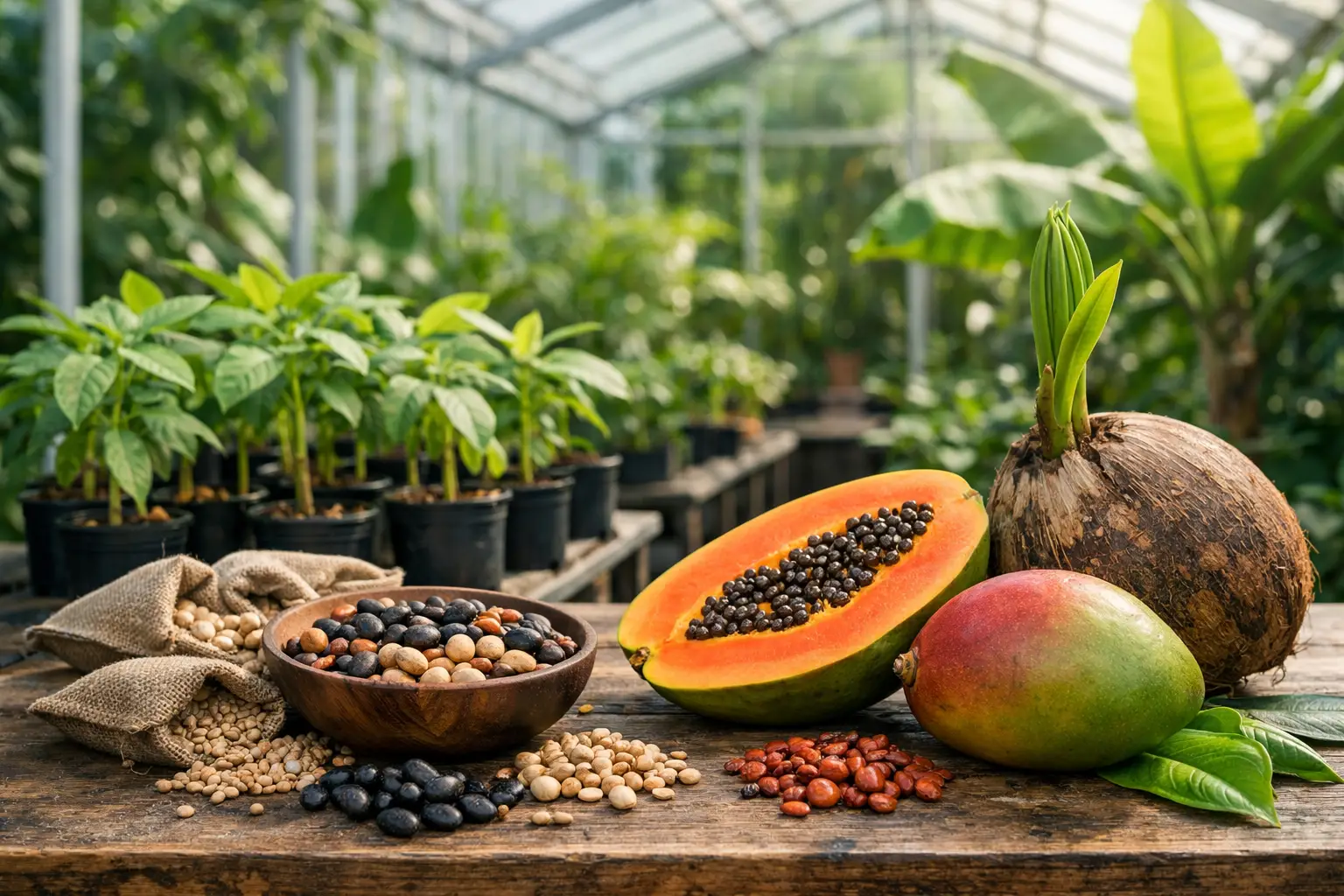
A greenhouse can turn a single seed into a cashew tree, a marula specimen, or a fragrant pepper tree that would never tolerate a temperate winter outdoors. But tropical seeds for greenhouse cultivation are not interchangeable. The same enclosed space that protects a heat-loving species can be too cool, too dim, too dry, or too crowded for another.
For collectors, the attraction is clear: seed offers access to botanical material that rarely appears on ordinary nursery benches. The reward is not merely an unusual plant. It is the chance to observe a species from its earliest stage, learn its natural rhythm, and give it conditions suited to its particular origin.
A greenhouse is a climate tool, not automatically a tropical climate. Before choosing species, consider what the structure actually provides from November through February. Record the lowest overnight temperature, daytime high, light levels, humidity, and available bench or floor space. A bright conservatory with winter nights near 60°F will suit a different collection from a heated greenhouse maintained above 70°F.
Tropical species are often grouped together because they cannot withstand frost, yet their preferences may differ considerably. Lowland equatorial plants generally favor steady warmth and high humidity. Plants from seasonally dry tropical regions may welcome warmth but resent wet soil around their roots. Subtropical trees can tolerate cooler nights once established, although young seedlings remain more sensitive.
Light is frequently the limiting factor in northern greenhouses. Glass reduces some light, short winter days reduce more, and large-leaved seedlings can quickly shade smaller pots. If supplemental lighting is not part of the plan, select species with a realistic tolerance for the available winter conditions and time sowing so the strongest early growth occurs in spring and summer.
A good collection begins with a clear question: are you building a warm, humid understory of edible and ethnobotanical plants, raising young trees for a summer terrace, or growing permanent greenhouse specimens? Each aim calls for a different seed selection and a different commitment to space.
Tree seeds are among the most compelling choices for a greenhouse collection, particularly when the species is rarely offered as a young plant. They also demand a longer view. A seedling that fits in a 4-inch pot during its first season may need a substantial container, pruning strategy, or future planting site within a few years.
Anacardium occidentale, the cashew, is a notable example. Its broad leaves and sculptural form make it a handsome warm-house subject, while its edible and ethnobotanical significance adds another dimension. Cashew seeds are recalcitrant: they do not retain viability through prolonged drying and storage in the way many common garden seeds do. Freshness matters, and warm germination conditions are usually more useful than elaborate treatments. The mature plant needs bright light, warmth, and excellent drainage.
Sclerocarya birrea, marula, carries a different character. Native to seasonally dry parts of Africa, it is valued for its fruit and cultural history as much as for its graceful presence. Marula is better treated as a long-term woody specimen than a quick greenhouse crop. Give young plants warmth during establishment, use a sharply draining medium, and avoid assuming that tropical origin means constant moisture.
Schinus molle, Peruvian pepper, is another species whose fine-textured foliage and pendulous habit appeal to collectors. It is not a plant for a cool, wet greenhouse. Strong light, careful watering, and enough room for its developing root system are central to growing it well. In mild regions, it may eventually be better suited to a protected outdoor position than a permanent indoor life.
These examples point to an essential trade-off: the more distinctive the future specimen, the more likely it is to challenge the boundaries of a modest greenhouse. Choose at least one species for its mature character, but do not fill every bench with trees unless you have a credible plan for their second and third years.
Many tropical seeds germinate best in a warm medium, commonly around 75°F to 85°F, but temperature alone does not resolve dormancy or freshness issues. Seed type matters. Some hard-coated seeds may benefit from scarification, while others should simply be sown promptly and kept evenly moist. Large fleshy seeds often lose viability quickly. Very fine seeds may need light to germinate and should not be buried deeply.
Read the biology of the species rather than applying one routine to every packet. A seed from a dry woodland, a rainforest canopy tree, and a tropical herb may all be labeled tropical while requiring different handling. When reliable species-specific information is unavailable, start conservatively: use a clean, airy medium, modest depth, bottom heat if appropriate, and moisture that is even rather than saturated.
Humidity domes can be useful during germination, especially in dry heated environments. Remove or vent them once seedlings emerge. Stagnant, saturated air encourages damping-off and teaches seedlings to depend on conditions they will not have later. Air circulation from a small fan is a quiet but valuable part of greenhouse seed raising.
The most common early mistake with unusual tropical species is overwatering. Growers see warmth and humidity as a paired requirement, then keep the root zone constantly wet. Yet warm, wet compost with limited air is an invitation to rot.
Use a free-draining, sterile starting mix suited to the seed size. Fine seeds need a relatively smooth surface and close contact with the medium. Larger seeds can be placed individually in deep cells or small pots, which reduces root disturbance at transplanting. For species that make a pronounced taproot, depth matters more than a wide pot at the beginning.
Water after sowing so the medium is moist throughout, then let the surface approach dryness before watering again unless the species is known to require uninterrupted moisture. The pot should never sit in standing water. Labels should include the full botanical name, sowing date, seed source, and any treatment used. For a serious collection, this record is not a formality. It allows you to recognize patterns in germination and adjust future sowings with confidence.
Do not discard slow pots too soon. Tropical germination can be uneven, particularly with woody species. At the same time, a pot that remains cold and wet for months is unlikely to improve through patience alone. Reassess the temperature, moisture, seed depth, and viability before repeating the same method.
A newly germinated tropical plant is not a miniature mature tree. Seedlings often need gentler light, steadier moisture, and protection from abrupt temperature swings. Move them gradually from a propagator or shaded bench into brighter greenhouse light. Leaf scorch, stalled growth, and sudden wilt after transplanting usually indicate a transition that was too fast, not a lack of fertilizer.
Begin feeding only after active growth is clear. A diluted, balanced fertilizer is generally preferable to heavy feeding, especially for young plants in containers. Mineral buildup becomes a concern in greenhouse culture, so occasional thorough watering to flush excess salts is useful when drainage is good.
Pot on when roots have begun to occupy the container, not simply because a calendar says it is time. Oversized pots hold too much moisture around a small root ball. For long-lived tropical trees, increase container size in measured stages and choose a medium that remains open as it ages.
Pruning is sometimes necessary, but timing matters. A collector may want a naturally expressive specimen, while a greenhouse may require a compact plant that can be moved and overwintered. Light formative pruning during active growth can establish a manageable framework. Severe pruning of a stressed or newly transplanted seedling usually creates more problems than it solves.
A considered greenhouse collection is often more satisfying than a crowded one. Combine one or two long-term woody specimens with smaller plants that can occupy the understory or be renewed from seed. This gives the space visual depth without committing every square foot to future canopy.
At Quinta dos Ouriques, botanical names are a practical starting point for this kind of selection. They help distinguish plants with similar common names, reveal family relationships, and encourage growers to consider origin and habit before sowing. For collectors, that specificity is part of the pleasure: each label represents a living species with its own history and conditions, not merely an exotic category.
The finest greenhouse specimens are seldom the fastest. Select seeds whose mature needs you can honor, keep careful notes through the first season, and allow each young plant to reveal what it needs. A greenhouse then becomes more than winter shelter – it becomes a place where rare botanical material can be grown with real attention.