
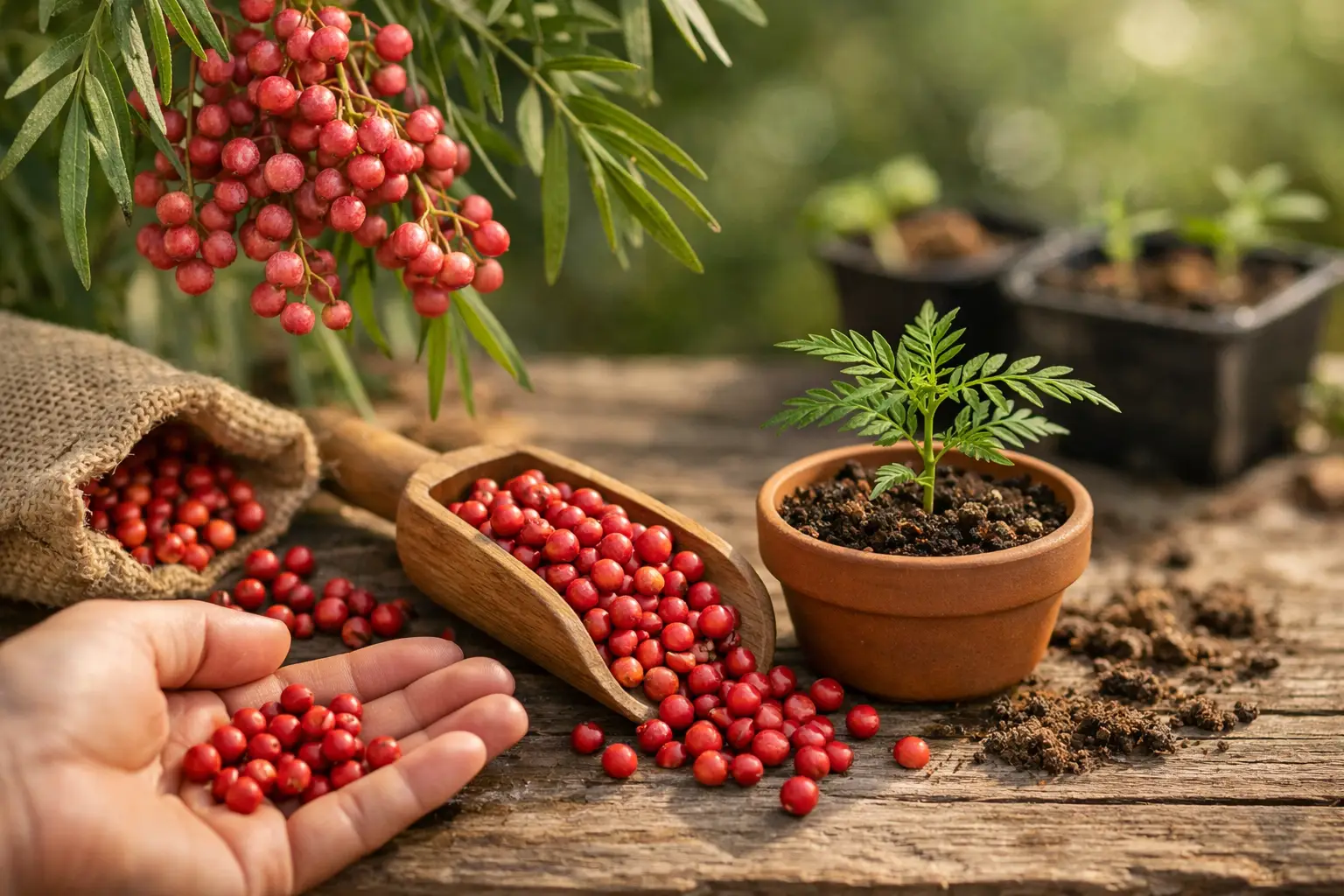
The appeal of peruvian pepper tree seeds begins long before a mature canopy forms. Each seed offers the prospect of Schinus molle, a finely textured evergreen to semi-evergreen tree with pendulous branches, aromatic foliage, and clusters of rose-pink fruits. For growers seeking a specimen with botanical character rather than a familiar landscape default, it is an unusually satisfying species to raise from seed.
Native to the dry landscapes of South America, Schinus molle belongs to the Anacardiaceae, the cashew family. Its botanical relatives include mango, pistachio, sumacs, and cashew – a useful connection both for the collector and for anyone mindful of plant sensitivities. The tree is often called Peruvian pepper tree, California pepper tree, or false pepper, though it is not related to culinary black pepper, Piper nigrum.
A well-sited Schinus molle develops an unmistakable silhouette. Its trunk becomes attractively furrowed with age, while long, pliable branches create a broad, airy crown. The leaves are divided into many narrow leaflets, releasing a resinous, peppery scent when handled. In warm regions, small cream-colored flowers are followed by abundant fruit clusters that persist as decorative detail.
Mature size is one reason to choose this tree deliberately. In favorable ground, a Peruvian pepper tree may reach 25 to 40 feet tall and equally broad, occasionally more. It is not a small courtyard tree, nor is it a sensible choice directly beside paving, foundations, or narrow walkways. Its charm lies in the generous scale of its canopy and its ability to make a dry, open planting feel established.
The species is most compelling where its naturally informal habit has room to show. A young plant can be maintained in a large container for a period, but a long-lived specimen ultimately performs best in open ground in a mild climate. Gardeners in cooler regions can still grow it as a container plant, provided they have bright winter protection and accept that growth may be more restrained.
Before sowing, consider climate as carefully as germination. Schinus molle is adapted to warmth, sun, and periods of dryness once established. It is generally suited to USDA Zones 9 through 11. Older trees may tolerate a brief light frost, but young seedlings are much less forgiving. In areas with regular hard freezes, a protected conservatory, greenhouse, or movable container is the more realistic path.
Heat is not a problem for this species when roots have room and drainage is good. Cold, stagnant moisture is more troublesome. A plant kept in a wet potting medium during a dim winter is more likely to struggle than one given measured watering and strong light.
There is also a local stewardship question. Peruvian pepper trees have naturalized beyond cultivation in some warm, dry regions, and may be invasive in particular landscapes. Regulations and ecological concerns vary widely by state, country, and even watershed. Responsible growers should check local invasive-plant guidance before planting outdoors, especially in Mediterranean climates, coastal areas, and places with undisturbed open land nearby.
Seed-raised trees reward patience, but Schinus molle is not an unnecessarily difficult species when its basic needs are respected. Germination can be uneven because seed freshness, fruit processing, and storage conditions matter. Sow more seeds than the number of plants you intend to keep, then select the strongest, most balanced seedlings.
The fruits contain a hard seed surrounded by fleshy material. If seeds arrive with any remaining fruit tissue, clean it away before sowing. The pulp can inhibit germination and may invite fungal growth in a humid seed tray. Rinse the seeds thoroughly, then allow them to dry briefly on a clean surface.
A short soak in room-temperature water for 12 to 24 hours can help hydrate the seed coat. Do not leave seeds submerged for days. The goal is gentle preparation, not fermentation. Some growers lightly nick especially hard seed coats, but this is optional and can damage the embryo if done too aggressively.
Use a clean, free-draining seed-starting mix. A blend designed for germination, amended with perlite or fine horticultural grit, provides the air around the seed that young roots need. Sow approximately one-quarter inch deep, firm the mix lightly, and water so it is evenly moist rather than saturated.
Warmth is the practical advantage. Keep the tray between roughly 70 and 80 degrees Fahrenheit, with bright indirect light until seedlings emerge. A propagation mat can be useful in a cool home or greenhouse, but it should support steady warmth rather than overheat the medium. Check the tray regularly: the surface may dry quickly, while the lower mix remains wet.
Germination may begin within a few weeks, though it can be irregular. Resist the urge to discard a tray too early. Once seedlings have formed several true leaves and are large enough to handle without bruising the stem, transplant them into individual pots. A deep pot is preferable to a shallow one because the young root system benefits from downward space.
At this stage, bright light becomes essential. Introduce seedlings gradually to direct sun over seven to 10 days. Sudden exposure from a low-light windowsill to intense outdoor sun can scorch tender foliage. As growth strengthens, allow the mix to dry modestly between waterings. This is the beginning of teaching a drought-adapted tree to develop a resilient root system.
For garden planting, select the sunniest available position and favor drainage over richness. Schinus molle can adapt to lean, sandy, gravelly, or moderately loamy soils. Heavy clay can work only if water moves away readily; a raised mound or improved planting area may be needed where winter wetness lingers.
Do not overfeed young trees. Excess nitrogen can encourage lush, weak growth that is more vulnerable to wind and cold. A modest, balanced fertilizer during active growth is sufficient for container specimens, while a garden-planted tree in reasonable soil often needs little additional feeding once established.
Water deeply after planting, then maintain regular moisture through the first growing season. After the roots have explored the surrounding soil, reduce frequency and water more thoroughly rather than offering shallow daily irrigation. Established trees can tolerate dry periods, but drought tolerance is not a reason to neglect a newly planted seedling.
The Peruvian pepper tree has qualities that suit a collector’s garden: fragrance, movement, finely divided foliage, and a mature form unlike the denser, more conventional shade trees seen in many landscapes. It can also be somewhat untidy. Leaves, fruit clusters, and fine branchlets may drop beneath the canopy, so it is better placed where a natural litter layer is acceptable rather than above a pristine patio or heavily used driveway.
Pruning should be selective. Early structural pruning can establish a sound framework and remove crossing or weakly attached branches. Mature trees should not be repeatedly sheared into rigid shapes. Their grace comes from the loose, sweeping architecture of the crown, and excessive cutting often produces a less convincing result.
The pink fruits are sometimes described as pink peppercorns, but they should not be treated as a casual home-spice crop. Plants in the Anacardiaceae family can cause allergic reactions in sensitive people, and the culinary suitability of Schinus fruits depends on species identification, processing, individual sensitivity, and local food guidance. Grow Schinus molle first as an ornamental and ethnobotanical tree, not as an assumed edible.
Wear gloves when handling crushed foliage or pruning material if you have known sensitivities to mango, cashew, poison ivy, or related plants. This is not a reason to avoid the species outright, but it is a sensible precaution for a tree with aromatic resins and a notable botanical family.
Seed-grown Schinus molle plants vary slightly in vigor, branching, and eventual form. That variation is part of the value of raising a tree from seed. Rather than expecting identical nursery uniformity, observe each young plant over time and keep the specimen with the healthiest roots, strongest central structure, and most appealing foliage.
For a warm-climate garden, give it sun, drainage, and room to mature. For a conservatory collection, give it a large root run, careful winter watering, and enough light to retain its refined, feathery presence. Peruvian pepper tree seeds are best approached as the beginning of a long botanical relationship – one that becomes more distinctive with every growing season.