
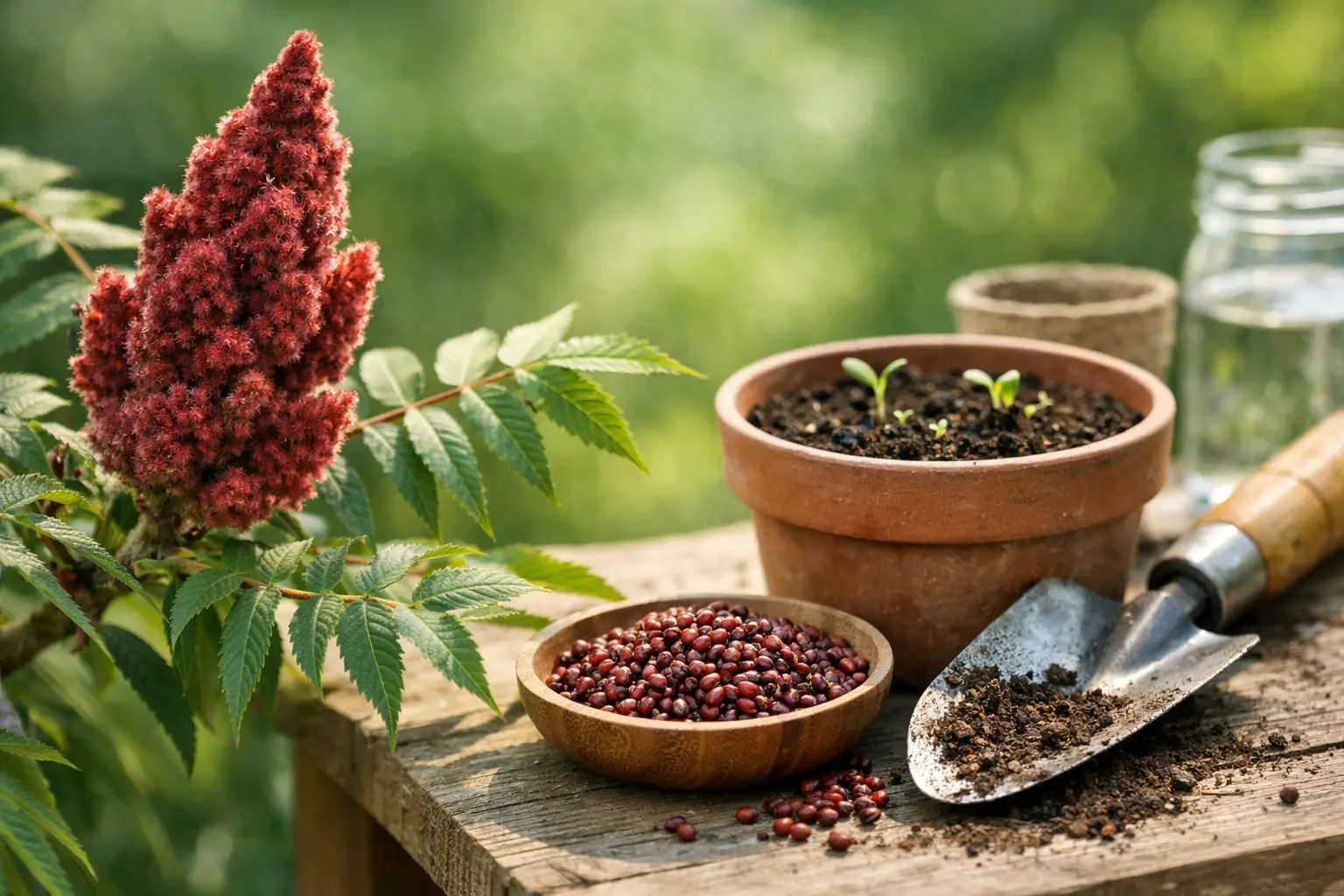
Staghorn sumac seeds offer more than an easy route to autumn color. They are the beginning of Rhus typhina, a distinctive North American shrub or small tree valued for its velvet-covered branches, sculptural branching, red fruit clusters, and capacity to hold its own in difficult, open ground. For growers building a native planting, collecting unusual woody species, or seeking a specimen with real seasonal presence, it is a seed worth treating with intention.
Unlike a compact ornamental selected for a small border, staghorn sumac has a spreading nature and a strong point of view. Give it the right site and room to establish, and it can become one of the most memorable plants in the landscape.
Rhus typhina belongs to the Anacardiaceae family, alongside cashew, pistachio, and mango. It is native across much of eastern and central North America, where it commonly occupies sunny woodland edges, roadsides, disturbed slopes, and open clearings. Its resilience is part of its appeal: established plants tolerate lean soil, heat, wind, and periods of dryness better than many conventional ornamental shrubs.
The common name comes from the dense, soft hairs that coat young twigs, closely recalling a stag’s antlers in velvet. Large, pinnately compound leaves create a tropical-looking effect through summer, then turn brilliant shades of yellow, orange, scarlet, and crimson in fall. Female plants carry upright clusters of deep red, fuzzy fruits that often remain into winter, bringing color and food value to a quiet garden.
Staghorn sumac is dioecious, meaning male and female flowers occur on separate plants. A seed-grown planting may produce plants of either sex. This is a meaningful distinction for collectors interested in the fruit display: one female plant will need a male plant flowering nearby for reliable fruit set. Seed propagation offers genetic variation, which is valuable in naturalistic or restoration-minded planting, but it does not provide the predictability of a named vegetatively propagated selection.
The first question is not whether Rhus typhina can grow in your garden. In many suitable climates, it can. The better question is whether its growth habit fits the space you have reserved for it.
Staghorn sumac performs best in full sun, where its branching, foliage density, and fall color are at their strongest. It accepts a wide range of well-drained soils, including sandy, rocky, and relatively infertile ground. A rich, frequently irrigated bed is not necessary and can encourage softer growth that is less in keeping with the plant’s naturally rugged character.
Mature height is commonly in the 15- to 25-foot range, although local conditions affect both height and spread. The more important consideration is its tendency to form suckers from the roots. Over time, a single plant can develop into a colony. This is useful on a bank, at the back of a large property, along a sunny boundary, or in a wildlife planting. It is less welcome beside a narrow lawn, a formal terrace, or a mixed border filled with delicate perennials.
Root barriers and regular removal of emerging shoots can contain a plant to some degree, but they ask for ongoing attention. If you want a completely stationary specimen, staghorn sumac may not be the right woody plant. If you want a living thicket with seasonal drama, its colony-forming habit becomes an asset.
The seeds of Rhus typhina are protected by a hard coat designed to delay germination until conditions are favorable. In nature, weathering, soil abrasion, and passage through an animal’s digestive system help weaken that coat. In cultivation, germination is usually improved by combining scarification with a period of cold, moist stratification.
Scarification simply means creating a small weakness in the seed coat so moisture can enter. For the home grower, mechanical scarification is the most measured approach. Gently rub one small area of each seed with fine sandpaper or a nail file until the outer coat is thinned. The aim is not to expose or damage the embryo. A light abrasion is sufficient.
After scarification, soak the seeds in room-temperature water for 12 to 24 hours. Seeds that take up water may appear slightly fuller. They can then be placed in a lightly moist medium such as clean sand, vermiculite, or a seed-starting mix, sealed in a labeled container, and refrigerated for roughly 30 to 60 days. The medium should feel barely damp rather than wet. Excess moisture invites mold and can compromise the seed before it ever reaches soil.
Some growers use chemical scarification for hard-coated species, but concentrated acids present obvious handling hazards and are unnecessary for most home collections. Mechanical scarification is slower, yet it is precise, accessible, and appropriate for the modest quantities typical of a considered seed sowing.
After cold stratification, sow seeds about one-quarter inch deep in a free-draining seed mix. Provide warmth, bright light, and even moisture. A temperature around 65 to 75 F is generally suitable for germination and early development. Do not keep the medium saturated. Sumac seedlings need moisture while establishing roots, but constantly wet conditions can cause damping-off and weak growth.
Germination may be uneven. This is normal for a woody species with physiological and physical dormancy mechanisms. Avoid discarding a tray too quickly when the first seedlings emerge. Keep records of scarification date, stratification period, sowing date, and germination results. For collectors, those notes become useful cultivation data rather than an afterthought.
Once seedlings have developed several true leaves and a stable root system, move them into individual containers. Use a mix that drains freely and avoid oversized pots, which remain wet for too long around small roots. Young plants benefit from bright light and gradual exposure to outdoor conditions before permanent planting.
Plant staghorn sumac in its final position after the plant is well rooted and weather conditions are mild. Spring planting is often convenient in colder regions because it gives the young plant a full season to establish, though early fall can also work where winters are not severe and soil remains workable.
Water deeply during the first growing season, allowing the soil surface to dry somewhat between waterings. Once established, Rhus typhina is notably drought tolerant, though prolonged drought can reduce growth and make fall color less dramatic. A light mulch around, but not directly against, the stem helps moderate soil temperature and suppress competing weeds.
Pruning is usually minimal. Remove damaged, crossing, or poorly placed branches in late winter or early spring. Heavy annual shaping works against the plant’s naturally architectural form and may stimulate vigorous, awkward regrowth. If a colony is desired, allow selected suckers to develop. If a single trunk or limited clump is preferred, remove unwanted shoots promptly while they are small.
Seed-grown plants can vary in vigor, branch angle, fall color, and fruiting potential. That variation is part of the appeal. Select the plants with the form and behavior best suited to your site, then make decisions early rather than trying to force a mature colony into a space that was too small from the start.
The red fruit clusters of female staghorn sumac are technically dense groups of small drupes. They provide late-season interest and can persist through winter, especially when not taken quickly by birds. The fruits are also associated with a tart, lemonade-like infusion in regional food traditions. Only use material from a correctly identified plant grown without pesticides or other unsuitable treatments, and approach any edible use with the same care given to other wild or ethnobotanical plants.
Correct identification matters because staghorn sumac is often confused by name with poison sumac, Toxicodendron vernix. They are different plants. Poison sumac generally grows in wetland habitats and bears loose clusters of pale, whitish fruits, while staghorn sumac favors drier, sunny ground and has dense upright clusters of red, hairy fruits. Gardeners sensitive to members of the Anacardiaceae family should also handle new plants thoughtfully.
For wildlife-minded growers, a sumac colony offers cover as well as fruit. Its broad leaves and branching structure create habitat, while its tolerance of exposed sites makes it useful where more demanding shrubs struggle. That said, native status does not remove the need for placement discipline. A vigorous native plant can still outgrow a small garden.
Staghorn sumac is not a generic landscape filler. It is a plant for growers who appreciate expressive form, seasonal change, and the possibility that a seedling may become a small colony with its own character. Its dormancy requirements ask for patience, and its root system asks for room, but those are not flaws. They are part of the biological character of Rhus typhina.
Sow it where its vivid fall canopy, red fruiting heads, and velvety young growth can be seen from a distance, and where its urge to spread can become a feature rather than a maintenance problem. Given that setting, it rewards careful cultivation with a presence few ordinary shrubs can match.