
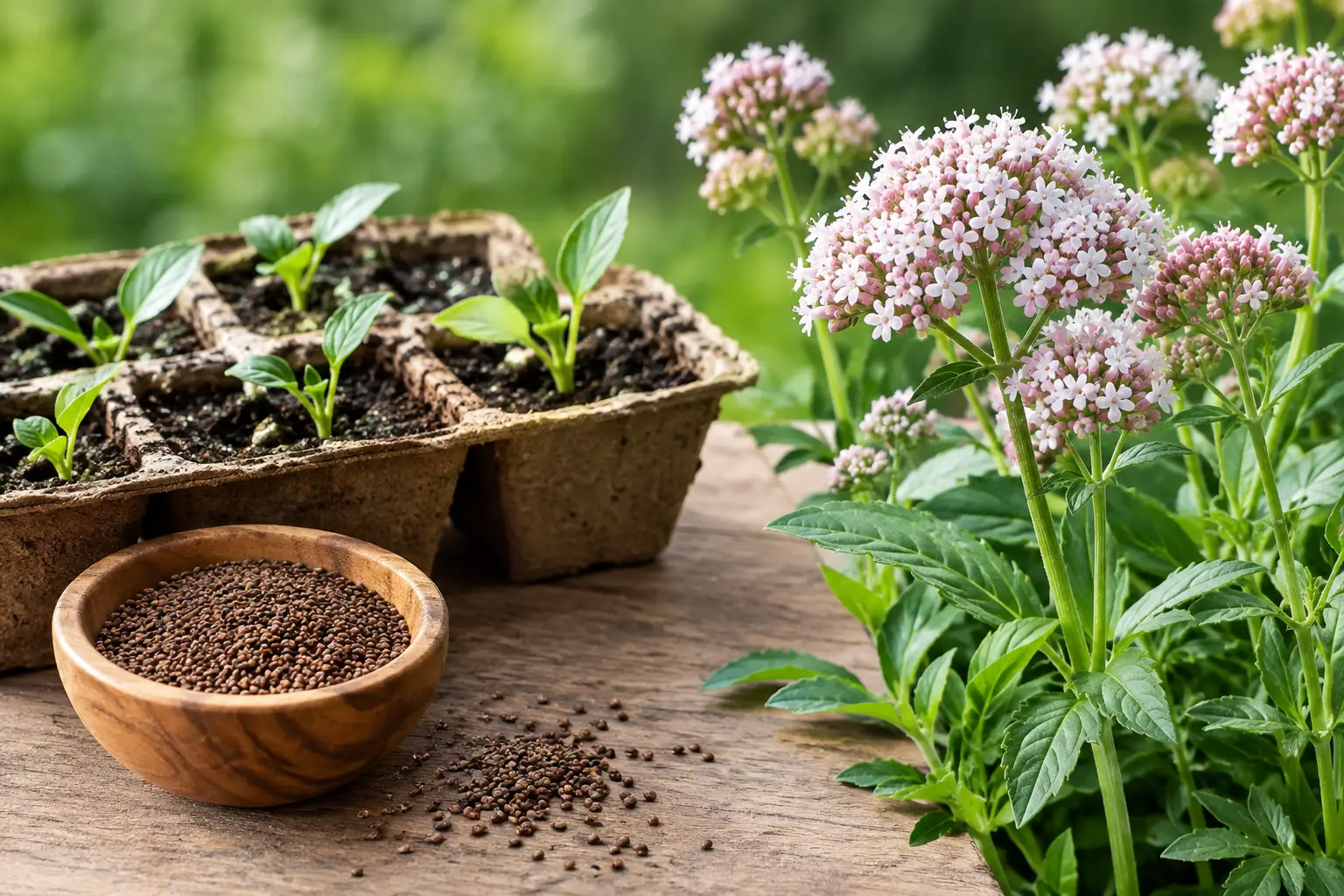
Valeriana officinalis is not a discreet little herb for the edge of a kitchen bed. Given moisture and room, it becomes a substantial perennial – often 3 to 5 feet tall in bloom – with finely divided foliage and broad, cloudlike heads of pale pink to white flowers. For growers wondering how to grow valerian plants, the key is to treat the species as a long-lived medicinal perennial rather than a compact annual herb.
Its roots are the familiar harvest, but the flowers also bring a soft, old-garden presence and considerable pollinator activity. This is a plant for a purposeful border, a medicinal plot, or a collector’s planting where its form and function can develop over several seasons.
Valeriana officinalis belongs to the Caprifoliaceae family and is native across Europe and parts of Asia. It has naturalized in parts of North America, particularly where soils remain reliably moist. The species is hardy in USDA Zones 4 through 9 and dies back in winter before returning from its perennial crown in spring.
Its growth habit explains many cultivation decisions. Valerian produces a basal clump first, then sends up hollow, branched flowering stems in early summer. It will seed itself generously in favorable ground. This can be welcome in a relaxed medicinal garden, but it requires attention in a small or carefully composed planting. Removing spent flower heads before seed ripens keeps the plant contained.
Fresh seed is preferable. Valerian seed is small and does not store indefinitely with the reliability of larger, harder-coated species. Begin with carefully kept seed, and sow more than the final number of plants required to allow for natural variation in germination.
Start valerian indoors about 8 to 10 weeks before the last expected spring frost, or sow outdoors in a prepared bed once the soil is workable. Indoor sowing gives better control over moisture and spacing, which is useful when only a few specimens are wanted.
Use a fine, free-draining seed-starting mix in shallow cells or pots. Scatter the seeds over the surface and press them gently into contact with the medium. Do not bury them deeply. Valerian seed benefits from light exposure, so a very thin dusting of vermiculite is sufficient if covering is needed to hold it in place.
Moisten from below or use a gentle mist so the seed is not displaced. Keep the medium evenly moist, never saturated, at roughly 60 to 70 degrees F. Germination commonly takes 10 to 21 days, though timing varies with seed freshness and temperature. A bright windowsill may work, but steady light from a seed-starting fixture usually produces sturdier, more uniform seedlings.
If germination is slow, patience is often more useful than repeated watering. Cool, wet compost can encourage damping-off before the seeds emerge. Good air circulation, clean containers, and careful watering make a noticeable difference with this small-seeded perennial.
Some growers cold stratify valerian seed for two to four weeks before sowing, especially when seed is older or conditions have been inconsistent. Fresh seed often germinates without this step. If you choose to stratify, place the seed in barely moist medium in a labeled container and refrigerate it, then sow on the surface as usual.
This is a reasonable hedge, not an absolute rule. Avoid making the medium wet enough to clump or drip. The aim is cool moisture, not prolonged saturation.
Transplant seedlings after frost danger has passed and they have developed several true leaves. Harden them off over about a week, gradually introducing outdoor sun, wind, and cooler nights. Space plants 18 to 24 inches apart. They can look modest in their first year, but established crowns broaden with time.
Valerian accepts full sun in cool or reliably moist climates. In warmer areas, a position with morning sun and afternoon shade is often the better choice, especially where summer heat is prolonged. Plants grown in dry, exposed ground tend to remain smaller and may require regular irrigation.
The ideal soil is fertile, moisture-retentive, and well drained: a deep loam enriched with finished compost is excellent. Valerian tolerates a range of soils, but it performs poorly in ground that dries hard and repeatedly. Equally, a stagnant wet spot is not ideal. The roots appreciate consistent moisture with enough structure and drainage for air to reach them.
A layer of organic mulch helps moderate soil temperature and reduces watering pressure during summer. Keep mulch a few inches away from the crown to prevent persistent dampness around emerging stems.
Once established, valerian is relatively undemanding. Water deeply during dry periods rather than giving frequent shallow irrigation. In rich garden soil, heavy feeding is unnecessary. A topdressing of compost in spring is generally enough to support vigorous foliage and flowering.
Tall flowering stems can lean after rain or in especially fertile ground. A discreet ring support, placed early in the season, keeps the plant upright without changing its informal character. Deadheading is useful if you want to limit self-sowing, while leaving some flowers to mature can provide seed for future propagation.
Watch for aphids on young growth and for slugs around newly transplanted seedlings. Neither is usually a serious long-term threat to a mature plant. Crowded, damp foliage can occasionally develop mildew or leaf spotting, so give clumps sufficient spacing and remove tired foliage at the end of the season.
Valerian can be divided in early spring or fall once the clump is well established. Division is practical when you want to renew an older planting or share a particularly vigorous specimen. Seed propagation, however, preserves the pleasure of observing the full early development of the species and is the appropriate starting point for a botanical collection.
The aromatic roots are traditionally harvested in fall, after the foliage has begun to die back. For the most substantial yield, wait until the second year or later. First-year plants are better allowed to build their crown and root system unless space is limited or you are simply assessing the plant.
Lift the plant carefully with a garden fork, working well outside the crown. Shake away loose soil, rinse the roots promptly, and cut them into manageable pieces for drying. The fresh root has a distinctive scent that becomes stronger during drying. Dry it in a warm, shaded place with good airflow until thoroughly crisp, then store it in a sealed, labeled container away from light and moisture.
Harvesting the whole root ends that individual plant’s life, so consider maintaining several plants and taking only a portion of the patch each season. This approach preserves both a steady supply and the visual value of flowering stems in the garden.
Valerian has a long history in traditional herbal practice, but a homegrown crop is not a substitute for individualized medical guidance. Those who are pregnant, nursing, managing a health condition, or taking sedatives or other medications should consult a qualified clinician before using valerian preparations.
A well-sited valerian patch improves with patience. Let a few plants establish their roots deeply, control volunteers where needed, and allow the species to occupy the generous scale it naturally prefers. In return, Valeriana officinalis becomes more than a medicinal harvest: it is a lasting, botanically expressive presence in the garden.