
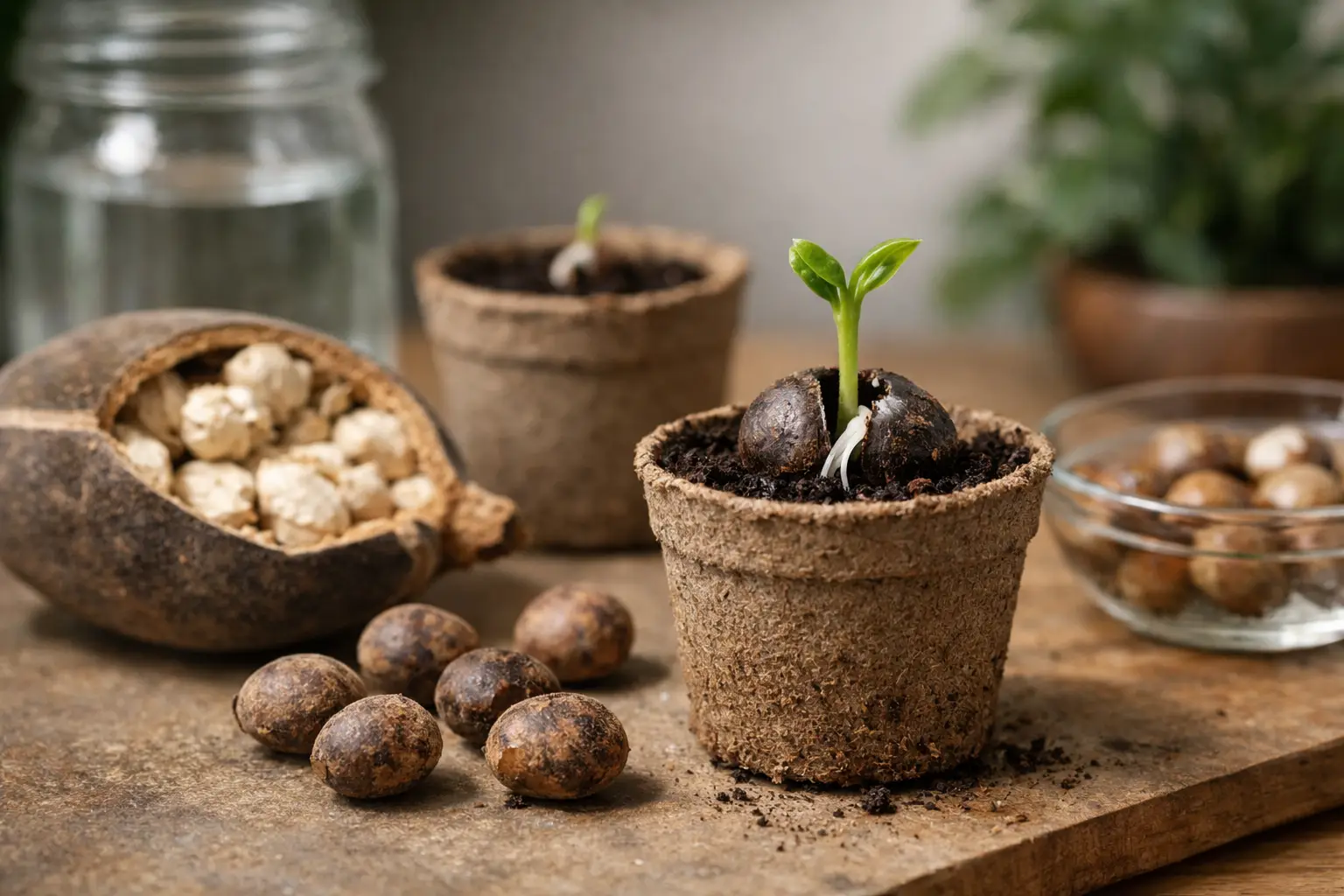
A baobab seed is built for patience. Its hard, dark seed coat protects the embryo through dry seasons and makes how to germinate baobab seeds less like sowing a tomato and more like preparing a small piece of living botany for its first rainfall. With the correct preparation, steady warmth, and restraint around watering, Adansonia can be a rewarding species for the collector’s greenhouse, conservatory, or summer container collection.
The baobab most commonly offered in cultivation is Adansonia digitata, the African baobab, a member of the Malvaceae family, subfamily Bombacoideae. Other Adansonia species may vary somewhat in pace and appearance, but their germination requirements are broadly similar: overcome the water-resistant seed coat, then provide warmth without allowing the seed to sit in saturated compost.
Baobab seeds have physical dormancy. In nature, abrasion, weathering, digestive passage, and seasonal moisture gradually weaken the coat. In cultivation, scarification performs this work more reliably and on a more useful schedule.
Inspect each seed before starting. A viable baobab seed is usually firm, dense, and free of pinholes, mold, or soft areas. Size and surface variation are normal. Do not discard a seed simply because its coat looks rough or irregular.
Use fine sandpaper, a small file, or the edge of a clean nail clipper to wear through a small patch of the outer coat. The aim is not to split the seed in half or expose the interior. Stop as soon as a lighter-colored layer beneath the dark surface becomes visible.
Work slowly. Over-scarifying can damage the embryo, while barely marking the coat may not admit enough water. If the location of the embryo is not clear, choose a small area on the broad side of the seed rather than cutting deeply into a seam or end.
Scarification is the most consequential part of the process. Seeds sown intact can germinate, but often do so unevenly or remain dormant for months. For a limited, curated seed lot, giving each seed individual attention is usually worthwhile.
Place the scarified seeds in warm water for 12 to 24 hours. Water that feels pleasantly warm rather than hot is sufficient. Avoid boiling water or prolonged exposure to very high temperatures, which may injure the embryo rather than wake it.
A seed that swells noticeably during soaking has taken up water and is ready to sow. If a seed remains completely unchanged after 24 hours, lightly abrade the same small patch again and soak it for another 12 hours. Do not keep seeds submerged for several days. Once hydrated, they need air as well as moisture.
Use a clean, free-draining seed-starting medium. A blend based on fine coco coir or seed compost, amended with perlite, pumice, or coarse horticultural sand, gives young roots moisture while leaving enough air around them. Heavy garden soil and dense potting mixes are poor choices for this stage.
Choose individual pots or cells with drainage holes. Baobabs make a strong early root, so a deeper pot is preferable to a shallow tray when available. Fill the container with pre-moistened medium that feels evenly damp when squeezed but does not release water.
Sow each seed about one-half inch deep, then cover it lightly and firm the surface just enough to ensure contact. Label pots with the scientific name, sowing date, and any scarification method used. This record becomes useful when comparing lots, species, or future germination attempts.
After sowing, cover the pots loosely with a clear humidity dome or place them in a propagation area where humidity remains moderate. Remove or vent the cover as soon as seedlings emerge. Stagnant, overly humid air is not an advantage once germination begins.
Baobab seed germination is most dependable in warm conditions. Aim for a root-zone temperature of roughly 80 to 90 F. A heat mat with a thermostat is especially useful in cooler homes or during early spring, when a bright windowsill may provide light but not reliable warmth.
Light is helpful but not essential before emergence. Once seedlings break the surface, move them promptly into bright light. A strong grow light or a very bright, protected location prevents the stems from stretching. Direct outdoor sun is best introduced gradually, particularly for seedlings raised under artificial light.
Check the medium every day or two. Water only when the upper surface begins to dry and the pot feels lighter. The goal is a repeating rhythm of gentle moisture and partial drying, not a permanently wet root zone. Baobab seedlings come from regions with pronounced dry periods, but newly germinated plants should not be treated like mature drought-tolerant trees.
Under good conditions, germination may begin in one to three weeks. Some seeds take longer, particularly if scarification was modest or temperatures fluctuated. It is sensible to keep apparently inactive pots warm for six to eight weeks before deciding they have failed.
The first growth is often more dramatic than the seedling’s small size suggests. Cotyledons open, the stem gains substance, and the early leaves begin to reveal the plant’s character. Keep the medium lightly moist at first, then allow a little more drying between waterings as the root system develops.
Avoid fertilizing immediately. Once the seedling has produced true leaves and is actively growing, a diluted, balanced fertilizer can be used sparingly during the warm growing season. Excess fertilizer encourages weak, overly soft growth and is rarely helpful for a young caudiciform tree.
Baobabs appreciate warmth, bright light, and a well-drained substrate. In climates with warm summers, seedlings can spend the season outdoors after they have been acclimated to stronger sun and nighttime temperatures remain comfortably warm. Protect them from cold rain, waterlogged containers, and temperatures below about 50 F.
As the season shortens, growth may slow and leaves may be shed. This can be a normal response to lower light and cooler conditions, not necessarily a sign of failure. Reduce watering substantially when the plant is dormant or nearly dormant. A leafless baobab in cool, dim conditions is especially vulnerable to rot if its soil remains wet.
The two common causes are insufficient scarification and cool media. A seed may look perfectly unchanged in a pot because water never entered the coat, or because room temperatures were adequate for people but too low for tropical germination.
Carefully uncover one non-germinated seed after several weeks only if you need to assess the lot. A firm seed without a sour smell may still be viable. It can be re-scarified lightly, soaked briefly, and returned to fresh medium. A soft, dark, or foul-smelling seed has rotted and should be discarded rather than left to affect neighboring pots.
Mold on the surface of the medium usually signals excessive moisture and poor airflow. Remove the affected material, improve ventilation, and let the pot dry slightly before watering again. Sterile medium and clean containers make a meaningful difference when working with slow-to-emerge tropical species.
Growing Adansonia from seed is an exercise in measured cultivation. The emerging seedling will not yet resemble the monumental tree of its native range, but its thickening base, seasonal rhythm, and architectural form make it a specimen worth observing closely from the first successful germination.