
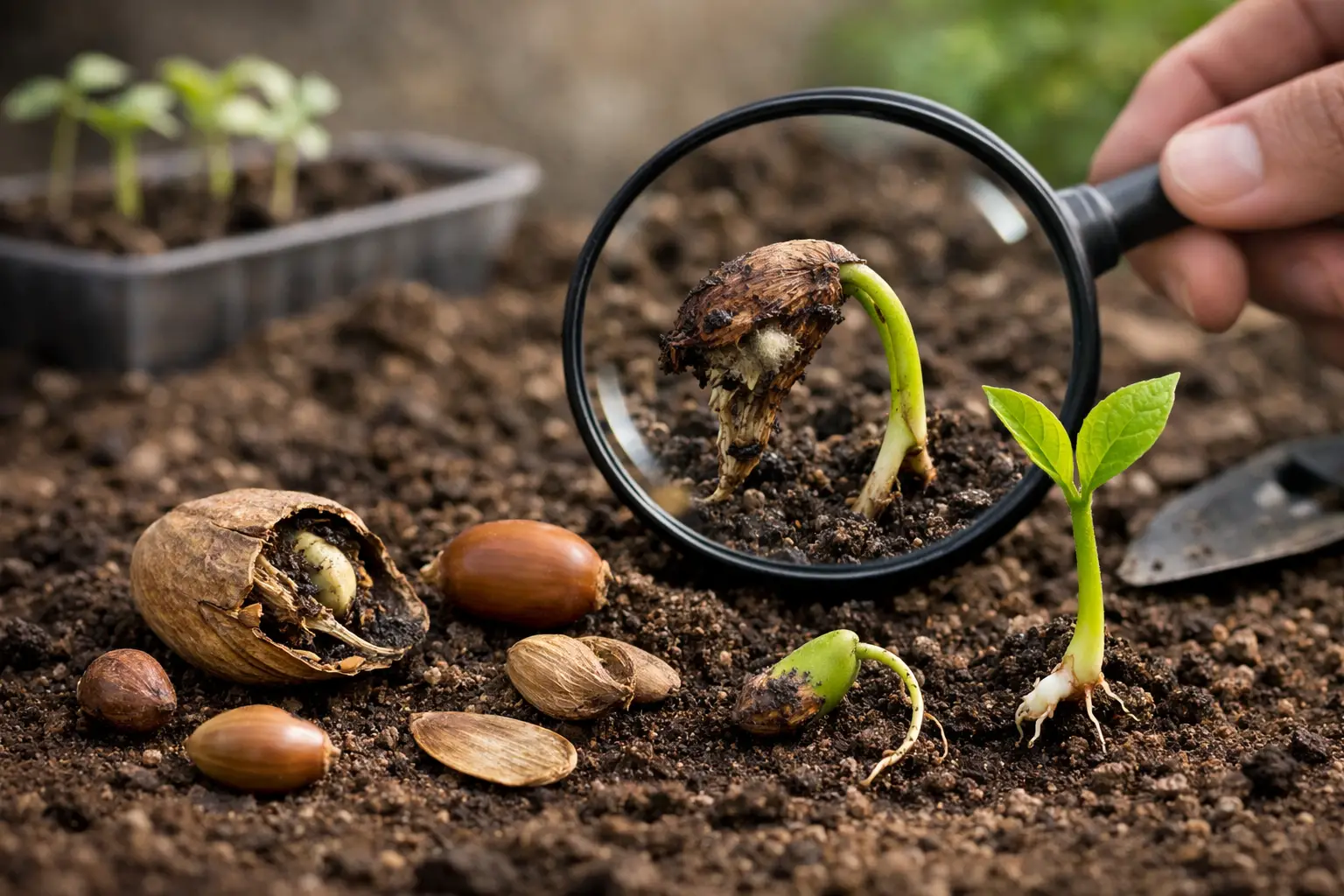
A packet of tree seed can look immaculate and still contain a difficult proposition. This is especially true of uncommon woody species, whose seeds may have traveled across climates, require a particular dormancy sequence, or remain viable for only a brief period. When growers ask, why do tree seeds fail, the answer is rarely simply that the seed was “bad.” More often, a viable seed met conditions that did not match its biology.
For collectors raising distinctive trees from seed, diagnosis matters. A failed sowing of Schinus molle is not approached in quite the same way as a failed sowing of Anacardium occidentale or Sclerocarya birrea. Seed size, native habitat, fruit structure, storage behavior, and germination cues all shape the result. The aim is not to force every species into one universal method, but to read the material in front of you with greater precision.
The most decisive part of germination may occur before a seed reaches the pot. Tree seeds fall broadly into two storage categories: orthodox and recalcitrant. Orthodox seeds tolerate drying and can often be stored for meaningful periods under cool, dry conditions. Recalcitrant seeds cannot. They lose viability when allowed to dry, and many also react badly to cold storage.
This distinction is particularly relevant to tropical and subtropical trees. Fresh cashew seed, for example, is biologically different from a dry, long-stored seed of a temperate woodland species. Marula and other species from seasonally warm regions also reward attention to freshness, seed preparation, and warmth. A seed may appear intact after its embryo has already lost the capacity to grow.
Age is not always visible. A pale seed coat, clean surface, and firm texture do not guarantee viability. Conversely, some sound seeds look weathered because their natural dispersal process involves drying, abrasion, or passage through fruit pulp. The most useful question is not whether a seed looks perfect, but whether it was handled in a way appropriate to its species.
Many tree seeds are built to wait. Dormancy is a survival strategy that prevents germination during a brief warm spell before winter, a dry season, or another unsuitable interval. The seed is alive, hydrated enough to remain functional, and deliberately inactive until a specific barrier is removed.
Physical dormancy is common in families with hard, water-resistant seed coats, including many members of Fabaceae. Water cannot readily reach the embryo, so the seed may sit in moist medium for weeks with no outward change. In nature, weathering, fire, microbial action, or abrasion opens the coat. In cultivation, carefully nicking a small area of the seed coat or using an appropriate hot-water treatment can provide the same first step. The embryo must not be cut or cooked in the process.
Physiological dormancy is different. Here, the embryo needs a period of cold, moisture, warmth, or a sequence of conditions before it will resume growth. Temperate trees and shrubs frequently require cold stratification: weeks or months in a moist medium at refrigerator-like temperatures. Some species need warm stratification first, followed by cold. Starting them on a heat mat in a bright room may be tidy and convenient, but it does not satisfy the biological calendar encoded in the seed.
A third possibility is morphological dormancy, in which the embryo is underdeveloped at dispersal and needs time to mature after sowing. Patience is not an afterthought for such species. It is part of the germination protocol.
Applying scarification to every hard seed, or cold stratification to every tree seed, creates avoidable losses. Hard-coated seed may need a break in the coat, but cold alone will not necessarily produce it. A species from a cool temperate habitat may need stratification, while a tropical species can be damaged by prolonged cold and wet conditions.
The scientific name is therefore more useful than a generic label such as “ornamental tree” or “exotic seed.” Genus and family can offer valuable clues, but species-level information remains the standard. Closely related plants can differ in the depth of dormancy, ideal temperature range, and tolerance for storage.
Seeds need moisture to begin metabolic activity. They do not need to be submerged in a stagnant, airless medium. This is where many otherwise thoughtful sowings fail.
A saturated mix excludes oxygen from the spaces around the seed. Without oxygen, respiration falters; meanwhile, fungi and bacteria gain an advantage. Large seeds are especially vulnerable because they contain abundant stored food, which also feeds microorganisms when the seed coat is compromised. The result can be a seed that turns soft, dark, or sour before any root emerges.
Use a clean, open seed-starting medium that holds moisture without becoming dense. The correct texture is evenly damp, not glossy-wet. If a squeezed handful releases water, it is too wet for most tree seeds. Containers should drain freely, and humidity covers should be vented or removed once condensation becomes heavy.
Underwatering can also stop germination. A seed that absorbs water and then repeatedly dries may be stressed at the exact point when its internal processes are beginning. The best practice is steady moisture with air available around the seed, checked often rather than corrected dramatically.
Warmth is often recommended as though it were universally beneficial. It is not. Temperature determines the speed of biochemical activity, but every species has a range rather than a single ideal number.
Tropical trees often respond well to sustained warmth in the upper 70s to mid-80s F, especially when the medium remains airy. Cool-climate species may germinate more evenly at lower temperatures, often after stratification. Excessive heat can accelerate decay, dry the surface of shallow trays, and encourage dormant pathogens before a slow-germinating seed can establish a root.
Day-night fluctuation can matter, too. Seeds from open habitats may respond better to a modest difference between daytime and nighttime temperatures than to constant heat. Light can be another cue. Some small seeds germinate best on or near the surface, where they receive light; burying them deeply removes that signal. Larger seeds usually need a depth roughly related to their diameter, though the exact rule varies by species and seed structure.
Not every failure begins with an unsuitable treatment. Fungal spores, algae, and bacteria are present in ordinary growing environments, and a germinating seed is vulnerable before it has roots and leaves capable of defending itself.
Poor sanitation raises the risk. Reused pots with old residue, garden soil in a covered tray, unwashed labels, and stale water can all introduce a heavy microbial load. This does not mean seed starting must become sterile laboratory work. It means using clean containers, fresh medium, good drainage, and enough air movement to keep conditions from becoming persistently humid.
Damping-off is often discussed as a seedling problem, but decay can begin before emergence. If seeds collapse one after another, review moisture, temperature, and sanitation before assuming a genetic issue. A fungicide may have a role in some professional settings, but it cannot compensate for a waterlogged medium or unsuitable temperature.
Seeds are living structures, not decorative dry goods. Small errors in handling can become decisive. Leaving seed in direct sun, storing it beside a radiator, soaking it for days without a species-specific reason, or crushing it while attempting scarification may damage tissues that cannot recover.
Chemical residue is another overlooked concern. Containers rinsed with strong cleaners should be thoroughly washed, and treated wood or contaminated compost should not be used for sensitive sowings. Labels deserve care as well. When several slow species share a tray, a missing label can lead to premature disposal because one seedling is mistaken for another.
There is also a trade-off between inspection and disturbance. Excavating a seed every few days to see whether it has sprouted can break an emerging radicle or introduce pathogens. A better approach is to sow in a medium that allows observation, record the sowing date and treatment, and wait through the species’ expected window before intervening.
When germination is poor, begin with the chronology. Ask whether the seed was likely fresh enough for its storage class, whether dormancy was addressed, and whether temperature matched its geographic origin and seasonal rhythm. Then inspect the physical evidence: was the seed firm, swollen, moldy, hollow, soft, or unchanged?
An unchanged hard seed often points toward an unbroken coat, insufficient moisture contact, or unfulfilled dormancy. A soft or foul-smelling seed points more strongly toward excess moisture, warmth, or pathogen pressure. A seed that germinated but produced weak, collapsing seedlings may have passed the germination stage successfully and failed later through low light, poor air circulation, nutrient issues, or damping-off.
Keep records with the precision you would give a small collection: botanical name, source, date received, pretreatment, substrate, temperature, and emergence dates. Over time, these notes become more useful than generic advice because they reveal how a particular species performs in your greenhouse, windowsill, or propagation area.
At Quinta dos Ouriques, a considered seed collection begins with the recognition that rarity does not remove a plant’s ecological history. It makes that history more worth observing. Give each species the treatment its biology asks for, and a delayed seedling may prove to be not a failure at all, but a tree still keeping its own time.