
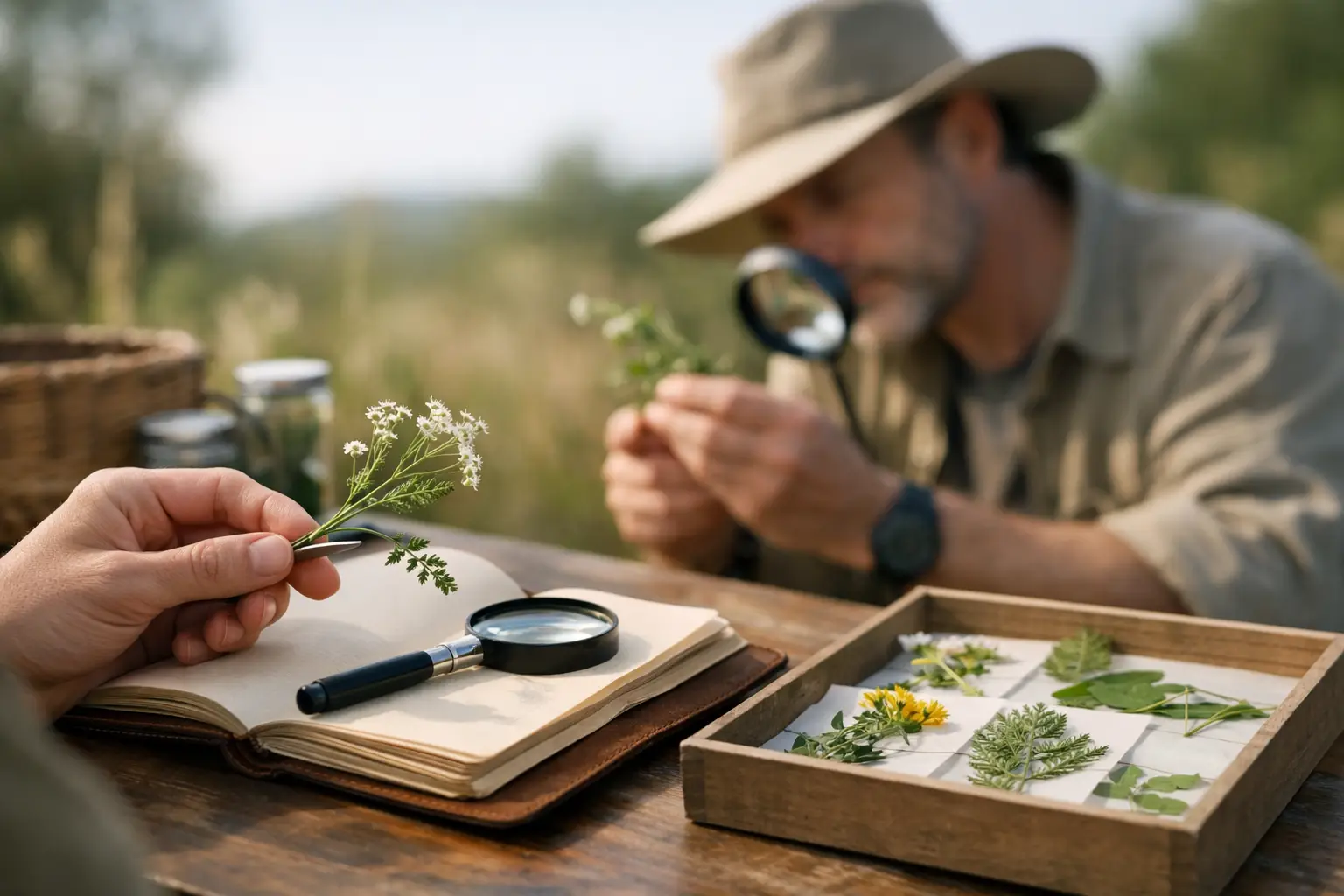
A packet of Valeriana officinalis is not simply a future perennial, and a few seeds of Sclerocarya birrea are not merely an unusual tree experiment. Each is an entry point into a species, a habitat, a plant family, and a particular set of cultivation questions. Botanical collecting begins when seeds are chosen for those connections rather than for filling an empty border.
For the serious home grower, a collection is a living reference library. It may hold medicinal plants beside edible species, dry-climate trees beside temperate woodland perennials, or plants connected by a family, a region, or a historical use. Its value is not measured by the number of packets stored away. It is measured by the thought behind the selection and the attention given once a seed is sown.
Botanical collecting is the purposeful acquisition, documentation, and cultivation of plants or seeds with a defined interest beyond ordinary garden variety. That interest may be taxonomic, ornamental, ethnobotanical, edible, medicinal, geographic, or conservation-minded. A collector may focus on Anacardiaceae, seek useful plants from Mediterranean climates, or build a small assemblage of species with fragrant foliage and traditional applications.
The distinction matters because a collector does not approach every seed as a guaranteed garden performer. Some species are selected precisely because they ask more of the grower. Schinus molle, Peruvian pepper, has a different temperature tolerance and mature scale from a familiar culinary herb. Cashew, Anacardium occidentale, makes more sense for a heated greenhouse or frost-free setting than for a northern outdoor bed. These are not reasons to avoid them. They are reasons to choose with clarity.
A considered collection also accepts that botanical names are practical tools, not academic decoration. Common names can refer to several unrelated plants, while a scientific name identifies the species being sought. Knowing that staghorn sumac is Rhus typhina, for example, makes it easier to understand its family relationships, research its growth habit, and distinguish it from other sumacs with different characteristics.
The most satisfying collections have a boundary. It can be broad enough to evolve, but it should offer a reason for one species to sit beside another. Without that thread, seed buying can become accumulation: attractive packets with no practical place in the garden or propagation area.
Start with the conditions you can genuinely provide. Consider winter lows, summer heat, rainfall, soil drainage, indoor light, greenhouse capacity, and the space a plant will require after its first promising season. A tropical fruit tree may be fascinating, but fascination does not alter a hard freeze. Conversely, a species that is marginal outdoors may become a fine container subject where protected winter quarters are available.
Then decide what you want the collection to teach you. A few coherent directions include:
These themes can overlap. Valeriana officinalis may belong in a medicinal collection, a temperate perennial collection, or a study of nectar-rich garden plants. The point is not to assign every plant one fixed identity. It is to know why it belongs in yours.
Rarity has value when it leads to a more distinctive and meaningful collection. It is less useful when it overrides basic suitability. Before acquiring seed, consider the mature dimensions, expected lifespan, germination requirements, and whether you can offer the plant appropriate conditions after transplanting.
A slow-growing tree can be a rewarding long-term subject, but it occupies attention for years. A short-lived perennial may establish quickly yet require regular seed saving or replacement. Some seeds need cold stratification; others demand consistent warmth; still others lose viability if stored too long. There is no single ideal collecting strategy. The right balance depends on whether your pleasure comes from raising difficult seedlings, establishing a designed garden, preserving genetic diversity in cultivation, or learning a particular genus in depth.
The quality of a collection begins before germination. Seed should be identified at species level whenever possible and accompanied by enough context to support sensible cultivation. A label that gives only a broad common name creates uncertainty at the exact point where accuracy matters most.
Look for current seed, clear botanical nomenclature, and realistic cultivation information. With unusual species, provenance can be useful, but it should not be treated as a substitute for correct identification or healthy handling. A seed lot collected from a particular region may offer insight into adaptation, yet growing results still depend on the conditions you provide.
Ethics belong in this process as well. Do not collect seed from protected populations, private land, or public landscapes without permission. Avoid taking more than a small, responsible amount even where collection is allowed, and do not move plants or seeds across borders without understanding applicable import and phytosanitary rules. Rare does not mean consequence-free.
Curated sources are especially valuable when they organize offerings by species and family rather than presenting plants as anonymous novelties. At Quinta dos Ouriques, this taxonomy-conscious approach supports a more deliberate search: a grower can begin with a species of interest, then notice related plants, compatible collection themes, or unfamiliar genera worth studying.
A collector’s first responsibility is to give each accession a fair trial. That does not mean forcing every species through identical conditions. It means matching the sowing method to the seed and recording what happens.
Use clean containers, a suitable propagation medium, clear labels, and a stable environment. Put the full scientific name on every label, along with the sowing date and seed source. For species with specific pretreatments, note the duration of soaking, scarification, or cold stratification. Small details disappear quickly once trays are moved, watered, and replanted.
Germination percentages should be interpreted with restraint. A low result may reflect seed dormancy, uneven temperatures, an incorrect pretreatment, or a species that naturally germinates over a long period. It may also indicate an older or weaker seed lot. One tray is evidence, not a final verdict. When seed quantity permits, repeat the sowing with one adjusted variable rather than changing everything at once.
Patience is especially necessary with woody and ethnobotanical species. Some seedlings appear quickly and then pause. Others produce modest early growth while establishing roots. Resist the urge to overpot, overfeed, or constantly relocate them in search of faster results. Good cultivation often looks uneventful until a plant has had enough time to settle.
A collection loses much of its meaning when its records separate from its living material. Labels should remain legible from seed tray to pot to garden bed. For long-lived plants, use durable tags and retain a separate written or digital record in case weather, sun, or a curious animal removes the original label.
Record the name, family, source, date acquired, sowing method, germination dates, transplant dates, and observations on vigor, flowering, fragrance, pests, and winter performance. Add notes on failures too. A plant that declines in humid summers or resents root disturbance has taught you something useful, even if it never becomes a permanent specimen.
Photographs taken at regular intervals can be as valuable as written notes. They reveal changes in juvenile foliage, branching, color, and scale that memory tends to smooth over. Over several seasons, these records turn individual experiments into genuine horticultural knowledge.
The best botanical collections eventually influence how a garden is seen. A single unusual plant may lead to a new appreciation for a family, a climate type, or a method of propagation. A medicinal perennial can become both a useful garden subject and a prompt to learn its morphology, pollinator relationships, and history in cultivation.
Leave room for that change. Some species will prove poorly suited to your conditions, while others will exceed expectations and deserve repetition, seed saving where appropriate, or a more prominent place in the landscape. Keep the collection selective enough that each plant can be observed rather than merely owned.
Choose the next seed packet as you would choose a volume for a small, serious library: for what it adds, what it connects to, and what you are prepared to learn from it over time.