


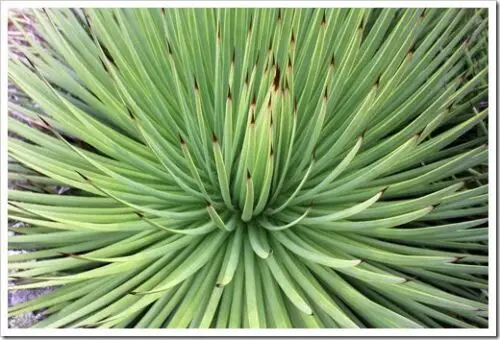
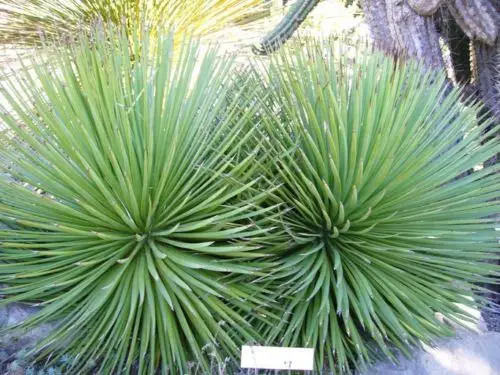
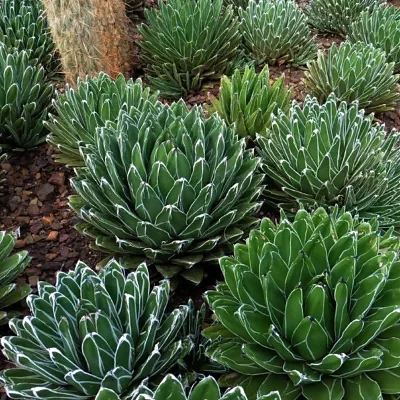
Meet the plant that looks like a living sea urchin: a perfect sphere of hundreds of needle-thin, striped leaves crowned with sharp dark spines. Agave striata demands almost nothing—full sun, dry soil, sparse water—yet delivers extraordinary architectural presence. Compact (just 20 inches), it thrives in containers or raised beds. Easy to grow from seed, and unlike most agaves, it flowers repeatedly over its lifetime. This is the succulent for minimalist ga
€2.20
There’s a reason collectors search for this plant: Agave striata subsp. striata is nature’s proof that perfection comes in small, spiky packages.
Native to the high limestone cliffs and rocky slopes of northeastern Mexico, in the Tehuacán Valley region of Puebla and Oaxaca, this hedgehog agave has evolved to thrive where few other plants dare. Here, in arid, sun-scorched terrain, it developed something extraordinary: a dense, perfectly spherical rosette of hundreds of impossibly thin, grey-green leaves that look more like a prehistoric sea creature than a desert plant. The common name “Hedgehog Agave” is apt—this plant *is* the hedgehog of the succulent world, all spines and armor, compact and self-contained. In Spanish, “Rabo de León” (lion’s tail) captures another visual: those needle-like leaves seem to stream from a central point like flowing hair. It’s a plant that stops conversations.
What makes Agave striata truly special—and this is critical—is its role as an architectural showstopper for modern, minimalist landscapes. Unlike the broad, fleshy leaves of typical agaves, striata forms a dense, rounded ball of stiff, pencil-thin foliage. Each leaf is covered in fine longitudinal striations (the lines that give it its scientific name), and every single leaf terminates in a dark, wickedly sharp terminal spine. The margins are completely smooth—a rare trait in agaves—which makes handling them slightly easier, though respect for those needle tips is non-negotiable. When mature rosettes (8-10 years old) flower, they produce soaring racemes up to 7 feet tall, dressed in small, reddish-purple or greenish flowers that bloom in summer. Here’s the kicker: unlike almost every other agave species, which flower once and die (monocarpic), Agave striata is polycarpic—it flowers multiple times over its lifespan and continues living. This is genuinely rare in the genus and makes the plant even more valuable to collectors.
For designers and plant enthusiasts seeking dramatic focal points, striata is non-negotiable. Its architectural form—that perfect geometric sphere of radiating, rigid lines—commands attention in xeriscapes, rock gardens, and modern container arrangements. In a pot, it becomes living sculpture. On a cliff edge or raised bed, it’s a statement piece that whispers sophistication. The foliage may develop red tints in summer, adding subtle color variation. Because it stays compact (reaching only 15-20 inches tall and wide), it’s perfect for spaces where larger agaves would eventually dominate. It’s a plant for the gardener with vision, the collector with restraint, and anyone who understands that true luxury is often minimal.
Growing Agave striata is refreshingly straightforward—perhaps the plant’s greatest gift to impatient gardeners. It demands full sun (at least 6-8 hours daily; more is better) and absolutely refuses to tolerate wet feet. Soil must be extremely well-draining: sandy, gritty, rocky. If your native soil is clay or heavy, amend aggressively with sand, gravel, or pumice. In containers, use a cactus or succulent mix with added perlite or sand. Water sparingly during the growing season (spring-summer), allowing soil to dry completely between waterings. In winter, reduce water further or cease entirely. The plant is hardy to USDA zones 8-11 (surviving temperatures down to 20°F/-6.7°C when established and protected from winter wet). In mild climates with dry winters, plant directly in the ground in raised beds or on slopes. In temperate or humid zones, grow in containers you can move into a greenhouse or shelter during cold months. This plant will not tolerate waterlogging or humidity—both invite crown rot, the enemy of agaves. Fertilize rarely (once yearly in spring, if at all); overfertilizing encourages weak growth. Generally, agaves thrive on neglect once established. Handle minimally—they prefer to be left alone. Propagate from seed (surprisingly easy indoors under grow lights) or from offsets (pups) that f
Only logged in customers who have purchased this product may leave a review.

Reviews
There are no reviews yet.