
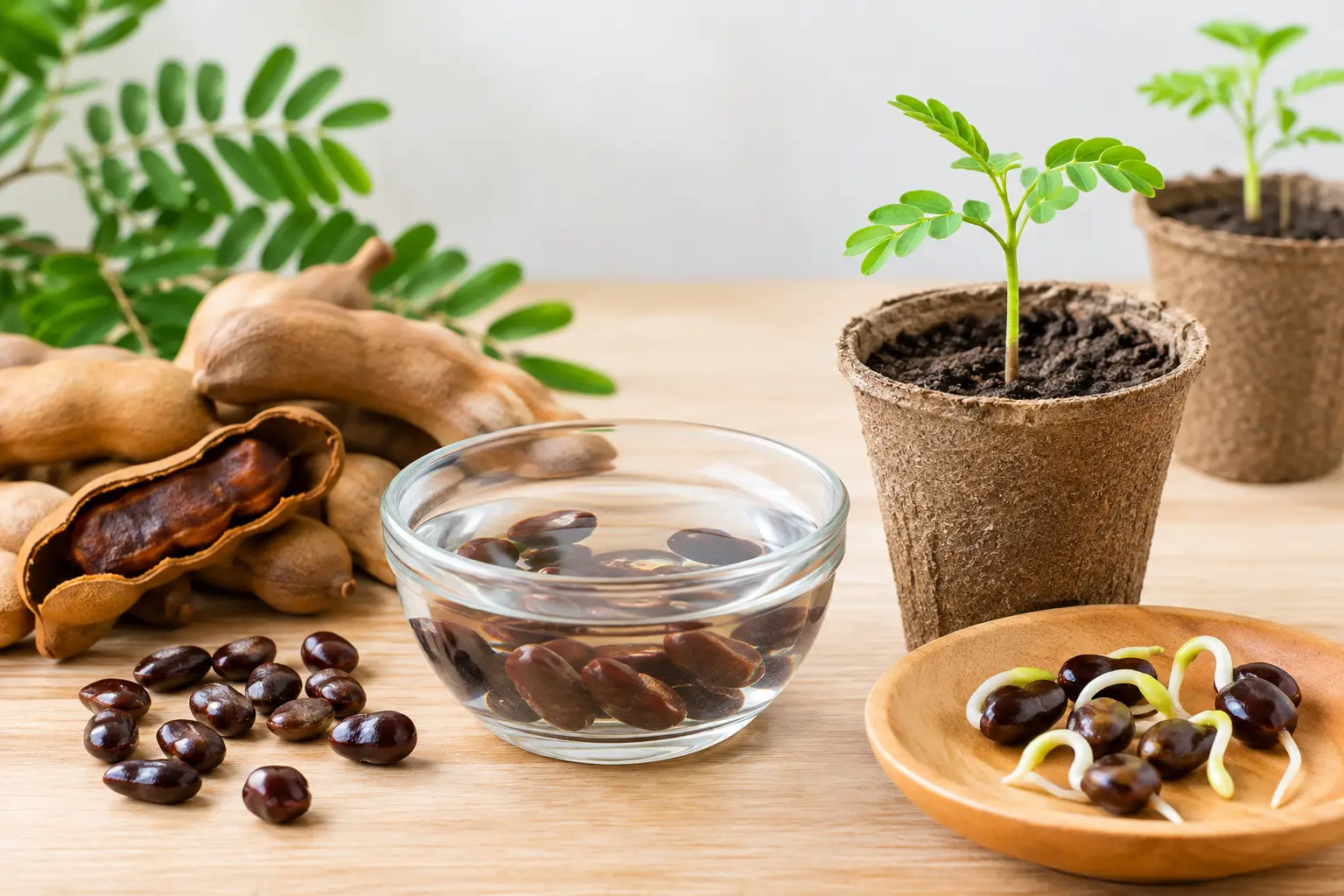
A tamarind seed is built for patience. Its glossy, chestnut-brown coat protects an embryo adapted to warm seasonal landscapes, not a cool windowsill in late winter. Knowing how to sprout tamarind seeds means recreating the conditions that tell Tamarindus indica it is safe to begin: consistent warmth, even moisture, and a free-draining medium.
For collectors, the reward is considerable. Tamarind is an enduring edible tree in the Fabaceae family, valued for its distinctive sour-sweet pulp, fine pinnate foliage, and broad, dignified canopy in suitable climates. Starting it from seed is straightforward once its hard seed coat and tropical requirements are respected.
Seed quality has an outsized effect on germination. Fresh seed taken from mature pods generally performs more reliably than seed that has been stored for years in warm or humid conditions. A viable seed should feel hard, full, and smooth, without insect holes, deep cracks, or a shriveled appearance.
If seeds come directly from a tamarind pod, remove every trace of the sticky pulp before sowing. The pulp is edible, but it can encourage mold in a seed-starting container. Rinse the seeds under lukewarm water, rub away any remaining fibers, and let them dry on a clean towel for a day. There is no need to dry them for weeks before planting.
Tamarind seeds remain viable longer than many tropical species because of their tough coat, but freshness still matters. Older seed may germinate, though it often does so more slowly and less uniformly. When working with a limited or particularly valued seed lot, sowing several seeds is prudent. Tamarind is not always perfectly synchronized, even under good conditions.
The simplest pre-treatment is soaking. Place the cleaned seeds in a cup of warm water for 12 to 24 hours. The water should be pleasantly warm rather than hot enough to damage the seed. After soaking, some seeds may look slightly swollen. Others will appear unchanged, which does not necessarily mean they are unviable.
For especially old seed, or seed that remains very hard after soaking, gentle scarification can shorten the waiting period. Use a nail file or fine sandpaper to abrade one small spot on the outer coat, stopping as soon as a lighter inner layer becomes visible. Do not cut deeply into the seed. The aim is to admit moisture, not expose or injure the embryo.
Scarification is useful but not mandatory for fresh tamarind seed. It is a trade-off: it can encourage more even germination, while excessive filing can ruin a seed outright. For a fresh, well-stored batch, an overnight soak is often the more conservative choice.
Tamarind develops a pronounced taproot early in life. Start seeds in individual deep pots, tree tubes, or biodegradable pots rather than a shallow communal tray. A container at least 4 to 6 inches deep gives the root room to descend without immediately coiling around the base.
Use a clean, airy medium that holds moisture without becoming dense. A quality seed-starting mix amended with perlite, pumice, or coarse horticultural sand works well. Tamarind does not require a rich compost-heavy medium to germinate. In fact, excessive organic matter and poor drainage are more likely to create problems than modest fertility.
Moisten the medium before sowing so that it feels evenly damp throughout. It should clump lightly in the hand but should not release water when squeezed. This distinction matters: seeds need moisture to activate, but a constantly saturated pot excludes oxygen and invites rot.
Plant each seed about one-half to three-quarters of an inch deep. Cover lightly, firm the surface with a gentle touch, and label the pot with both the common and botanical name. In a collection that includes several woody legumes, a clear label prevents later uncertainty.
Warmth is usually the deciding factor in tamarind germination. Keep the pots between 75 and 90 F, with roughly 80 to 85 F being especially favorable. A heat mat beneath the containers can be useful in a cool home, greenhouse, or propagation area. Do not place the pots directly on a radiator or in intense sun where temperatures can swing sharply.
At suitable temperatures, fresh seed commonly emerges in 7 to 21 days. Some seedlings take three or four weeks, particularly if the temperature has been uneven or the seed coat was not softened thoroughly. Do not discard a pot after a few quiet days. Maintain the same conditions for at least four to six weeks before judging a seed unsuccessful.
Covering the container with a clear propagation dome or loose plastic bag can help retain humidity while the seed is below the surface. Check it daily. Once shoots appear, increase ventilation immediately and remove the cover within a few days. Stagnant humidity around new growth can lead to damping-off, especially where air circulation is limited.
Bright indirect light is enough before emergence. After seedlings break the surface, move them into strong light. A sunny south-facing window may work if it remains warm, although a grow light provides more consistent results in cooler regions. Introduce direct outdoor sun gradually; tender seedlings can scorch if moved from indoor light to intense summer exposure without acclimation.
A newly germinated tamarind produces delicate paired leaflets that quickly reveal its leguminous character. During this stage, keep the root zone lightly and consistently moist, allowing the upper surface of the mix to begin drying between waterings. Water thoroughly when needed, then let excess water drain away.
The most common error is watering on a calendar rather than responding to the pot. In a warm propagation setup, the medium may dry quickly. In a dim, cool room, the same pot can remain wet for far too long. Lift the container occasionally to learn its weight when moist and when approaching dryness.
Do not fertilize immediately. Once the seedling has formed several sets of true leaves and is growing steadily, begin with a diluted balanced fertilizer every few weeks during active growth. A modest feeding program is preferable to forcing lush, weak growth. Tamarind is a tree, and its early structure benefits from steady rather than excessive development.
When roots begin reaching the bottom of the starter container, move the seedling into a deeper pot with a similarly free-draining mix. Handle the root ball carefully. Tamarind tolerates transplanting best when it is done before the taproot becomes crowded or damaged. If using biodegradable pots, make sure the material will allow roots to pass through or remove it carefully at transplant time.
Tamarindus indica is a tropical to subtropical tree. It thrives where warmth is prolonged and frost is absent. Mature specimens can tolerate brief cool spells better than young plants, but seedlings are vulnerable to cold and should be protected from temperatures below about 50 F. Frost can be fatal.
In warm parts of the United States, tamarind may eventually become a landscape tree if there is adequate space, full sun, and excellent drainage. Elsewhere, it is best treated as a container-grown specimen that spends warm months outdoors and winters under bright, protected conditions. This is not a compromise for collectors. A well-grown potted tamarind can be an exceptionally handsome foliage tree, though fruiting indoors or in a short growing season is less certain.
Fruiting from seed also requires patience. Seed-grown trees vary in vigor, form, and fruit quality, and they may take many years to mature. For growers interested chiefly in fruit production, named grafted selections offer greater predictability. For those drawn to the species itself, seed offers the pleasure of observing a long-lived tree from its first root downward.
When tamarind seed fails, the cause is usually cool soil, persistent wetness, or a coat that never took up enough water. Before sowing another batch, assess the propagation conditions rather than adding more water or fertilizer. Raise the temperature, confirm drainage, and consider a light scarification treatment for hard, older seed.
Mold on the surface is another sign that the medium is too wet or airless. Remove visible mold carefully, improve ventilation, and allow the top layer to dry slightly. A seed can survive a brief correction, but it cannot germinate in an oxygen-starved pot.
The first tamarind leaves have a quiet elegance that hints at the tree to come. Give the seedling warmth, room for its root, and time to establish, and you are not merely raising a plant for the season but beginning a specimen with decades of potential.