
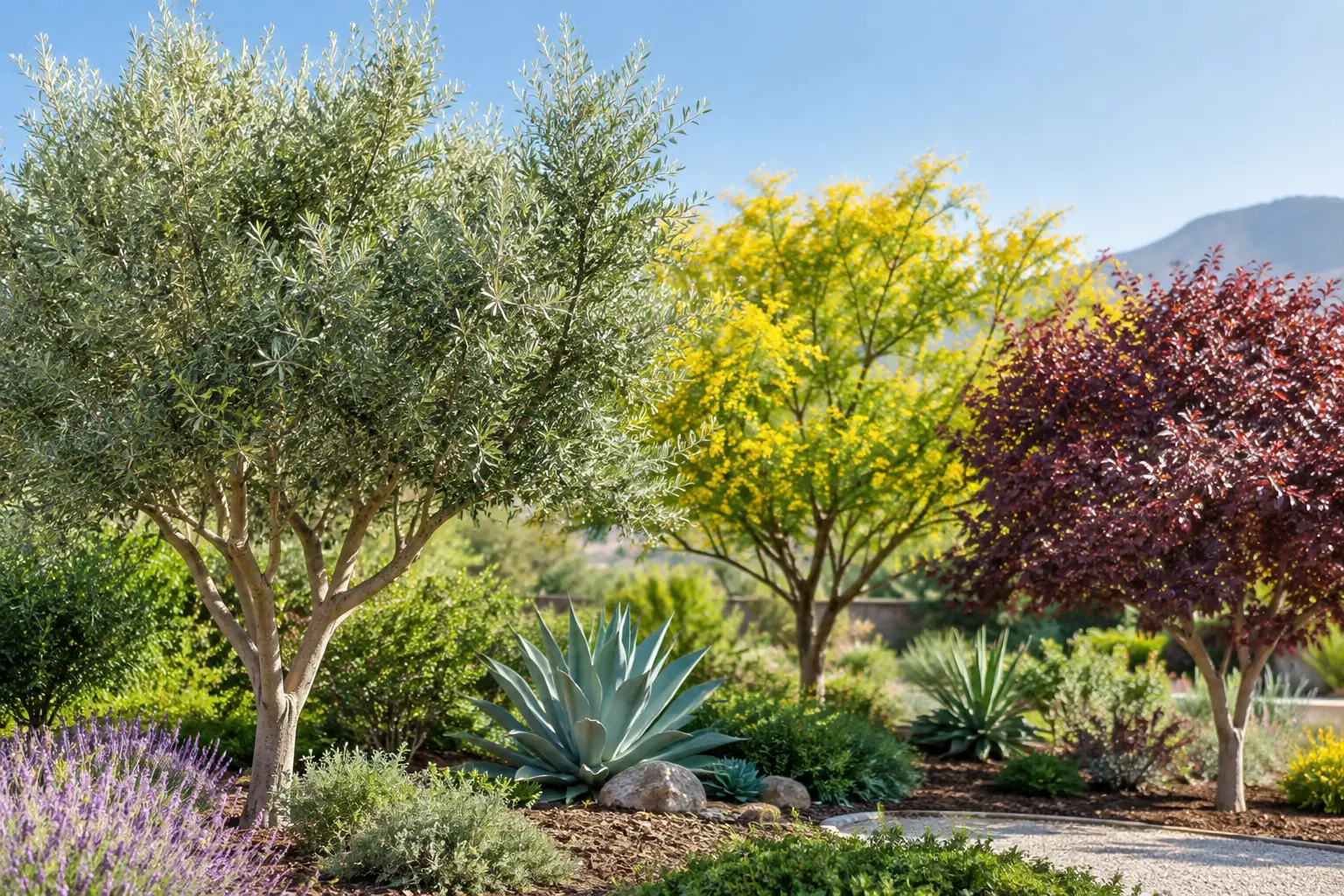
A specimen tree earns its place by being memorable in every season: a silhouette against winter sky, remarkable bark, silver foliage, architectural branching, or fruit with a story. The best drought tolerant specimen trees do more than survive a dry summer. They bring presence to a garden while asking for less supplemental water once their roots are established.
Drought tolerance is never a permission slip to neglect a young tree. A seedling or newly planted sapling requires regular, deep watering until it has formed a substantial root system. Climate, soil depth, winter cold, humidity, and drainage also determine whether a species will perform as intended. The following trees are therefore best read as a considered palette, not a universal planting list.
A useful specimen tree has a clear visual identity and a good long-term relationship with its site. In a small garden, mature width matters as much as height. In regions with humid summers, a tree adapted to dry Mediterranean hills may struggle despite its reputation for drought tolerance. In cold climates, a heat-loving species may be better treated as a conservatory subject or container-grown collection plant.
Soil is equally consequential. Many dry-climate trees resent winter-wet roots more than summer drought. On heavy ground, plant on a broad, low mound only when necessary, avoid burying the root flare, and resist the instinct to enrich the planting hole heavily. A tree needs to root outward into the native soil rather than remain dependent on a pocket of compost.
For growers starting from seed, provenance deserves attention. Seed collected from a population accustomed to cold winters, alkaline ground, or monsoonal rainfall may produce plants better suited to those conditions than material from a different part of the species’ range. This is especially relevant with wide-ranging genera such as Quercus, Pistacia, and Acacia relatives.
Holm oak is a serious evergreen for mild to moderately cold climates. Its dense, dark canopy and enduring structure give it a gravity that few drought-adapted trees match. Young leaves can be subtly prickly, while mature foliage becomes smoother and more leathery.
It is particularly valuable where summer dryness is paired with wind, limestone, or lean soil. Give it room: this is a long-lived tree with the potential to become broad and substantial. It is not the fastest answer to an empty landscape, but patience is part of its appeal.
Few trees express a dry-climate garden more clearly than the olive. Twisted trunks, gray-green leaves, and the luminous underside of the foliage make even a young plant feel established. Fruiting depends on cultivar, climate, and pollination, but the tree’s ornamental value does not depend on a harvest.
Olives want sun and excellent drainage. They are well suited to warm, low-rainfall regions, yet severe cold and persistently wet winter soil can be limiting. In borderline climates, an olive can make an exceptional large-container specimen moved under protection during hard freezes.
For areas that experience genuine winter cold, Chinese pistache offers one of the finest drought-tolerant autumn displays. Its rounded crown, tidy pinnate foliage, and orange to scarlet fall color make it an elegant choice for lawns, courtyards, and larger borders.
This species is adaptable once established, including on urban and alkaline soils. Select sexed material if fruit is a concern: female trees can carry decorative clusters, but fallen fruit may be unwelcome near paving. Seed-grown plants bring variation, which can be rewarding for collectors but less predictable for formal landscape use.
Desert willow is not a willow, but its narrow leaves and relaxed branching create a similarly airy effect. Trumpet-shaped flowers, often pink to lavender, appear through the warm season and give the tree a distinctly regional character in Southwestern gardens.
Its open habit is an advantage rather than a flaw when planted against walls, gravel gardens, or lower desert landscapes. It needs full sun and sharp drainage, and it is best suited to arid interiors rather than humid climates. Pruning can develop a single trunk or preserve a more natural multistemmed form.
The green bark of Jerusalem thorn is a notable adaptation and a visual feature in its own right. Fine foliage, yellow flowers, and an irregular, light-catching canopy give it a distinctly desert character. It is exceptionally tolerant of heat and dryness once established.
There are meaningful cautions. The tree bears thorns, can self-seed in favorable climates, and is considered invasive in parts of the southern United States and elsewhere. It belongs only where its behavior is understood and permitted. For the right dry, frost-light site, however, it is unforgettable.
Kurrajong develops a handsome, upright trunk and a dense canopy of variable, glossy leaves. Native to Australia, it is adapted to periodic dryness and has a composed, almost sculptural presence that suits contemporary planting as well as more naturalistic collections.
It tolerates heat, poor soil, and drought better than prolonged hard freezes. In warm-temperate and subtropical gardens, it can become a large, durable focal point. Its seed pods contain irritating hairs, so handle seed and opened pods with care.
Pacific madrone is one of the great bark trees of western North America. Its smooth trunk peels to reveal cinnamon, ocher, and green tones, while evergreen leaves and clusters of pale flowers add year-round interest. Mature trees tolerate dry summers well in their native-style conditions.
The trade-off is cultivation difficulty. Madrone dislikes root disturbance, irrigation near the trunk after establishment, and poorly drained soil. It is a collector’s tree for suitable Pacific Coast or Mediterranean-type conditions, not a forgiving general-purpose choice. Seed-grown plants can be especially meaningful where patience and site fidelity are available.
Eastern redbud is not a desert tree, but it deserves consideration where drought is seasonal rather than absolute. In spring, its bare branches are lined with vivid rose-pink flowers before the heart-shaped leaves emerge. Its compact scale makes it a valuable specimen for smaller gardens.
It performs best in well-drained soil with some moisture during establishment and benefits from occasional deep watering during prolonged drought. In hot, dry regions, afternoon shade can reduce stress. Choose it for floral drama and manageable proportions, not for the harshest xeric sites.
Marula is a distinctive warm-climate specimen with compound foliage, a spreading crown, and deep ethnobotanical significance across southern Africa. Its fruits are valued in regional food traditions, while the tree itself is associated with seasonally dry savanna landscapes.
It is appropriate only in frost-free or nearly frost-free climates with heat and space. Young plants need protection from cold, and fruiting may require both male and female trees because the species is commonly dioecious. For collectors in suitable subtropical conditions, it offers a rarity that extends beyond ornament.
Peruvian pepper has a graceful, pendulous canopy of finely divided foliage, textured bark, and clusters of rosy fruits. Its silhouette is especially effective in dry gardens where shade is desired without a heavy, formal canopy.
It tolerates drought and heat admirably, but it can be invasive in some mild climates and may produce litter from fruit and leaves. Confirm its local status before planting, and keep it away from spaces where a constantly clean surface is essential.
Sweet acacia carries fragrant golden flower spheres that can perfume a garden in late winter or spring. Fine-textured foliage and a compact, spreading form make it an appealing specimen for warm, dry landscapes. It also has a long history of use in perfumery and traditional plant culture.
Thorns are part of the plant’s character and should guide placement. Keep it away from narrow paths, children’s play areas, and frequent maintenance zones. Where winter frost is modest and drainage is good, it is a rewarding tree with uncommon sensory appeal.
Honey mesquite is a tree of immense regional integrity in the American Southwest. Its filtered shade, twisted branching, fragrant flowers, and long pods create a landscape that feels grounded in place rather than imposed upon it. Established trees withstand severe heat and long dry periods.
Mesquite is best for expansive sites and native or desert-oriented designs. Thorns, surface roots, and pod litter can be drawbacks near patios or formal lawns. In the right setting, those same qualities read as authenticity rather than inconvenience.
Plant in the mildest part of the year for your climate, usually fall in warm regions and spring where winters are severe. Water slowly and deeply at planting, then maintain a generous mulch ring kept clear of the trunk. The goal is not frequent shallow irrigation but a root system encouraged to travel downward and outward.
Reduce irrigation gradually rather than abruptly. A tree that has received daily water for two summers will not suddenly behave like a dryland native when the hose is removed. Watch the canopy, soil moisture below the surface, and the weather rather than relying on a calendar.
The finest drought-adapted specimen is not necessarily the one with the lowest water requirement. It is the tree whose mature form, ecological character, and cultural needs belong convincingly to the place you are asking it to grow.