
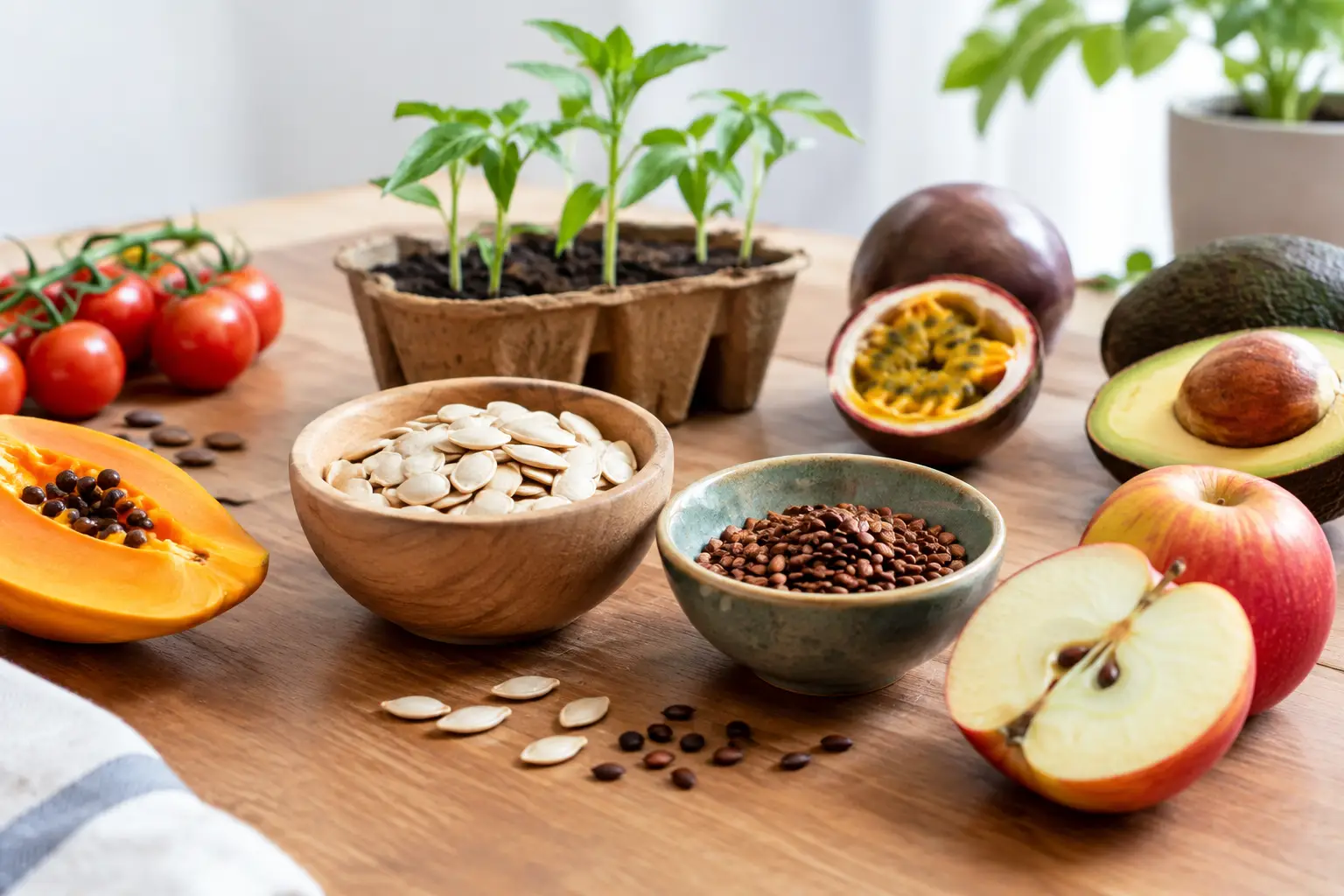
A packet of fruit seeds can represent far more than a future crop. It may be the beginning of a canopy tree, an edible landscape specimen, a dryland collection plant, or a botanical connection to a region far beyond the ordinary home garden. For growers drawn to uncommon species, the value lies not merely in germination, but in choosing material whose biology, origin, and eventual scale suit a real growing purpose.
Unlike quick annual vegetables, many fruit-bearing plants ask for patience. Some germinate within weeks; others need warmth, moisture, cold exposure, or time to release dormancy. A few are best treated as long-term greenhouse, conservatory, or container specimens outside their native climate. That slower rhythm is precisely what makes fruiting species so rewarding to collect.
The phrase “fruit tree” can conceal enormous differences in cultivation. A cashew, Anacardium occidentale, is a tropical evergreen with a limited tolerance for cold. Marula, Sclerocarya birrea, is adapted to seasonal warmth and drier conditions. Peruvian pepper, Schinus molle, produces decorative pink drupes and an expansive, finely textured canopy, but it requires careful consideration of local climate and regional planting guidance.
These are not interchangeable novelties. They belong to different families, occupy different ecological niches, and make different demands on the grower. Selecting by scientific name is useful because it moves the decision beyond a common name or an appealing fruit image. It lets you investigate mature dimensions, hardiness, pollination, dormancy behavior, and whether the species is realistically suited to your garden, greenhouse, or protected growing space.
For collectors, a fruiting plant may be chosen for one quality above all others: foliage, historical use, drought tolerance, fragrance, architecture, or ethnobotanical interest. The fruit can be central, but it need not be the only reason to grow the plant. A considered collection has room for both dependable edible species and plants whose greatest value is botanical distinction.
Before sowing, assess the conditions you can maintain for several years, not merely the conditions available this month. Temperature is the obvious starting point, but day length, winter humidity, root space, summer heat, and protection from frost can be equally decisive.
Tropical fruit seeds generally respond best to consistent warmth and should not be allowed to chill during germination. Freshness is often especially significant with these species. Seeds from plants adapted to warm, moist climates may lose viability faster than dry-stored temperate species, so prompt sowing is usually the sensible approach.
For gardeners in colder regions, this does not automatically rule out tropical material. It changes the intended use. A young cashew or other warmth-loving species may be cultivated as a container plant, moved to a bright protected setting for winter, and appreciated as a foliage and form specimen even where outdoor fruiting is unlikely. The trade-off is clear: a plant may be botanically successful without becoming a regular harvest crop.
Many temperate fruiting trees and shrubs have evolved to prevent seeds from sprouting just before winter. Their seeds may require cold, moist stratification – a period of cool, damp conditions that imitates a natural winter – before they germinate evenly.
Skipping this stage can lead to delayed or irregular results, which growers sometimes mistake for poor seed quality. The correct treatment depends on the species. Some need only a brief chilling period, while others benefit from a sequence of warm and cold phases. A species-specific propagation note is more useful than a generic instruction to “soak and sow.”
Species from seasonally dry climates often need excellent drainage from the beginning. Use a clean, free-draining medium rather than a dense compost that stays wet around the seed. Warmth may encourage germination, but constant saturation can cause rot before a root has formed.
Once established, these plants frequently benefit from a growing regime that respects their native rhythm: active warmth, bright light, and a more restrained approach to watering. For growers in humid climates, airflow and careful potting media can matter as much as temperature.
Fruit seeds are often discussed as though they either “grow” or “do not grow.” In practice, three distinct factors shape the outcome.
Freshness concerns how well a seed has retained its ability to germinate since harvest. Viability is the seed’s current capacity to produce a living seedling. Dormancy is a built-in biological delay that can prevent a viable seed from germinating until conditions are appropriate. A seed can be viable and still remain dormant.
This distinction changes how a grower responds to slow germination. When a species is known to be dormant, patience and correct pretreatment are appropriate. When a short-lived tropical seed has dried excessively or been stored poorly, waiting longer may not solve the problem. Curated seed selection matters because botanical identity and handling expectations are part of the material itself, not an afterthought.
Avoid treating all large seeds as hard-coated and all small seeds as surface-sown. Seed size does not reliably dictate propagation method. Some seeds benefit from light scarification, others from soaking, and others from no intervention beyond clean medium, stable moisture, and the proper temperature. Excessive scarification can damage the embryo, while prolonged soaking can deprive the seed of oxygen. When in doubt, use the least aggressive treatment compatible with the known requirements of the species.
The first green shoot is an encouraging milestone, but a fruiting plant’s long-term quality often begins below the surface. Many tree and shrub species develop vigorous root systems early. Start them in containers deep enough to accommodate initial root growth, and transplant before roots circle densely around the pot.
Use a sterile or clean propagation medium that holds moisture without becoming waterlogged. Sow at an appropriate depth for the seed size, label every container with the full botanical name and sowing date, and maintain even conditions. Labels are particularly valuable in a diverse collection, where several species may emerge at very different rates.
Light should be introduced according to the species and stage of growth. Most seedlings need bright conditions soon after emergence, but sudden exposure to intense outdoor sun can scorch tender leaves raised under cover. Gradual acclimation produces sturdier plants and reduces setbacks during the first season.
A restrained approach to fertilizer is equally worthwhile. Seedlings can be weakened by rich feeding before they have developed a stable root system. Begin with a modest, balanced program only after active growth is apparent, then adjust according to the species’ vigor and container size.
Growing fruit seeds means accepting genetic variation. A seed-grown plant is not a clone of its parent, even when the fruit was exceptional. Its vigor, fruit quality, growth habit, and tolerance of local conditions may differ. This uncertainty is a limitation when a grower needs a named cultivar with predictable traits, but it is also part of the appeal for collectors and breeders.
For certain species, fruit set also depends on more than a healthy individual plant. Some require cross-pollination from a genetically distinct companion, while others have male and female flowers on separate plants. A seed-grown specimen may take years to reveal its flowering behavior. If reliable fruit production is the sole goal, grafted or otherwise vegetatively propagated stock can be the more efficient choice. If the goal includes discovery, adaptation, and the pleasure of raising a species from its first root, seeds offer a different and equally valid path.
Research mature size before planting out. The charming seedling of a large fruiting tree can become unsuitable for a small yard, a narrow border, or a low greenhouse roof. Containers can extend the cultivation window, but they do not erase a species’ natural architecture. Pruning, root restriction, and overwintering requirements should be planned rather than improvised.
A strong fruit-seed collection is rarely assembled by chasing every unusual name. It gains character from a point of view. You might focus on edible trees from the Anacardiaceae, drought-adapted fruiting plants, useful species with traditional food histories, or ornamental trees that produce visually distinctive fruits. Taxonomic themes give a collection coherence while leaving room for surprise.
This approach also encourages better recordkeeping. Note the source, sowing date, pretreatments, germination timing, potting changes, and seasonal response. Over time, these observations become more useful than generic advice because they reveal how a particular species performs in your own conditions.
Quinta dos Ouriques approaches botanical seed selection with this kind of intentionality: each species can be considered on its own merits, while still belonging to a wider living collection. The aim is not to make every plant easy. It is to make each choice informed.
The most memorable fruiting plants often begin as seeds that ask a little more of the grower: a warmer bench, a colder winter treatment, a deeper pot, or several years before the first flowers. Give those requirements the attention they deserve, and the resulting plant will feel less like a purchase and more like a cultivated relationship.