
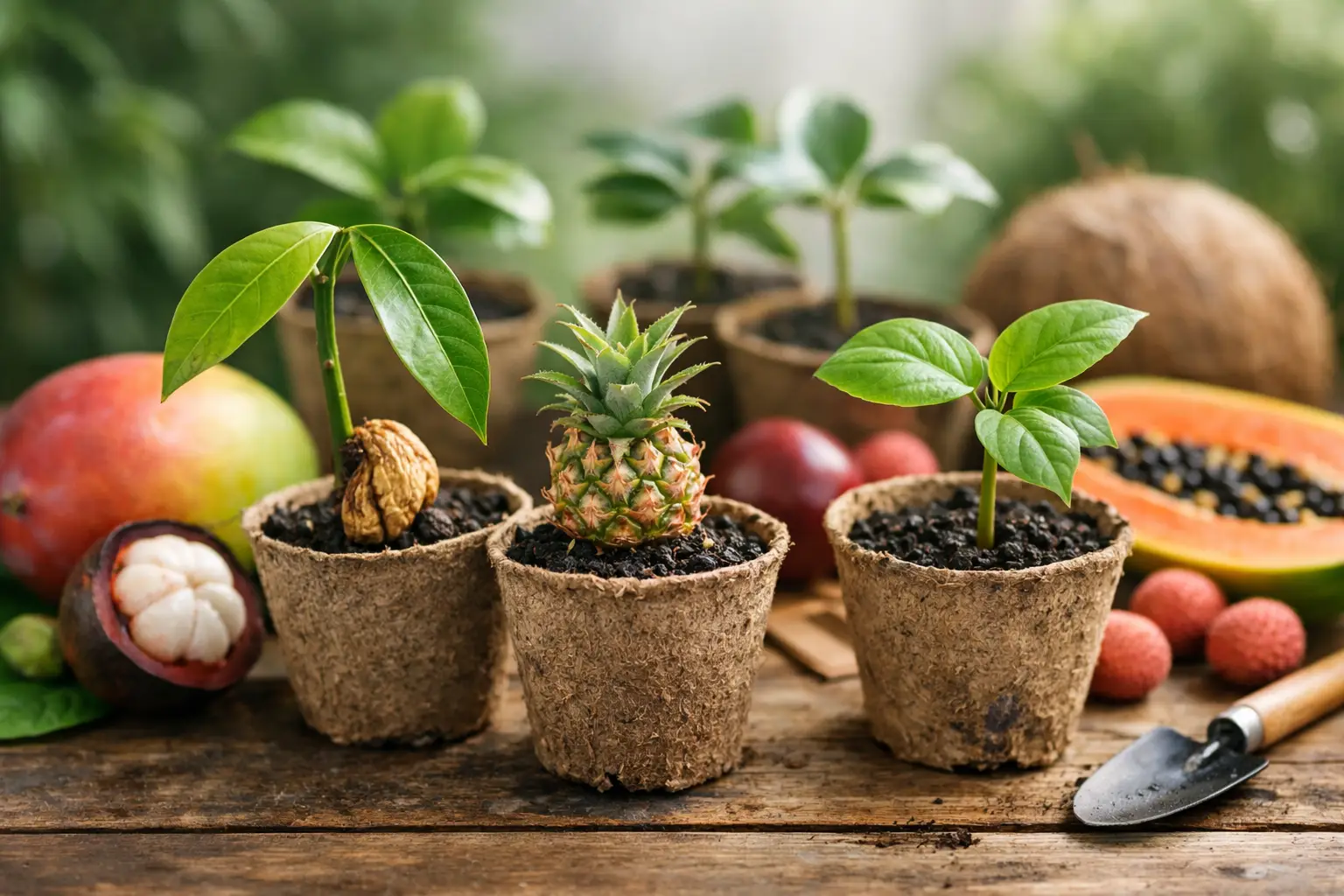
A mango pit sprouting in a warm pot is easy to romanticize. Raising it into a healthy, productive tree is a different undertaking, shaped by climate, root space, light, and several patient years. This guide to tropical fruit seedlings is for growers who value the full botanical proposition: not merely a quick houseplant, but an edible specimen with the potential to become part of a greenhouse collection, conservatory, orchard, or protected garden.
Tropical fruit trees reward informed selection. Their seeds are often short-lived, their juvenile phases can be long, and their final size may exceed what an ordinary windowsill or small patio can support. Yet these same qualities make them compelling. A seedling of Theobroma cacao, Garcinia mangostana, Annona muricata, or Plinia cauliflora carries a distinct geography, growth habit, and cultivation challenge.
“ Tropical fruit” is a useful market category, but it is not a cultivation category. A plant from humid equatorial forest, a dry tropical savanna tree, and a subtropical fruiting shrub can all be sold under that label while requiring very different conditions.
Begin with your available growing environment. A heated greenhouse allows a far wider range than a sunny indoor room, particularly through winter. A mature tree may tolerate brief stress that a seedling cannot. Night temperatures, humidity, root-zone warmth, and seasonal light levels are often more decisive than daytime warmth alone.
Consider the mature architecture as seriously as the fruit. Mango (Mangifera indica) and cashew (Anacardium occidentale) are substantial trees, best reserved for warm climates, greenhouse cultivation, or growers prepared to manage their size. Soursop (Annona muricata) also wants sustained heat and can grow quickly under favorable conditions. Jaboticaba, commonly Plinia cauliflora, grows more slowly and can be a more practical long-term container specimen, though it still needs generous root room and consistent moisture.
There is also a distinction between tropical and subtropical tolerance. Some species will endure cooler winters if kept dry or protected, while true tropicals may decline when temperatures remain below about 60°F. Do not treat a short period of survival as evidence that a plant is thriving. Pale new growth, stalled roots, and repeated leaf loss usually indicate that conditions are merely tolerable.
Many tropical fruit seeds are recalcitrant: they are not designed to dry down and wait in storage. Seeds of cacao, mangosteen, rambutan, and many Artocarpus species can lose viability quickly once removed from the fruit. For these plants, freshness is not a small advantage. It is central to successful germination.
Other species are more forgiving. Tamarind (Tamarindus indica), papaya (Carica papaya), and some Annona species may remain viable longer when properly prepared and stored. Even so, every seed lot has a history. Age, storage temperature, moisture exposure, and handling all affect the embryo within.
When fruit pulp is present, remove it carefully before sowing. Residual flesh can encourage fungal growth and attract fungus gnats. Rinse the seed in clean water, then sow promptly unless the species is known to benefit from a drying period or a specific pretreatment. Hard-coated seeds may respond to light scarification or soaking, but avoid treating every species the same way. Excessive scarification can damage the embryo, especially where the seed coat is thinner than it appears.
A useful rule for collectors is simple: research the species, not the category. The germination behavior of Garcinia is not a template for Passiflora, and a treatment suitable for tamarind may be inappropriate for cacao.
Use a clean, airy medium that holds moisture without becoming saturated. A blend containing fine bark, coco coir or a quality seed-starting mix, and perlite or pumice is often suitable. The exact recipe matters less than its behavior after watering: it should feel evenly moist, drain freely, and leave oxygen around developing roots.
Planting depth depends on seed size. Small seeds are usually covered lightly, while large seeds are commonly set at a depth roughly equal to their own thickness. Some large tropical seeds are best positioned on their side or only partly covered, but species-specific guidance should take precedence. The aim is stable moisture around the seed without burying it so deeply that emerging growth struggles toward the surface.
Bottom heat is one of the most useful tools for warm-climate species. Many tropical fruit seeds germinate most reliably when the medium remains around 75°F to 85°F. A warm room can be enough in summer, but a thermostatically controlled heat mat gives more dependable results during cool months. Keep pots away from cold windowsills and uninsulated floors, where root temperatures can fall far below the surrounding air temperature.
Humidity covers can help retain moisture during germination, especially for seeds that must not dry out. They also reduce airflow. Check the medium regularly and remove or vent the cover if mold appears. A seed tray should smell clean and earthy, not sour. If it remains wet for days, increase aeration rather than adding more water.
Germination is only the first test. Newly emerged tropical fruit seedlings need bright light, but not necessarily punishing sun. A young cacao seedling, for example, naturally begins beneath forest canopy and can scorch in abrupt full sun. Mango, papaya, and many dry-tropical species usually accept stronger light once established, provided they are acclimated gradually.
Indoors, bright supplemental lighting often makes the difference between a seedling that persists and one that grows with substance. Place lights close enough to provide useful intensity without heating the leaves. Watch the plant rather than relying only on a schedule: stretched stems and wide gaps between leaves suggest insufficient light, while bleached patches or curled margins can signal excess intensity or heat.
Warmth should remain consistent after emergence. A tropical seedling exposed to chilly nights may stop growing even when daytime conditions seem adequate. Protect it from cold drafts, air-conditioning vents, and sudden outdoor transitions. If moving plants outdoors for summer, begin with shade and sheltered conditions, then increase light over one to two weeks.
Watering requires restraint. Seedlings have limited roots and can dry quickly, but constantly wet medium is a frequent cause of loss. Water thoroughly when the upper layer begins to dry, then let excess water drain. Species from wet forest habitats generally prefer more consistent moisture than species adapted to seasonal drought, though neither group benefits from stagnant roots.
Tropical fruit seedlings are often sold or raised in containers too small for long-term development. Pot up when roots have reached the container edge, when watering becomes difficult to manage, or when growth slows despite appropriate light and warmth. Move only one pot size at a time. A very large container surrounding a small root system stays wet too long and can delay establishment.
Choose a pot with reliable drainage and enough weight to stabilize future growth. Deep-rooted species may appreciate taller containers, while fibrous-rooted plants can perform well in standard nursery pots. Root pruning is not equally appropriate for every fruit tree. Some species resent disturbance, particularly those with pronounced taproots, so transplant while young and handle the root ball gently.
Fertilizer should follow active growth, not the calendar. Once a seedling has produced several true leaves and is visibly growing, begin a diluted, balanced fertilizer program. Slow, steady feeding is preferable to heavy doses that leave salts in the potting medium or stimulate weak, overly soft growth. Trace elements become increasingly relevant in container culture, especially for long-lived specimens grown in soilless mixes.
Growing from seed brings variability. A seed-grown mango may not reproduce the fruit qualities of its parent exactly, and a seedling can take years before flowering. For collectors, this is part of the appeal: each plant is an individual expression of its species. For growers focused on dependable fruit production, grafted plants may be the better choice for certain crops.
Pollination is another practical consideration. Some species are self-fertile, some benefit from cross-pollination, and others depend on insects or conditions that are difficult to replicate indoors. A healthy, attractive tropical fruit tree may never fruit in a small room, particularly if it lacks winter light, mature size, or suitable pollination. That does not make the project unsuccessful, but it should shape expectations from the start.
Keep records from the day you sow. Label each pot with the scientific name, source, sowing date, and any pretreatment used. Notes on germination timing, temperature, and early growth become especially valuable when raising several species or comparing future seed lots. Taxonomic accuracy also prevents a familiar common name from obscuring a plant’s real requirements.
The most satisfying tropical fruit seedlings are raised with a clear sense of their eventual place. Give each species conditions that reflect its origin, allow its pace to be its own, and treat every new leaf as evidence that a rare living specimen has accepted your care.