
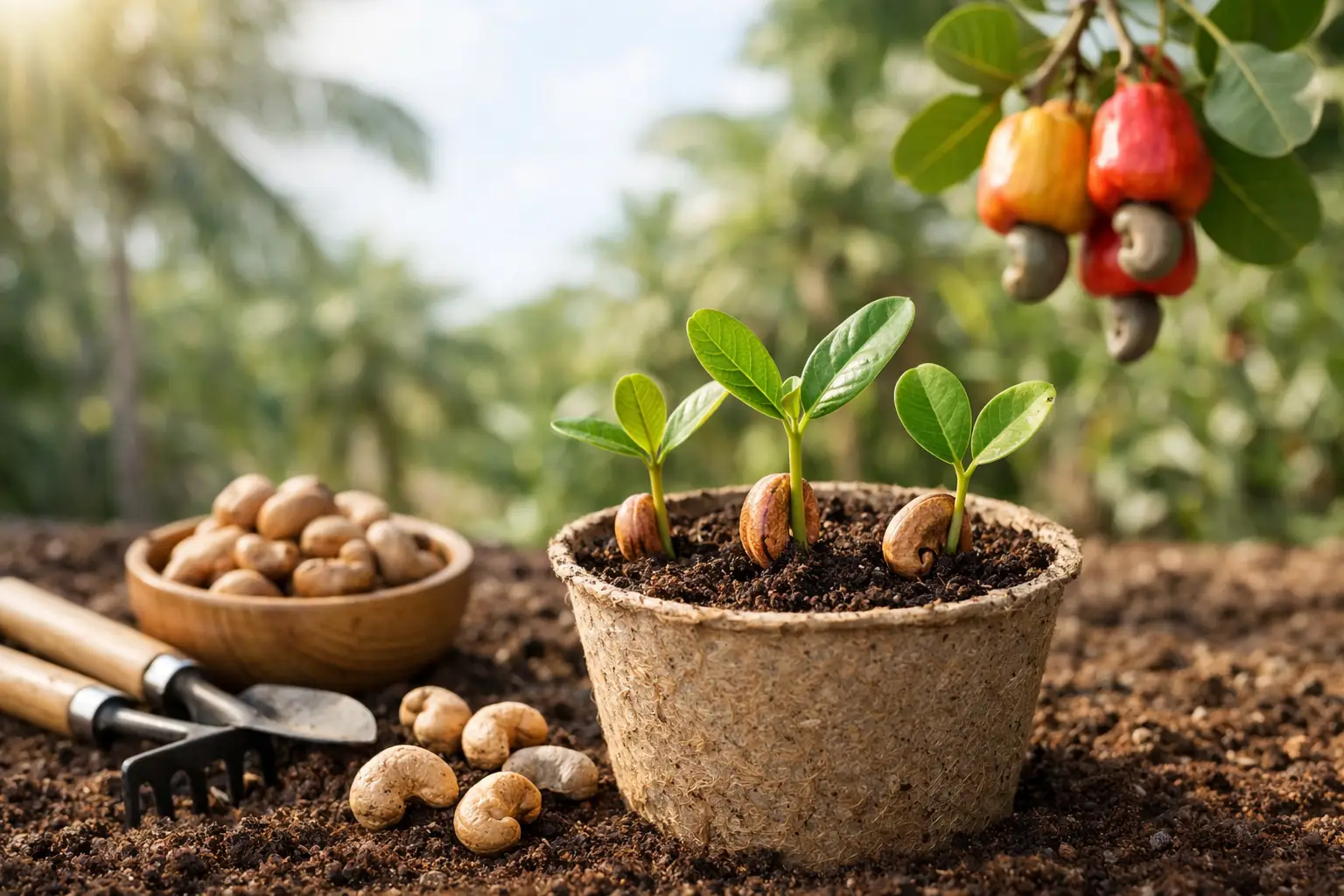
A viable cashew is not the familiar snack found in a pantry. Cashew tree seeds are living, shell-enclosed material from a tropical tree, and their success depends far more on freshness, warmth, and space than on complicated seed-starting techniques. For the collector who can provide those conditions, Anacardium occidentale offers an edible, ornamental, and ethnobotanical specimen with a notably individual presence.
Cashew belongs to the family Anacardiaceae, alongside mango, pistachio, and sumac. Native to northeastern Brazil and now cultivated across tropical regions, it develops a broad, low-branched crown, leathery evergreen leaves, and small pinkish flowers that give way to one of the more unusual fruit structures in cultivation.
The swollen red, yellow, or orange portion commonly called the cashew apple is technically a pseudofruit. The true fruit is the kidney-shaped structure attached beneath it. Inside that structure sits the seed that produces a new tree.
This distinction matters to growers. A cashew tree is not merely a source of nuts. It is a warm-climate landscape tree with substantial mature proportions, handsome foliage, and fruit that is culturally significant in many tropical food traditions. In a conservatory or large greenhouse, it can also become a serious botanical focal point.
Freshness is the first consideration. Cashew seed loses vigor with age, especially when stored under warm or damp conditions. Seek intact, mature seeds with their natural shell unbroken, and sow them soon after arrival rather than treating them as material for a distant future project.
Do not substitute commercially packaged cashew nuts for planting stock. Culinary cashews have usually been heated, shelled, processed, or stored in ways that eliminate viability. A seed intended for cultivation should be botanically identified and handled as propagation material from the start.
The shell also requires respect. Cashew shells contain caustic phenolic compounds, including anacardic acid and cardol, which can irritate skin. Never crack, roast, or attempt to process shell-on cashews at home. Wear gloves when handling the seeds, keep them away from children and pets, and sow them intact. The tree can be a rewarding edible species, but home processing of the raw nut is a separate and potentially hazardous undertaking.
Cashew is best started in the container where it will spend its first extended season. The seedling forms a decisive root system, and unnecessary early transplanting can slow establishment. Choose a deep pot with drainage holes rather than a shallow seed tray.
Use a free-draining medium that holds some moisture without becoming saturated. A quality seed-starting mix amended with coarse perlite, pumice, or horticultural grit is suitable. Cashew tolerates relatively lean, sandy soils once established, but germinating seeds still need even moisture and air around the developing root.
Plant each intact seed on its side, roughly 1 to 2 inches deep. Cover it lightly, water the medium thoroughly, and allow excess water to drain. The goal is a consistently damp substrate, not a wet one. In cool or poorly drained soil, the seed may rot before growth begins.
Maintain a soil temperature near 77 to 86 F. A heat mat can be useful in a temperate home or greenhouse, particularly when nighttime temperatures fall. Bright indirect light is sufficient before emergence, but move the pot into stronger light as soon as the seedling breaks the surface.
Fresh seed often germinates within two to four weeks, though timing varies with seed age and temperature. Resist the urge to excavate the pot to check progress. A firm seed, warm medium, and measured watering offer better odds than repeated disturbance.
Once established, cashew prefers abundant sun. Introduce young plants gradually to direct outdoor light so that tender leaves do not scorch after a protected indoor start. In a greenhouse, strong light and air movement help produce sturdier growth than a dim windowsill can provide.
Water deeply when the upper portion of the growing medium has begun to dry, then let the container drain freely. Cashew does not appreciate chronically wet roots. At the same time, a young plant should not be allowed to dry to the point of wilt. This balance becomes easier as the root system fills the pot and the plant gains woody structure.
Begin feeding lightly only after active growth is evident. A balanced fertilizer applied at modest strength during the growing season is generally enough. Excess nitrogen can produce lush, soft growth at the expense of a well-formed branch structure. For a specimen tree, steady development is preferable to a brief flush of growth.
The central question is not whether cashew can germinate in a northern climate. With heat and light, it can. The more useful question is whether the plant can be carried through several years of growth with adequate warmth, root room, and winter light.
Cashew is frost-sensitive. It is best suited to frost-free outdoor cultivation in USDA Zones 10b and 11, with protection often needed at the cooler margins of that range. Gardeners elsewhere should regard it as a container-grown greenhouse, sunroom, or conservatory specimen. Temperatures below about 50 F can check growth, and frost can seriously damage or kill a young plant.
In suitable ground, a mature tree may reach 20 to 40 feet tall with a generous spread, depending on climate, soil, and pruning. A large container naturally limits its dimensions, but container culture does not turn cashew into a small houseplant. Plan for a substantial tub, regular repotting while the plant is young, and a protected winter position with strong light.
Pruning can help maintain a lower, more branching form. Start with modest shaping once the seedling is established, removing weak or crossing growth rather than cutting aggressively. The tree’s natural architecture is part of its appeal, especially where it has enough room to develop a broad crown.
A seed-grown cashew is an individual, not a clone. Its eventual vigor, branching, fruit color, crop timing, and nut production may differ from those of the parent tree. That variability is often appealing to collectors, but it is a trade-off for growers seeking uniform orchard performance.
In excellent tropical conditions, seedlings may begin flowering and fruiting in roughly three to five years. In containers or marginal climates, the timeline can be longer, and fruiting is never guaranteed simply because a plant is healthy. Flower production depends on maturity, heat, light, nutrition, and the presence of insect activity or suitable pollination conditions.
If fruit does develop, appreciate the tree first as a living specimen. The cashew apple is perishable and may be used fresh where it is safely and suitably prepared. The attached nut, however, should not be opened or processed casually because of the irritant shell oils. Growing the tree and preparing the commercial nut are very different horticultural and culinary tasks.
Cashew rewards a particular kind of patience. It asks for genuine warmth, a deep container, and room to become more than a novelty seedling. In return, it offers a botanically distinctive tree whose foliage, form, fruiting habit, and cultural history extend well beyond the familiar cashew nut.
For growers assembling a collection around edible tropicals, Anacardiaceae, or unusual woody species, sowing Anacardium occidentale is an intentional choice. Give the seed warmth and time, then allow the young tree enough space to show why it belongs in a considered botanical collection.