
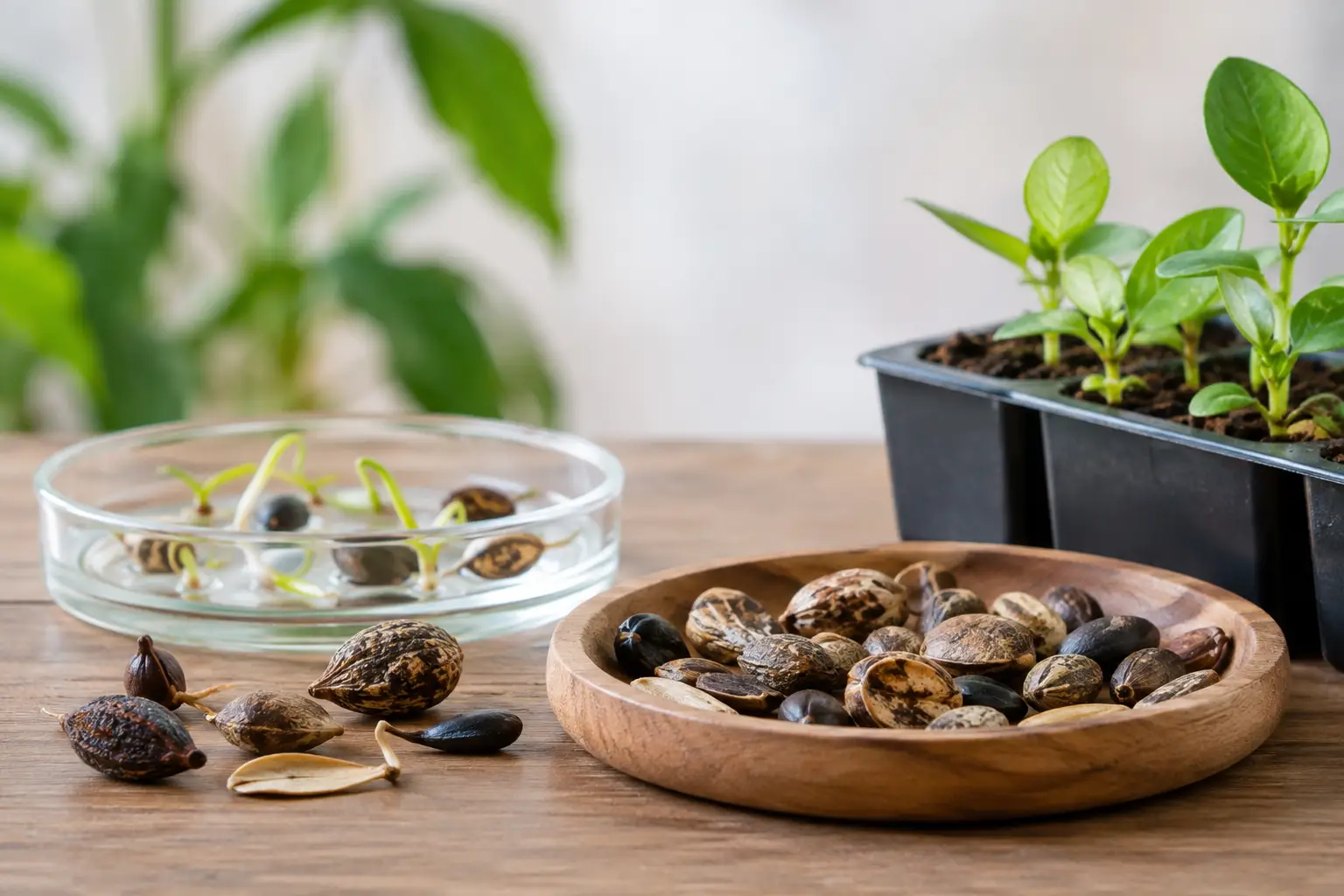
A packet of Sclerocarya birrea or Schinus molle seed is not a miniature version of a packet of basil. It represents a particular species, a particular reproductive strategy, and often a narrower margin for error. Rare seed germination begins with that distinction: the objective is not simply to make seeds sprout, but to understand what a species requires before it will do so.
For collectors and purposeful growers, the appeal of unusual seed lies partly in this process. A successful seedling of Valeriana officinalis, cashew (Anacardium occidentale), or staghorn sumac (Rhus typhina) carries more meaning when its first conditions were chosen thoughtfully. The most useful approach is observant rather than forceful – guided by seed biology, sound sanitation, and patience.
“Rare” does not automatically mean difficult. Some uncommon species germinate quickly when fresh and warm, while familiar plants can have elaborate dormancy mechanisms. What matters is the seed’s origin, structure, maturity at harvest, and natural seasonal cycle.
A useful first distinction is between seeds that must remain moist and seeds that tolerate drying. Many tropical and subtropical tree seeds are short-lived once removed from the fruit. Cashew is a good example of a species for which freshness and warmth can matter more than complicated pretreatment. Storing such seed for months in a dry drawer may reduce viability before sowing even begins.
Other species have evolved to wait. Temperate woody plants frequently use dormancy to prevent autumn germination before winter. Staghorn sumac, in the Anacardiaceae family, may combine a water-resistant seed coat with internal dormancy. In this case, warmth alone is unlikely to provide a uniform result. The seed may need scarification, followed by a period of cold, moist stratification.
Small-seeded herbaceous plants require another sort of restraint. Some respond to light and should be pressed onto the surface of a fine, moist medium rather than buried. Others are easily lost to damping-off if the medium is too wet or airless. Before applying any treatment, identify the species by its botanical name. Advice given for a genus is a starting point, not a substitute for species-level information.
Begin with a clean work area, labeled containers, fresh medium, and water of reasonable quality. This modest preparation protects a limited seed lot from avoidable confusion. When several unusual species are being started at once, a durable label with the scientific name and sowing date is more valuable than memory.
Examine seeds without expecting appearance alone to predict viability. Firmness, full shape, and intact coats are generally encouraging. Mold, pinholes, soft tissue, or a stale odor deserve caution. Large fruits and nuts may retain pulp or fruit residues that encourage fungal growth, so clean them carefully before sowing.
If seed has arrived dry, do not assume that soaking is always beneficial. A short soak can help some hard-coated seeds take up water, but extended soaking may deprive them of oxygen or damage more delicate seed. With tiny seed, surface sowing onto already-moistened medium is usually more precise than soaking.
Keep records from the first day. Note the seed source, date received, treatments used, medium, temperature range, and emergence dates. Rare seed germination is often improved less by a new product than by better records. A notebook allows the next sowing to be based on evidence rather than a vague recollection that a species was “slow.”
Pretreatment should answer a biological question. Is the seed coat preventing water entry? Is embryo dormancy requiring winter-like conditions? Is the seed freshly released from a warm-climate fruit? Applying every available method at once can make it impossible to know what helped and can damage seed that needed little intervention.
Scarification weakens a hard seed coat so moisture can enter. It is common among species adapted to fire, weathering, animal digestion, or long persistence in soil. Mechanical scarification – lightly abrading a small area with sandpaper or a file – offers control for larger seeds. Stop when the outer surface is thinned; cutting into the living tissue can end the attempt before it starts.
Hot-water treatment is sometimes used for hard-coated seed, but it is not universally safe. Heat tolerance varies by species and seed age. If a trial is appropriate, divide the lot and leave a portion untreated as a comparison. With a limited number of seeds, preserving some for a second method is prudent cultivation rather than hesitation.
Cold stratification imitates winter. Seeds are held moist, not saturated, at refrigerator temperatures for a species-appropriate period. A barely damp mix of fine medium in a labeled, breathable container works well. Check periodically for mold and for early germination.
Timing is not a rigid calendar. Some temperate species need several weeks; others need several months, and a few respond best to warm stratification before cold. If a seed germinates during stratification, pot it promptly and move it into suitable light. The goal is to meet the seed’s seasonal signal, not to complete an arbitrary number of days.
For species from frost-free climates, stable warmth can be the decisive condition. Use a free-draining medium and a container deep enough for early root development. Bottom warmth may be useful, but excessive heat can dry the medium quickly and create wide swings at the surface.
Fresh tropical seed should be sown without unnecessary delay. This is particularly relevant to seeds with limited storage life. If germination is uneven, resist the urge to discard the tray early. Differences in maturity, seed-coat thickness, and water uptake can spread emergence over weeks.
The ideal medium holds moisture while retaining air. A fine seed-starting blend is appropriate for many species, while large seeds may benefit from a coarser, more open mix. Garden soil is rarely the best choice for first germination because it can compact, carry pathogens, and make moisture difficult to judge.
Water thoroughly after sowing, then adjust according to the medium and container. The surface should not become dust-dry, but constant saturation is equally damaging. Germinating seeds respire. When pore spaces fill with water, oxygen becomes scarce and rot gains an advantage.
Humidity covers can reduce drying, especially for small seed, but they require attention. Lift them regularly for air exchange and remove them once seedlings emerge. High humidity without circulation is a common cause of fungal loss, particularly where temperatures are warm.
Light should be considered separately from heat. A bright windowsill can be too cold at night, while a heated propagation area can be too dim after emergence. Provide the light level required for the species once cotyledons appear, and avoid placing newly emerged seedlings directly under intense sun before they have acclimated.
A tray that has not germinated is not necessarily a failed tray. Some species emerge irregularly, and woody seeds may take substantially longer than annual vegetables. The appropriate waiting period depends on the species, the freshness of the seed, and whether its dormancy requirements were met.
Intervene when there is evidence: persistent mold, sour medium, collapsed seed, or a clear mismatch between conditions and species needs. Otherwise, avoid repeated disturbance. Digging up seed to inspect it can break a newly extending radicle or reset moisture around it.
When a seedling emerges, the work changes. Give it air movement, appropriate light, and measured water. Transplant only after roots have begun to hold the medium together and the young plant can tolerate handling. A rare seedling is not strengthened by being rushed into a larger pot.
Each species that germinates well becomes more than a new plant in the collection. It becomes a record of place, season, and careful attention – a living reason to keep cultivating with precision.