
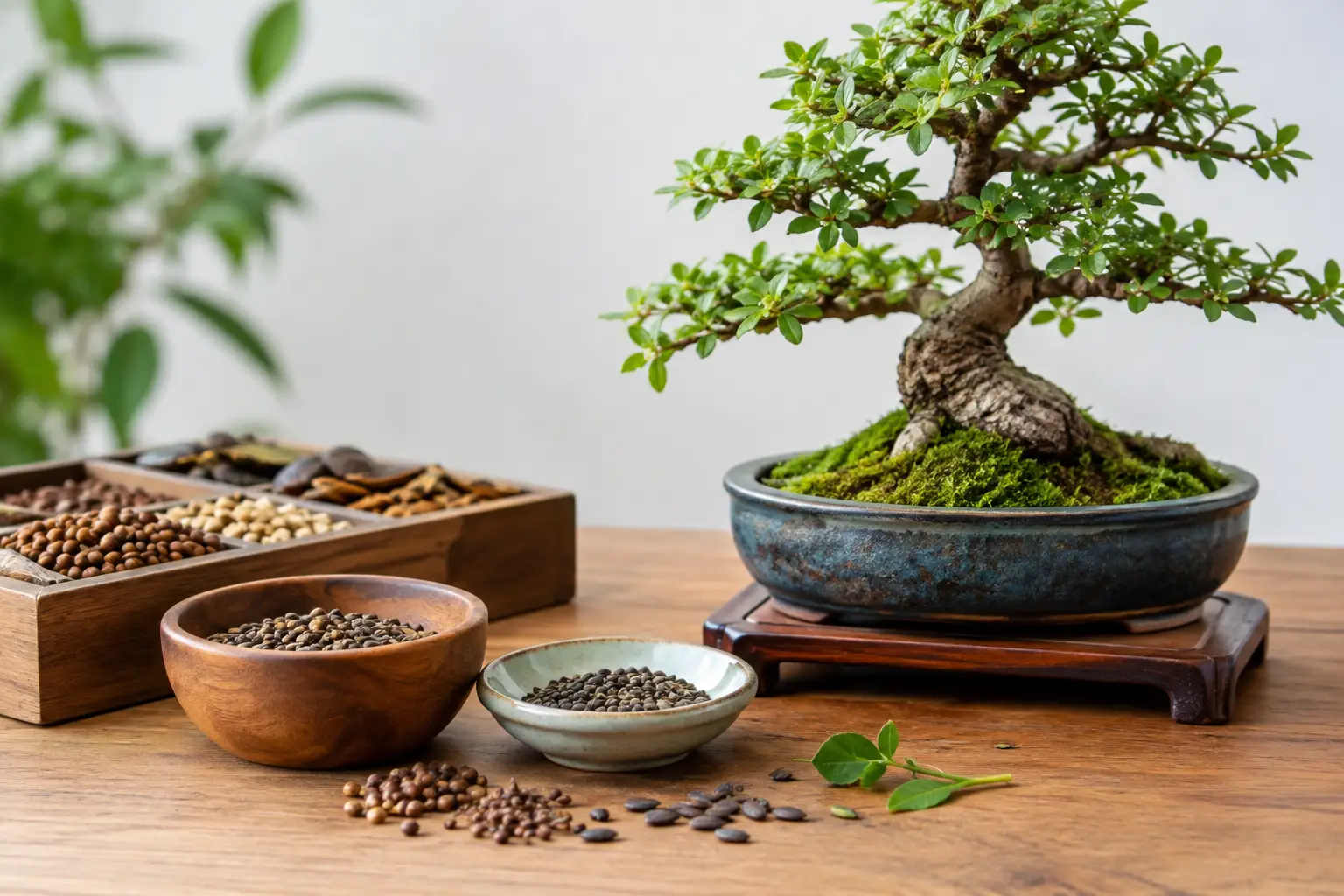
A bonsai grown from seed is not a shortcut to a finished tree. It is a long-term horticultural study: a chance to observe a species from its first root, direct its trunk movement early, and select for character over time. The best seeds for bonsai projects are therefore not simply seeds from small trees. They are species with the vigor, response to pruning, leaf or needle scale, and seasonal character to reward years of deliberate cultivation.
For collectors, seed-grown bonsai also offers something nursery stock cannot. Every seedling is genetically individual. A flat, vigorous root system, a naturally compact internode, unusual bark, or a promising first bend may appear in one plant and not another. Growing several seedlings of one species creates the opportunity to select the few that deserve continued attention.
A suitable bonsai species has more than attractive foliage. It must accept repeated root work, branch pruning, wiring, and a life in a comparatively shallow container. Its leaves or needles should remain proportionate to the intended tree, or reduce reasonably under bonsai culture. It should also develop features that become more convincing with age: fissured bark, taper, ramification, seasonal color, flowers, fruit, or a distinctive silhouette.
Climate matters just as much as visual appeal. A Japanese maple may be an excellent deciduous bonsai in a garden with a reliable winter dormancy, yet a poor choice for a warm apartment with no cold season. A tropical ficus can thrive indoors under strong supplemental light, while a black pine needs full sun and the changing temperatures of an outdoor year. Start with the conditions you can provide consistently, then choose the species.
Seed freshness and germination requirements are equally consequential. Some temperate trees need a period of cold, moist stratification before they germinate. Others have hard seed coats, irregular germination, or short-lived viability. These are not flaws, but they do shape the project. A patient grower may find that seasonal preparation is part of the appeal.
Trident maple is one of the most accommodating deciduous species for bonsai development. Its naturally small, three-lobed leaves, energetic growth, and tolerance for pruning make it especially useful for growers who want to practice trunk development and branch selection from an early stage. Mature specimens develop pleasing bark and convincing ramification.
Seedlings should be allowed to grow freely for periods rather than kept miniature from the start. Sacrificing a branch or growing the young tree in the ground or a larger training container can build trunk thickness far more effectively than restricting it in a bonsai pot. This is a species that rewards alternating periods of vigor and refinement.
Acer palmatum is chosen for delicacy rather than speed. The palmate foliage, fine branching potential, and autumn color give it a refined presence, particularly in informal upright, clump, or forest compositions. Seed-grown plants also offer variation in leaf shape, color, and growth habit that makes each batch interesting to assess.
The trade-off is sensitivity. Japanese maples dislike drying out at the roots, harsh wind, and extreme heat. In much of the United States, they appreciate morning sun and protection during the hottest part of summer. Seeds generally require cold stratification, and seedlings need patient handling during their first few growing seasons.
Chinese elm combines small leaves, rapid growth, fine twigging, and a forgiving response to pruning. It can be trained in many styles, from informal upright to broom, and older trees may develop mottled, exfoliating bark. For growers seeking a lively, responsive tree with a compact visual scale, it is one of the strongest candidates.
Its adaptability should not be mistaken for indifference. Outdoor cultivation produces the best vigor and seasonal rhythm in suitable climates. Where winters are severe, a young Chinese elm needs appropriate protection. It may also be maintained in a bright, cool indoor setting only with enough light and attention to watering.
Japanese black pine is a classic seed-grown conifer because early work can shape the entire future trunk. Root arrangement, first bends, sacrifice branches, and the placement of low branches all begin while the tree is young. Its rugged dark bark and strong needles suit powerful, weathered designs.
This is not the simplest first bonsai project. Pines demand a clear understanding of seasonal growth, full sun, and species-specific pruning timing. They should not be treated like broadleaf trees. Yet for a grower prepared to learn their rhythm, Pinus thunbergii offers exceptional structural potential and a lifetime of refinement.
Japanese zelkova is valued for an elegant vase-shaped habit, serrated leaves, fine ramification, and pale exfoliating bark on mature trunks. It is particularly suited to broom-style bonsai, where a straight trunk rises into a balanced, branching crown. From seed, it grows with enough vigor to make developmental choices visible quickly.
Like maples and other temperate deciduous trees, zelkova requires winter dormancy. Its seeds commonly benefit from cold stratification, and seedlings should be protected from extremes while their roots are establishing. Once vigorous, the species accepts pruning well and can become notably convincing at a modest size.
For warm-climate and indoor growers, Ficus microcarpa offers a different route into bonsai. It tolerates pruning, responds strongly to warmth and light, and can produce aerial roots under humid conditions. Its resilience makes it useful for learning the practical cycle of growing, cutting back, and rebuilding branches.
Seed-grown ficus are best reserved for growers who can provide real brightness, preferably from a greenhouse, sunroom, or quality grow light. A dim shelf will maintain neither compact growth nor good health. In frost-free climates, outdoor summer growth can accelerate development dramatically.
The intended style should influence the seed selection. Deciduous maples, elms, and zelkovas lend themselves to branching detail, seasonal change, and woodland-scale compositions. Pines are better suited to trunks with drama, aged bark, and asymmetrical conifer silhouettes. Ficus favors tropical forms, exposed roots, and sculptural bases.
Avoid choosing a species solely because its seed is uncommon. A rare tree can be a compelling container specimen without being an ideal bonsai subject. Large compound leaves, coarse branching, weak back-budding, or a strong taproot may make refinement difficult. Cashew, marula, and staghorn sumac, for example, carry considerable botanical interest, but their leaf scale and growth habits ask for a larger, more interpretive container treatment than a traditional small bonsai.
That distinction is useful rather than limiting. Bonsai is not one visual formula. A collector may cultivate a small, refined trident maple beside a larger ethnobotanical tree trained for trunk character and proportion. The right project respects the natural language of the species.
A single seedling can become a cherished tree, but a small group gives a bonsai project greater depth. Germination rates vary, and young trees reveal their qualities gradually. One may develop a better basal flare, another a more flexible trunk, and a third may show tighter internodes. Selection is part of the craft.
Once seedlings are established, do not rush them into shallow pots. Early bonsai culture is primarily about roots and trunk development. Grow them in appropriately sized training containers with a free-draining medium, strong light suited to the species, and enough space for vigor. Root pruning should be timed to the species and season, never performed simply because a calendar says it is time.
For temperate seeds, plan around dormancy before sowing. If cold stratification is required, use a labeled, lightly moist medium and allow the necessary weeks in refrigeration. For hard-coated tropical or subtropical seeds, scarification or soaking may improve water uptake, though the exact treatment depends on the species. Botanical names matter here: germination advice should be species-specific, not based on a broad common-name category.
The most satisfying seed-grown bonsai are rarely the fastest. Choose a species that belongs in your climate, give it room to become strong, and let its early growth reveal the form it is capable of becoming.