
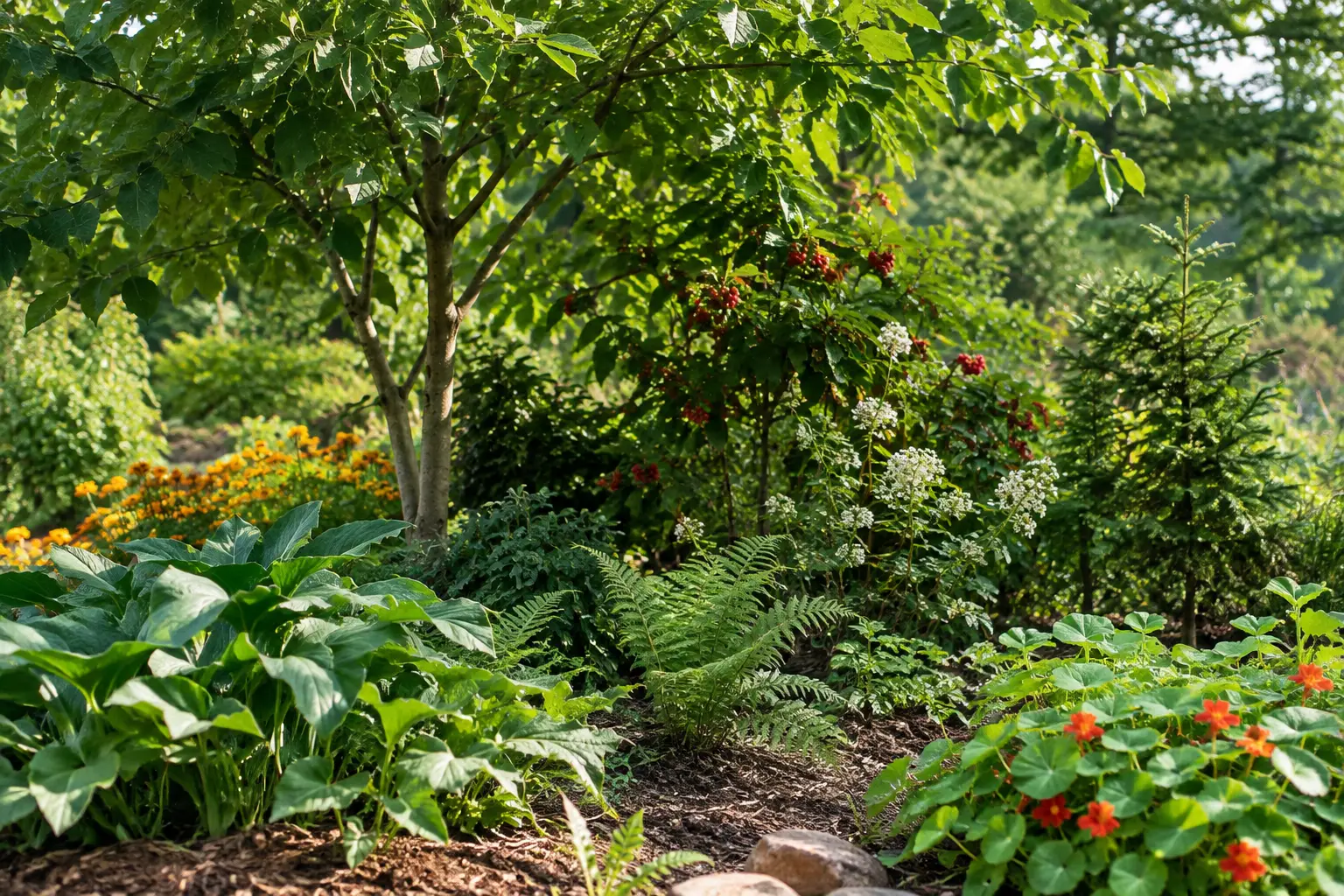
A forest garden is not a woodland with edible plants scattered through it. The best plants for forest gardens are chosen for the particular light, moisture, root competition, and seasonal role they will hold within a living community. A chestnut planted without room to mature, or woodland garlic placed in dry summer soil, will disappoint regardless of its botanical interest.
For growers who value unusual seed-grown material, this is where a forest garden becomes especially compelling. It can hold productive trees, medicinal perennials, fragrant ground covers, and species with strong ornamental character, provided each is given a deliberate place. The aim is not to fill every inch at once. It is to build layers that become more useful and more stable with age.
Begin with climate and site before assembling a plant list. A cool-temperate forest garden in the Northeast has very different possibilities from a dry Mediterranean-influenced garden in California or a humid subtropical planting in the Gulf states. Winter chill, summer drought, soil pH, and the amount of shade beneath established trees will narrow the selection quickly.
Also distinguish between a young planting and a mature one. In the first years, the ground receives substantial sunlight and can support sun-loving annuals or short-lived perennials. As tree canopies close, the garden shifts toward species that tolerate filtered light. Seed-grown trees and shrubs reward patience, but they require thoughtful spacing from the beginning.
A useful planting includes more than food. Choose species for at least two or three functions: harvest, habitat, leaf litter, nitrogen cycling, seasonal flowers, medicinal use, privacy, or visual structure. A plant that is beautiful but aggressive, however, may be the wrong choice for a small garden. Observe local invasive-species guidance before introducing any spreading or bird-dispersed plant.
Chinese chestnut is a serious long-term choice for sunny temperate sites with well-drained, slightly acidic soil. Its nuts bring real caloric value to a forest garden, while its broad canopy creates the conditions for a later understory. Trees need room, and more than one genetically distinct individual is usually desirable for pollination and nut set.
This is not a quick harvest crop. Seedlings vary, and meaningful yields take time. Yet for the grower planning in decades rather than seasons, that genetic variation is part of the appeal. Select the position carefully, away from compacted wet ground and close competition from large existing trees.
Mulberry offers abundant fruit, rapid growth, and generous shade once established. It is useful where a resilient small tree is needed, particularly in warmer temperate regions. Fruit color, sweetness, ripening period, and tree form can vary considerably among seedlings.
Its vigor is both an advantage and a constraint. White mulberry can naturalize in parts of the United States and may be unsuitable near sensitive natural areas. Where it is appropriate and contained, its fruit is valuable for people and birds, while fallen leaves contribute readily to the forest floor.
Serviceberry occupies the useful middle ground between shrub and small tree. Its white spring bloom, edible summer berries, and warm fall color give it more than one season of interest. It fits well along a woodland edge or on the brighter side of larger trees.
Birds appreciate serviceberries as much as gardeners do, so harvest timing matters. Netting is possible for a few plants, but many forest gardeners instead plant enough to accept a shared crop. In humid climates, good air movement helps reduce foliar disease pressure.
Pawpaw is one of the most distinctive edible trees for eastern North American forest gardens. It tolerates partial shade when young, produces large tropical-tasting fruit, and brings an unmistakably regional character to the understory edge. Its deep root system means young plants are best given a permanent position early.
Pawpaws often perform best with at least two unrelated plants for cross-pollination. They prefer deep, moist but well-drained soil and can be slow to establish. This is a species for patient growers, not those seeking immediate abundance.
Black chokeberry is a restrained, cold-hardy shrub with white flowers, dark fruit, and reliable autumn color. The berries are notably astringent when fresh, but they become more appealing in juice, preserves, syrups, and dried blends. Their high pigment content also makes them useful to growers interested in culinary color and processing.
Aronia tolerates a range of soils and some moisture, though it fruits best with more sun. In a forest garden, place it where it receives a half day of light or at an open edge rather than beneath dense evergreen shade.
Black currant is a productive shrub for cool climates and lightly shaded conditions. Its aromatic leaves and intensely flavored fruit offer a different character from familiar garden berries. It is particularly well suited to the transitional space between open garden and woodland.
Check local regulations before growing any Ribes species. Restrictions remain in some areas because certain currants and gooseberries can serve as hosts for white pine blister rust. Where permitted, give plants fertile soil, consistent moisture, and enough spacing for airflow.
Valerian earns its place through fragrant summer flowers, valuable medicinal roots, and a willingness to grow in moisture-retentive soil. The white to pale pink flower clusters are attractive to beneficial insects, while its height creates a graceful transition between shrub layer and lower ground cover.
Harvesting roots is inherently disruptive, so treat valerian as a renewable population rather than a single specimen. Allow selected plants to flower and set seed, then lift only mature plants from an established colony. Its scent is not universally appreciated, particularly around freshly harvested roots, but its botanical and traditional medicinal value is considerable.
Ramps are a classic deciduous-forest edible, emerging early in spring before the canopy fully leafs out. Their leaves and bulbs have a rich onion-garlic flavor, but their slow growth makes them a plant to cultivate with restraint. Woodland soil rich in leaf mold, reliable spring moisture, and summer shade are essential.
Avoid treating ramps as a one-time forage crop. Harvest a leaf from only a portion of mature plants, or take seed heads after they ripen, rather than removing bulbs. In the right site, a carefully established patch becomes more valuable each year.
Nettle is one of the most purposeful plants in a productive woodland garden. Young shoots are a nutritious cooked green, leaves can be dried for tea, and the plant supports numerous insects. Its deep roots also draw nutrients upward, and cut foliage can be used as a compost ingredient or mulch material.
Place nettle where its sting will not punish routine access: near a compost area, boundary, or managed edge. Gloves are essential during harvest. In rich moist soil it can spread enthusiastically, so remove unwanted runners and seed heads before it escapes its intended area.
Wild strawberry makes a low, attractive edible ground cover for brighter openings and woodland margins. Its smaller berries can be exceptionally fragrant, and its runners gradually knit bare soil together. It is less suitable beneath heavy shade, where flowering and fruiting decline.
Use it around young shrubs and on the sunny side of paths, leaving a little open soil for expansion. Its modest stature means it should not be paired immediately with overly vigorous ground covers.
Sweet violet brings early flowers, edible petals, and a soft evergreen-to-semi-evergreen presence in milder areas. It thrives in the dappled shade that defeats many conventional culinary crops. The leaves can also be used sparingly as a mild salad green or garnish.
Violets spread gently in favorable soil, which is often an advantage beneath shrubs. They are best used as a living carpet, not as a specimen expected to remain isolated.
Schisandra is a woody vine valued for its red berries and distinctive place in East Asian herbal traditions. It appreciates fertile, consistently moist soil and a support structure such as a trellis, fence, or sturdy small tree. Its climbing habit adds a vertical harvest layer without requiring a large footprint.
Do not allow it to overwhelm young trees. A dedicated support is the more controlled choice, especially in a collector’s garden where individual specimens deserve to remain visible and accessible. Multiple plants may improve fruiting, depending on the seed source and sex expression.
A well-composed forest garden changes as its canopy develops. Start with the trees and structural shrubs, then establish moisture-loving or shade-tolerant understory plants where their future conditions are clear. Ground covers can follow once paths, harvesting zones, and access to young trees have been protected.
The most rewarding forest gardens are edited as carefully as they are planted. Leave room for the chestnut to become a tree, for the pawpaw to settle into its site, and for a small colony of ramps or violets to establish without pressure. A considered selection of species, grown with attention to their botanical habits, will offer far more than a densely planted collection ever could.