
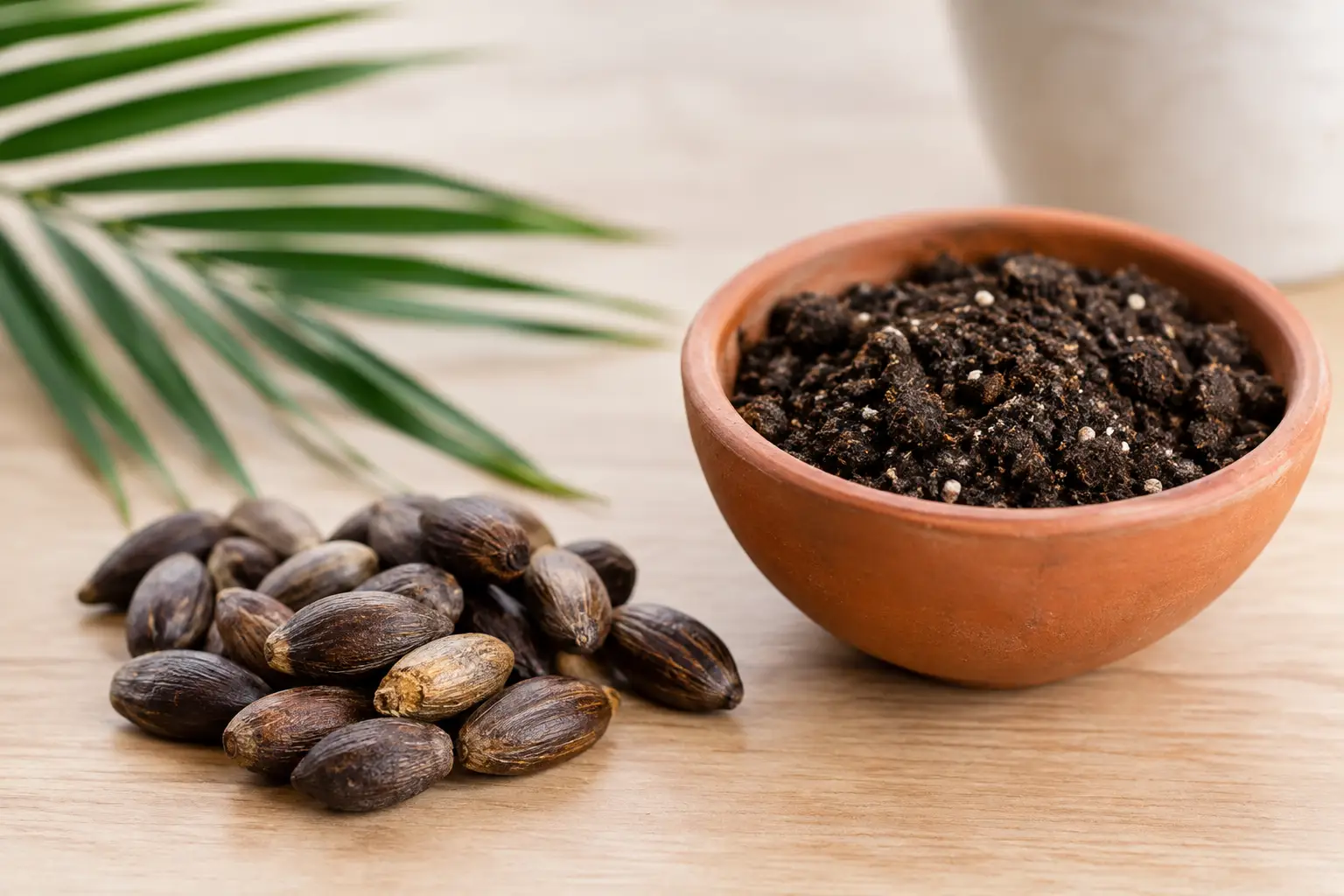
A palm seed can look perfectly sound, sit in warm mix for weeks, and still produce nothing. For collectors, that uncertainty is part of the appeal and the discipline of growing palms from seed. If you are asking, why wont palm seeds germinate, the answer is rarely a single missing trick. More often, it is a mismatch between the seed’s biology and the conditions it has received.
Palms belong to the family Arecaceae, a vast group that includes tropical understory species, desert-adapted fan palms, cool-climate mountain palms, and coastal taxa. Their seeds do not share one universal germination formula. The first task is to separate a genuinely nonviable seed from a viable seed that is simply slow, cool, too wet, too dry, or inadequately cleaned.
Freshness is the decisive variable for many palm species. Unlike the dry, long-lived seed of many annuals, palm seed often loses viability quickly after harvest. This is particularly true of seeds with high moisture content, sometimes described as recalcitrant or short-lived seeds. They are living material, not inert packets to be stored indefinitely.
A freshly harvested seed of an appropriate species may germinate readily, while the same seed held for many months in warm, dry storage may fail completely. The outside can remain firm and attractive after the embryo has declined. A float test or a squeeze test may help identify obviously hollow or rotten seed, but neither can prove viability. Germination remains the meaningful test.
For this reason, note the harvest timing whenever it is available and sow palms soon after receiving them. If immediate sowing is impossible, storage should be brief, clean, and suited to the species. Avoid treating all palm seeds as dry-storable. Some tolerate a period of dry storage better than others, but that distinction is taxonomic and species-specific.
Palm fruits are designed to be dispersed, not planted with their pulp intact in a pot. The fleshy outer layers can hold germination inhibitors, encourage mold, and create an oxygen-poor environment around the seed. Seeds of many ornamental palms arrive partly cleaned, but any remaining fruit tissue deserves attention.
Soak the fruit or seed briefly to soften stubborn material, then rub away all flesh under clean water. For hard fruit, patience is preferable to cutting deeply into the seed. Damage to the embryo or the small germination pore can end the attempt before sowing begins.
After cleaning, inspect the seed closely. Healthy palm seeds vary widely in color, texture, and hardness, so do not reject a seed merely because it is rough, streaked, or asymmetrical. Reject those that are soft, leaking, visibly mold-ridden, or hollow-feeling. A clean seed is not automatically viable, but it removes one common reason for failure.
Most palms in cultivation originate from climates where the rooting zone remains consistently warm. A windowsill may feel warm to a gardener yet become cold at night, especially during winter. That daily swing can slow germination considerably or stop it altogether in tropical species.
For many warm-climate palms, a medium temperature in the range of 80 to 90 F is productive. A heat mat with a thermostat is more reliable than placing a container near a radiator, where the medium can overheat, dry unevenly, or fluctuate sharply. Some subtropical and highland species prefer somewhat cooler conditions, however. The native origin of the species matters more than a generic palm-seed recommendation.
Warmth should reach the root zone, not merely the foliage space above a tray. If the potting mix remains at 65 F while the room is warm during the day, a seed may stay dormant-looking for months. Use a probe thermometer if results matter. It is a small diagnostic tool that replaces guesswork with a measurable condition.
Bottom heat increases evaporation. A seed tray that was evenly moist on Monday can be dry around the seed by Thursday, especially in a coarse mix or a shallow container. Check beneath the surface rather than judging only by the color of the top layer.
At the same time, a sealed bag or propagator can become saturated with condensation. Palm embryos need oxygen as they begin metabolic activity. Constantly waterlogged media favor decay, even in a warm environment. The desired condition is evenly moist and airy, similar to a wrung-out sponge, not wet enough to release water when pressed.
Palm seeds do not need rich soil to germinate. They need moisture, oxygen, stability, and a clean environment. A fine, free-draining seed-starting medium is usually more dependable than garden soil or a heavy compost-based potting mix. Coir, perlite, fine bark, and a quality sterile seed medium can be combined according to the species and the grower’s preferred method.
The bag method, in which seeds are held in barely moist medium inside a labeled plastic bag, is useful for monitoring small batches. It conserves moisture and makes early root emergence easy to see. Its trade-off is that neglected bags can harbor mold, and delicate roots can become entangled if seeds are left too long after sprouting.
Individual deep pots offer a different advantage. They reduce transplant disturbance and give room to species that send down a substantial initial root before producing a leaf. This is often the more orderly choice for a collector maintaining labels and records across several taxa. Whichever method you use, label each accession with the scientific name, sowing date, and source. Palm seedlings can look remarkably similar at first emergence.
A practical rule is to cover most palm seeds with a layer of medium roughly equal to their own diameter, or to leave the upper surface slightly visible for large seeds. Very deep sowing can deprive the seed of oxygen and makes it harder to inspect for rot. Surface sowing, on the other hand, can lead to rapid drying.
Many palms will orient themselves successfully if planted on their side. If you can identify a distinct germination pore, position it sideways or downward rather than forcing a precise vertical arrangement. Do not repeatedly turn or excavate seeds in search of progress. Once the root has begun, disturbance can break it.
Scarification is not a universal solution. Some exceptionally hard-coated palm seeds may benefit from gentle abrasion, but aggressive sanding, cracking, or drilling is more likely to injure the embryo than improve results. It should be a considered response to a known species requirement, not a standard ritual applied to every palm seed.
The most expensive mistake is discarding a viable palm seed too soon. Depending on species, seed freshness, and temperature, germination may take several weeks or several months. A few palms are notably erratic, with seeds from the same fruit germinating over a broad interval. This staggered behavior can be biologically normal.
Check the batch periodically for odor, collapse, and mold, but resist daily handling. If a seed remains firm and the medium is clean, correctly moist, and held at an appropriate temperature, time may be the missing ingredient. A warm-season sowing can also outperform a winter attempt in a cool home, even when artificial heat is used.
Conversely, patience cannot restore dead seed. If a batch has spent months in ideal conditions and every seed becomes soft or empty, revisit seed age, storage history, and cleaning rather than adding more water or heat. Repeating the same conditions more intensely rarely solves a viability problem.
For a small, valuable batch, begin with clean seed and a labeled record. Use a sterile, moisture-retentive but open medium, maintain the temperature appropriate to that species, and inspect only often enough to catch mold or drying before either becomes serious. Once a radicle appears, move the seed carefully into its long-term germination container if needed, handling the root rather than the emerging shoot as little as possible.
Fungicide is not automatically necessary. Excellent sanitation, fresh medium, adequate air exchange, and measured watering prevent many losses. If fungal pressure is recurring, first examine whether the propagation environment is too wet, too cool, or carrying old organic debris. The corrective action should fit the cause.
A palm seed is a compact expression of place: rainforest warmth, seasonal monsoon, limestone slope, desert margin, or island understory. Treating each species as a distinct botanical subject, rather than as a generic “palm,” gives the germination process its best chance. The reward is not simply a sprout, but the beginning of a specimen with years of character ahead.