
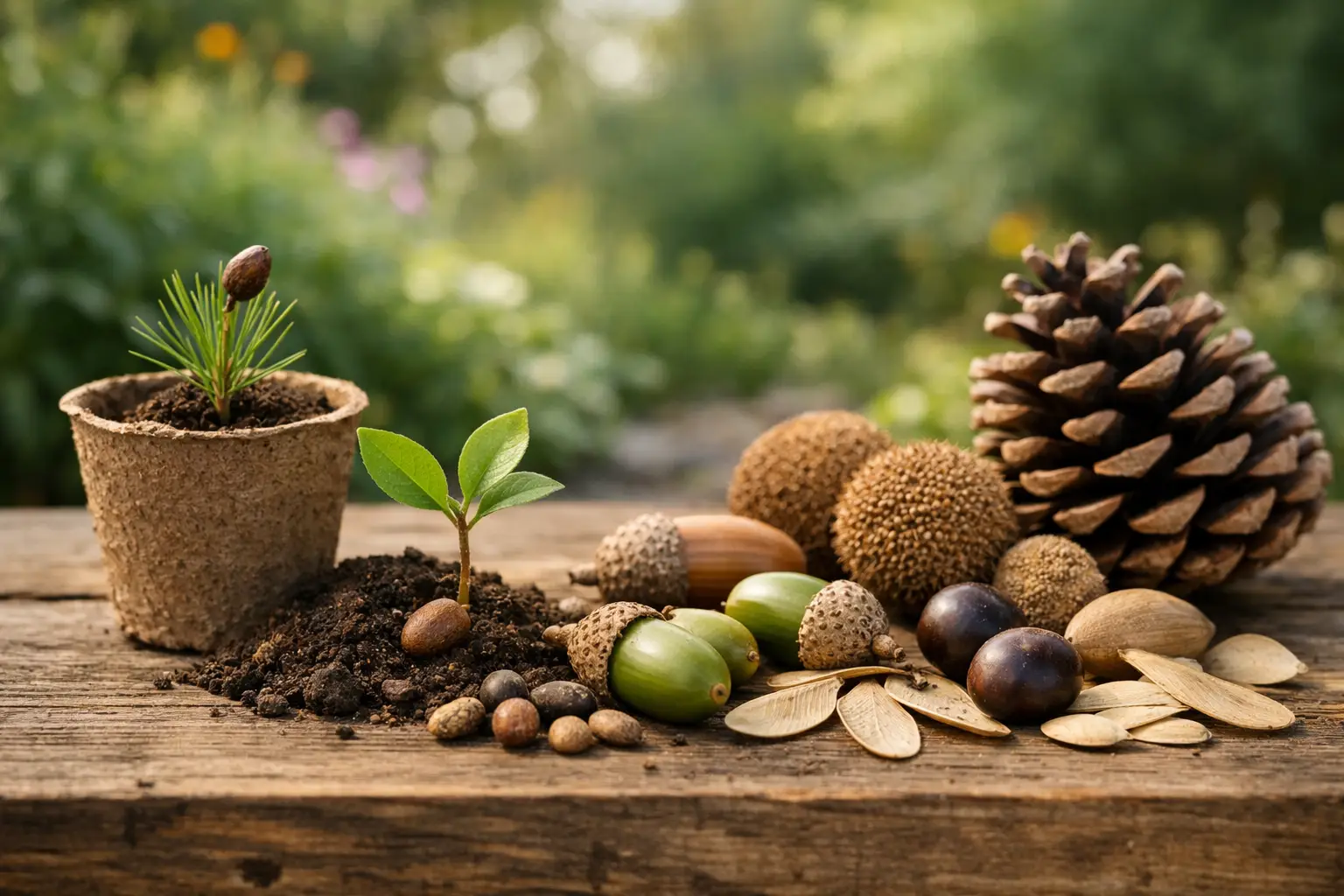
A packet of tree seeds can represent far more than a future shade tree. It may be the beginning of a fruiting specimen, an architectural focal point, a useful ethnobotanical plant, or a species rarely encountered beyond specialist collections. For growers willing to work at a tree’s pace, tree seeds offer access to plants that conventional garden-center inventories often overlook.
Growing trees from seed is not the fastest route to a finished landscape. It is, however, one of the most direct ways to build a garden or collection with botanical character. The process asks for observation, patience, and a realistic view of climate and space. In return, it allows the grower to understand a species from its first root onward.
A named cultivar purchased as a young plant offers predictability. It may fruit at a known age, remain within a planned size range, or carry a particular ornamental trait. Tree seeds offer something different: genetic variation, a longer relationship with the plant, and often access to species that are difficult to find as nursery stock.
That variation is not a flaw. Within a population of seedlings, subtle differences in leaf shape, vigor, branching, cold tolerance, fruit quality, and seasonal color can emerge. For collectors, small growers, and gardeners working toward a more diverse planting, this is part of the appeal. A seed-grown Schinus molle (Peruvian pepper) or Rhus typhina (staghorn sumac) develops as an individual specimen rather than as a repeated clone.
Seeds are also a practical choice for species that resent disturbance when older, are costly to ship at useful sizes, or are commonly cultivated in regions far from the buyer. The trade-off is clear: germination may be uneven, juvenile growth can be slow, and some species require several years before they reveal their full ornamental or edible value.
The most satisfying seed purchases begin with the intended role of the mature plant, not simply an attractive photograph. Ask where the tree will live, what function it will serve, and whether its natural requirements can be met consistently.
Hardiness zone is useful, but it is only a first filter. Winter wetness, summer humidity, heat accumulation, wind exposure, soil drainage, and the length of the growing season can matter just as much. A tree adapted to dry tropical conditions may survive in a protected greenhouse in a colder region, yet it will not become a carefree outdoor specimen there.
Cashew, Anacardium occidentale, is a good example. It is an intriguing edible tree with broad leaves, distinctive flowers, and an unmistakable fruiting habit, but it needs sustained warmth and freedom from frost. In most of the United States, it is a greenhouse or conservatory subject rather than a permanent garden tree. Marula, Sclerocarya birrea, similarly rewards growers able to provide heat, bright light, and excellent drainage.
Conversely, a temperate deciduous species may need winter cold to germinate properly and may struggle if it is kept warm year-round. Match the species to the conditions you can provide, rather than trying to force every rarity into the same setup.
A tree seed can look modest in a small pot while carrying considerable future dimensions. Research mature height and spread, root behavior, pruning tolerance, thorns or irritant sap, and any tendency to spread by seed or suckers. Staghorn sumac is valuable for its velvety branching, dramatic autumn display, and wildlife interest, but it can form colonies where conditions suit it. That is an asset on a large property and a concern in a compact, tightly managed border.
Purpose gives a collection coherence. You might choose edible subtropical trees for a heated glasshouse, drought-adapted ornamental species for a gravel garden, or deciduous trees selected for bark, silhouette, and fall color. Scientific names are especially helpful here. Common names shift between regions; Sclerocarya birrea identifies marula precisely, along with its botanical context in the Anacardiaceae family.
Not all seed packets behave alike. This is particularly true of trees, whose seeds may be protected by hard coats, enclosed in fleshy fruit, or programmed to wait through a season before germinating. Successful sowing begins with recognizing which kind of seed is in hand.
Some species produce orthodox seeds that tolerate drying and can remain viable in storage when kept cool and dry. Others are recalcitrant, meaning they lose viability if allowed to dry excessively or if stored too long. Many tropical and subtropical tree seeds belong to this second group. With these, freshness is not a minor detail. Prompt sowing can make the difference between a vigorous tray and a silent pot.
Hard-coated seeds may benefit from scarification, a controlled weakening of the outer coat so moisture can reach the embryo. Depending on the species, this may mean rubbing a small area with sandpaper, nicking the coat away from the embryo, or using a prescribed hot-water soak. The goal is not to expose or damage the embryo. It is simply to imitate the weathering, soil abrasion, or digestive processes that occur in nature.
Many temperate tree seeds need cold, moist stratification before they germinate. This period imitates winter and prevents seedlings from emerging just before unfavorable conditions. Seed is typically held in barely moist medium at refrigerator temperatures for a species-specific number of weeks or months, then sown when the dormancy requirement has been met.
Do not treat cold stratification as an optional extra when it is recommended for a species. A warm windowsill cannot substitute for it. Equally, avoid leaving seed in a wet medium without checking it. Excess moisture encourages decay, while a medium that dries completely interrupts the process. Inspect periodically and sow any seed that begins to show a root.
The first priority for young trees is a healthy root system. Use a clean, free-draining medium that holds enough moisture for germination without remaining saturated. Deep cells or narrow tree pots are often useful for species that form a strong taproot, as they reduce early root circling and give seedlings room to establish before transplanting.
Sow at a depth related to seed size. Fine seeds may be pressed onto the surface or covered only lightly, while large seeds generally need deeper placement. The practical principle is simple: a seed needs stable moisture and contact with the medium, but it also needs oxygen. Burying it too deeply can slow or prevent emergence.
Warmth should suit the species, not the grower’s impatience. Tropical seeds often germinate best with steady bottom heat, while many temperate species prefer moderate conditions once stratification is complete. Bright indirect light is usually sufficient until emergence, after which seedlings should be moved gradually into stronger light. Sudden exposure to intense sun can scorch foliage raised indoors or under cover.
Water carefully. A seedling medium should feel evenly moist rather than heavy and wet. Fungal losses are most common when cool conditions, stagnant air, and excessive watering occur together. Good air circulation, clean containers, and restraint with water are more effective than elaborate interventions.
Tree seedlings do not need to be pushed into rapid growth at every stage. Excess fertilizer can produce soft, elongated shoots that are poorly prepared for outdoor conditions. Once true leaves are established and active growth is underway, a light, balanced feeding program is usually enough. Adjust according to the species and the growing medium rather than following a fixed schedule.
Transplant when the root system has filled its container but before it becomes densely coiled. Handle the roots with care, particularly on species with a central taproot or limited tolerance for disturbance. For trees destined for the ground, gradual hardening off is essential. Introduce outdoor light, wind, and temperature variation over a period of days or weeks rather than moving a protected seedling directly into full exposure.
The first winter deserves planning. A hardy seedling planted late in the season may need shelter from drying wind, browsing animals, and repeated freeze-thaw cycles. Tender trees need a bright, frost-free space, with watering reduced enough to prevent weak winter growth but never withheld to the point of root loss.
A well-labeled seedling remains valuable long after its packet is discarded. Record the full scientific name, seed source, date sown, treatments used, germination date, and notable observations. If several seedlings are grown, assign each an individual number. This is especially useful when selecting the strongest plants or comparing performance across different conditions.
Photographs taken at intervals can reveal growth patterns that memory misses. Over time, these records transform a group of plants into a living botanical collection with provenance and context. They also make future choices more informed: which seeds germinated promptly, which needed deeper pots, and which species genuinely suited your climate.
The best tree seeds are not necessarily the quickest to germinate or the easiest to explain. Choose species whose mature form belongs in your space, give each seed the conditions its biology asks for, and allow time to do its quiet work. A tree raised with that attention becomes more than an acquisition. It becomes a record of cultivation, place, and patience.