
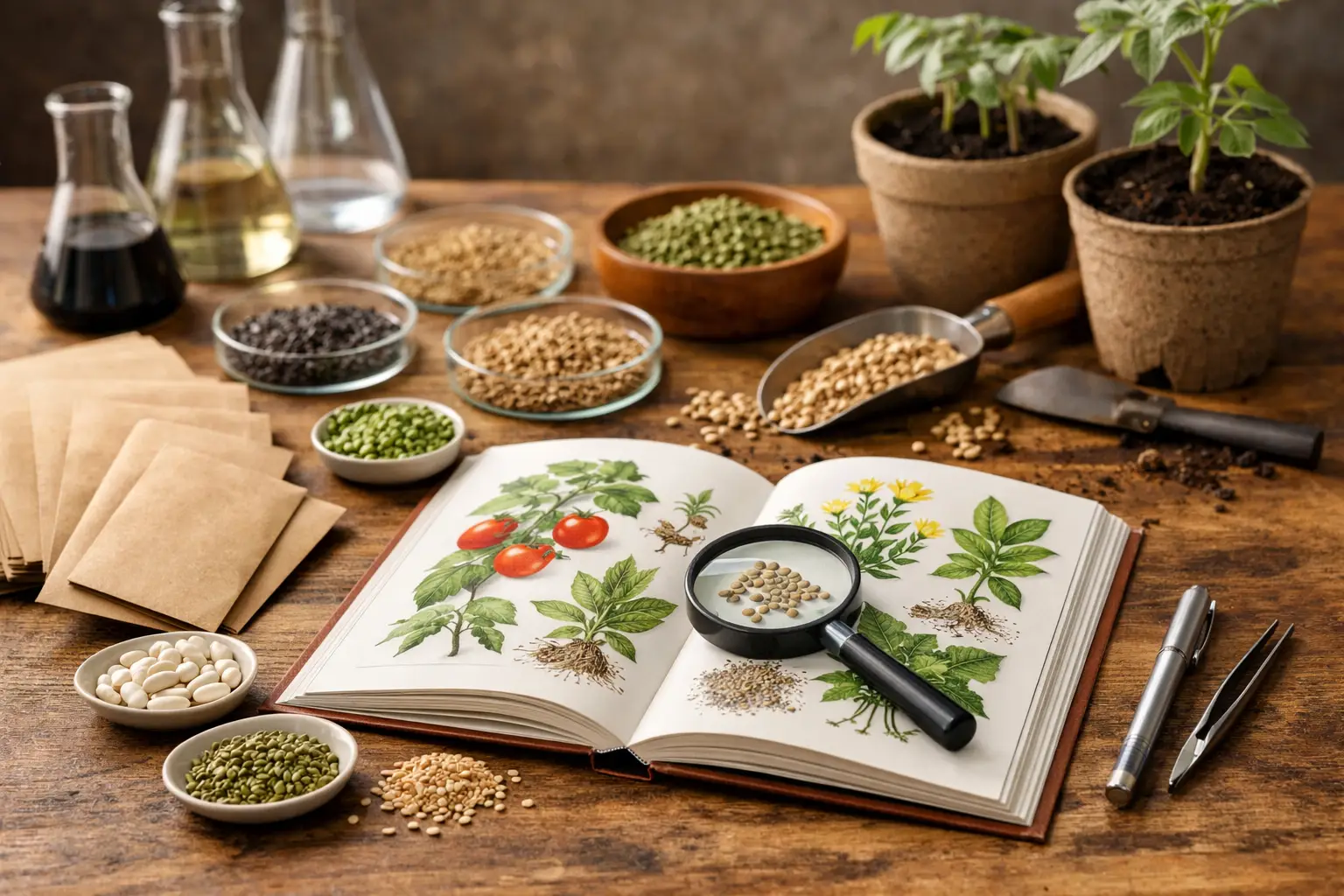
A seed packet labeled only “pepper tree” can lead to several very different plants. A scientific name seed catalog narrows that uncertainty at the beginning, where it matters most. It allows a grower to select a living species with intention: for a medicinal garden, a food forest, a conservatory collection, or the particular visual character of a specimen tree.
For collectors and serious home growers, botanical naming is not a layer of formality placed over ordinary shopping. It is the practical language that connects a seed to its identity, family, native range, likely growth habit, and cultivation questions. A catalog organized around species names makes room for plants that do not fit the usual garden-center categories.
A scientific name has two principal parts: the genus and the species epithet. In Valeriana officinalis, for example, Valeriana identifies the genus and officinalis identifies a particular species within it. This is more precise than a common name such as valerian, which may be used casually for related or entirely different plants depending on region and seller.
That precision becomes especially useful in a selective seed collection. Consider plants sometimes called pepper trees. Peruvian pepper, Schinus molle, is a weeping, aromatic tree in the cashew family, Anacardiaceae. It is not a culinary black pepper plant, which belongs to an entirely different genus. The common name is evocative, but the botanical name tells the grower what they are truly considering.
Scientific naming also keeps a catalog legible across borders. Common names shift among North America, Europe, and Asia, and can vary even within a single country. A species name gives growers a stable reference point for comparing climate tolerance, mature size, propagation information, and local planting restrictions. It does not remove every question, but it makes research considerably more reliable.
Names can change as botanical research develops. A well-curated catalog should treat taxonomy as a working scientific framework rather than a decorative label. If a plant has a recognized synonym, knowing that history can help a grower locate older references, seed-starting reports, and herbarium records without mistaking one accepted species for another.
The species name is the starting point, not the entire cultivation plan. Seeds remain living material, shaped by harvest timing, storage, dormancy, genetics, and the conditions in which they will be raised. A thoughtfully presented listing helps you read a species in context before you decide whether it belongs in your garden or greenhouse.
Begin with the plant’s natural character. Is it a herbaceous perennial such as Valeriana officinalis, a warm-climate tree such as cashew, Anacardium occidentale, or a drought-adapted ornamental with a wide eventual canopy? The same packet size may represent a modest border plant, a long-term container subject, or a tree that deserves years of planning and space.
Then consider the family. Family relationships are useful clues, though never a substitute for species-level instructions. Anacardiaceae includes cashew, marula, Sclerocarya birrea, staghorn sumac, Rhus typhina, and Peruvian pepper. These plants have very different appearances and climatic preferences, yet their relationship can prompt useful questions about fruiting, resin, sensitivity, and regional adaptation. The family category is a way to browse intelligently, especially when building a collection around a botanical theme.
Origin is equally revealing. Native range may suggest a species’ relationship to heat, seasonal rainfall, frost, humidity, or day length. It should not be reduced to a promise that the plant will perform identically in a new location. A marula seed may be fascinating material for a warm greenhouse collection, but it is not a casual choice for an exposed, frost-prone landscape. The right plant is not always the rarest one. It is the one whose requirements you can meet with care.
A good catalog encourages this distinction. It presents unusual material clearly enough for growers to recognize both the opportunity and the commitment. Rare seed is most rewarding when it is chosen for a real purpose, rather than acquired only because it is difficult to find.
Common names are useful entry points. They carry cultural memory, culinary associations, and a quick sense of a plant’s appearance or use. A search for staghorn sumac is reasonable; its branching winter silhouette is easy to remember, while Rhus typhina may not yet be.
The strongest approach is to use both names together. Search with the familiar name, then confirm the botanical identity before sowing or ordering. This is particularly valuable for medicinal and edible plants, where similar common names can conceal significant differences in use, plant parts, or safety considerations. A catalog that leads with the scientific name and retains a clear common name gives both accuracy and accessibility.
A scientific name seed catalog supports a more deliberate kind of browsing. Instead of beginning with a broad label such as “exotic plants,” begin with the role you want a plant to play. You may be seeking an aromatic medicinal perennial, a distinctive deciduous specimen, an edible tropical tree for protected cultivation, or a plant with ethnobotanical interest.
For a medicinal planting, species identity is essential. The name Valeriana officinalis distinguishes the traditional medicinal species from other plants sold under the broad valerian label. Even then, responsible cultivation means consulting reputable, species-specific sources for preparation and use. Growing a plant and using it medicinally are related but separate decisions.
For edible trees, maturity and climate deserve equal weight with novelty. Cashew is botanically compelling, but a grower should account for sustained warmth, light, root space, and the fact that the raw cashew shell contains irritating compounds. Seeds are an invitation to cultivate, not an assurance that every species is suitable for every household or landscape.
For ornamental collections, botanical identity protects the long view. Rhus typhina may offer dramatic foliage, architectural branching, and seasonal fruit clusters, but it can spread by suckers in favorable sites. A garden with room for a naturalized colony may welcome that trait; a tightly controlled border may not. Knowing the species lets you assess those trade-offs before the first seed is started.
The most useful catalog is paired with the right questions. Before ordering, establish whether your intended setting is outdoors, under protection, or in containers. Then consider your climate, available light, winter minimum temperatures, and the space the mature plant will need, not merely the space its seedling occupies.
Ask about seed behavior as well. Some species germinate readily when warmth and moisture are consistent. Others benefit from cold stratification, scarification, soaking, smoke treatment, or patience through uneven germination. Freshness can be especially consequential for certain tropical and recalcitrant seeds, while other species remain viable for longer under appropriate storage. Species-specific guidance is worth seeking because a generic seed-starting method can be inadequate for unusual material.
It is also sensible to check local rules before introducing a plant. A species may be welcome in one region and restricted, invasive, or unsuitable in another. This is not a reason to avoid distinctive plants altogether. It is part of treating them with the seriousness they deserve.
At Quinta dos Ouriques, species-level organization reflects a simple premise: a seed is more meaningful when its botanical identity is clear. The catalog becomes a place to compare plants by family, habit, purpose, and possibility, rather than a stream of loosely named curiosities.
The best seed choice often begins with a name you cannot yet pronounce confidently. Keep it on the label, learn the plant behind it, and let the species guide the space, patience, and care you give it. That is how a small packet becomes a considered addition to a living collection.