
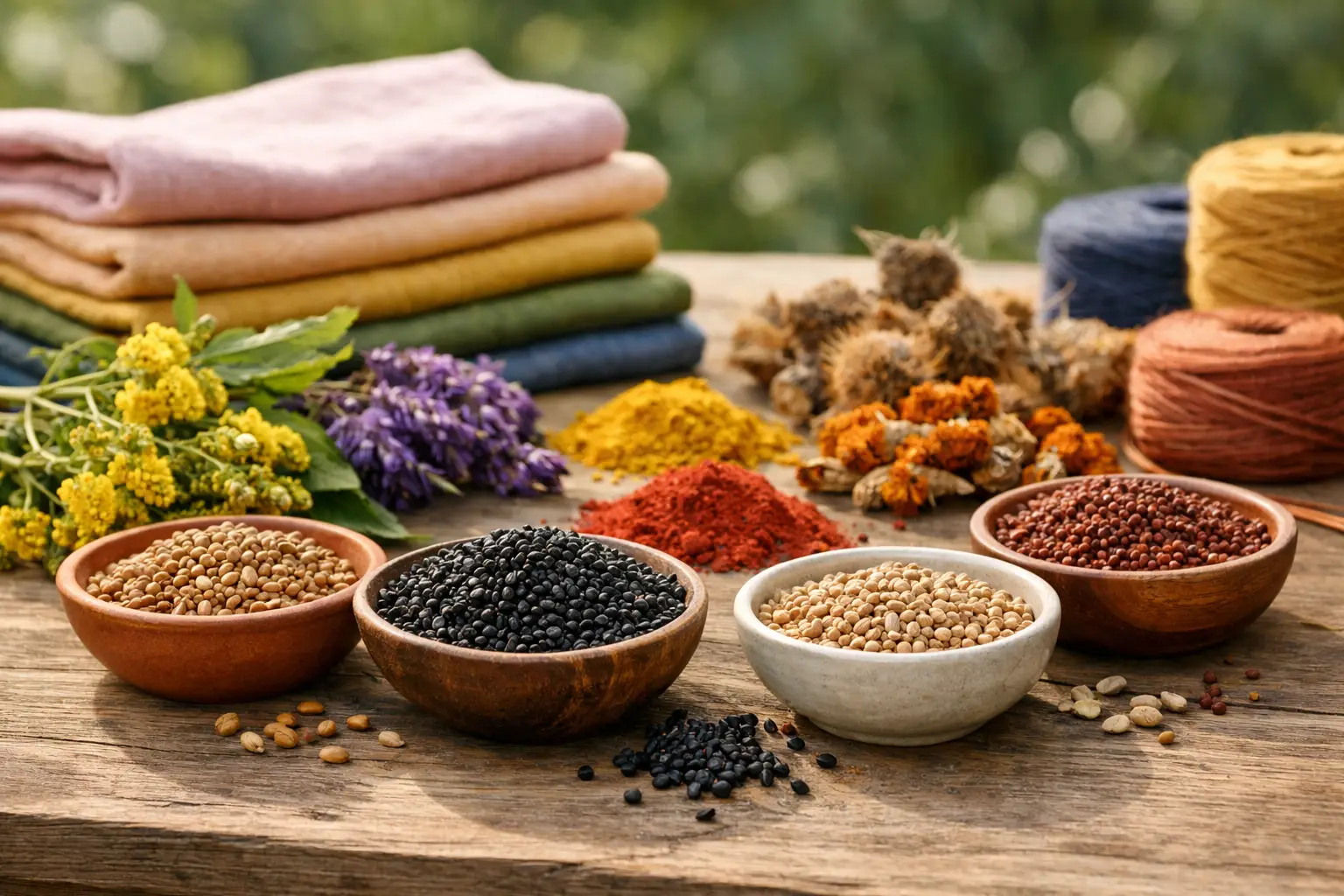
A dye garden begins long before fabric meets a vat. Natural dye plant seeds allow the grower to choose the source of color with the same care used to select a rare fruit tree, medicinal herb, or specimen ornamental. The result is not merely a supply of petals or leaves, but a living collection shaped by season, soil, climate, and the particular character of each species.
For collectors and serious home growers, dye plants are especially compelling because their value extends beyond pigment. Some carry a long ethnobotanical history. Others bring pollinators, useful architecture, or quiet beauty to a border. A well-chosen planting can produce color for fiber while earning its place in the garden on botanical merit alone.
The first useful question is not which color you want, but which plant part you are prepared to harvest. Dye plants differ greatly in the time, space, and disturbance they require. A flower crop can be gathered repeatedly through summer; a root crop asks the grower to wait, then lift a mature plant. Leaves may be abundant, but often need processing quickly for their freshest color.
Coreopsis tinctoria, commonly called dyer’s coreopsis, is an accessible annual for golden, rust, and warm brown tones. Its small bicolor flowers are generous over a long season, and regular picking encourages further bloom. It suits growers who want a productive cutting-style planting without sacrificing ornamental effect.
Tagetes species, especially forms related to Tagetes erecta and Tagetes patula, offer yellow through orange pigment from their flower heads. Marigolds are familiar plants, but that should not make them an automatic choice. Select for flower production and vigor rather than treating every ornamental cultivar as equally useful for dye work. Their compact habit makes them practical where space is limited.
For leaf color, Japanese indigo, now commonly listed as Persicaria tinctoria, is among the defining species of the dye garden. Fresh leaves can yield blue through a process that rewards attentive timing and clean handling. It is an annual in many temperate gardens, which makes it a satisfying seasonal project, though a meaningful harvest requires more plants than a single specimen.
Root dyes ask for more patience. Rubia tinctorum, madder, is a perennial species valued for reds, corals, and earthy orange-reds obtained from mature roots. It has attractive whorled foliage and a spreading habit, but the strongest root yield comes only after years in the ground. Plant it where it can remain undisturbed, and where its underground growth can be managed deliberately.
A dye collection becomes more interesting when it is not limited to the most familiar annuals. Several species deserve consideration for their pigment history as well as their horticultural presence.
Isatis tinctoria, woad, has a well-known European dye tradition. Its first-year leaves are the productive part, while its second-year flowering stems can rise dramatically and set seed freely. Woad is an excellent plant for growers who appreciate biennials and historical dye plants, but it requires judgment. It may be invasive or restricted in some regions, so local regulations and responsible seed handling should guide any decision to grow it.
Reseda luteola, weld, is another historically significant yellow dye plant. The flowering stems are generally harvested as they develop, and established plants bring a modest, airy vertical quality to the garden. Weld is often more valuable to the dedicated dyer than to the ornamental gardener, yet its subtle habit can suit a naturalistic planting where taller plants are welcome.
Carthamus tinctorius, safflower, produces yellow, orange, and red-toned dye material from its florets, depending on extraction and treatment. It is also an ancient oil and food plant, which gives it broader ethnobotanical interest. Its thistle-like form and prickly foliage are part of the bargain. Give it sun, drainage, and enough distance from paths that harvesting remains pleasant.
Anthemis tinctoria, golden marguerite or dyer’s chamomile, is useful for luminous yellows and can persist as a short-lived perennial in suitable conditions. Its finely divided foliage and daisy flowers provide a more polished border presence than many utilitarian dye crops. For a garden designed to be viewed as much as harvested, this distinction matters.
The color named on a plant description should be treated as a starting point, not a promise. Soil conditions, plant maturity, fiber type, water chemistry, extraction method, and mordant choice all affect the final cloth. A single species may produce a range that moves from clear yellow to olive, tan, bronze, or greenish gold. That variability is not a defect. It is one of the reasons a home-grown palette remains more compelling than a packet of standardized color.
A handsome dye bed can still be impractical if every crop reaches harvest at once. Arrange the planting around how you intend to work. Annual flowers such as Coreopsis tinctoria and marigolds offer repeated, small harvests. Japanese indigo may call for a larger session while foliage is at its best. Madder represents a longer commitment and a more disruptive harvest.
Give dye plants their own records from the first season. Label plants with both the common and scientific name, the seed source, sowing date, and any observations about vigor or flowering. When you later test a dye bath, record the harvested plant part, whether the material was fresh or dried, the fiber used, and the mordant. These notes turn a casual experiment into a collection with accumulated value.
Drying is useful for many flower dyes, particularly when the garden produces more than can be processed immediately. Spread clean material in a shaded, well-ventilated place and store it only when fully dry. Leaves used for fresh indigo work are different: their chemistry changes quickly, so harvest and process them according to the method you have chosen. The most suitable approach depends on whether you are pursuing fresh-leaf color, composted pigment, or another traditional preparation.
Natural color does not mean every ingredient is harmless, nor does it mean every method is casual. Some mordants used in textile dyeing require careful measurement, storage, and disposal. Start with small test skeins, use dedicated equipment for nonfood dye work, and follow the safety guidance for each material. The garden itself is only one part of the process.
Fiber matters just as much. Protein fibers such as wool and silk often accept plant color differently from cotton, linen, and other cellulose fibers. Before committing a season’s harvest to a large piece of fabric, test a small, properly prepared sample. This is particularly wise with pale yellow dyes, whose apparent brightness can shift substantially after washing or exposure to light.
It is also worth distinguishing between a plant that can make color and one that makes durable color. Some botanical materials produce an immediate, beautiful stain but fade quickly. Others offer better washfastness or lightfastness when harvested at the right stage and used with an appropriate mordant. A serious dye garden is therefore less about collecting every possible pigment plant and more about learning a few species deeply.
Natural dye plants reward a collector’s eye. Their value lies in the relationships between species: flower against root, annual abundance against perennial patience, historical European dye crops beside Asian indigo traditions, and practical pigment beside ornamental presence. A small planting of Persicaria tinctoria, Coreopsis tinctoria, Anthemis tinctoria, and Rubia tinctorum can already create a study in contrasting habits and harvests.
Choose seed with your growing conditions in mind. A compact sunny plot may favor annual flowers and Japanese indigo. A larger garden with a permanent edge can accommodate madder or weld. In a climate with short summers, fast-growing annuals may offer more reliable results than plants that need multiple seasons to establish. The most purposeful collection is not necessarily the largest one. It is the one you can tend, harvest, document, and enjoy.
Begin with one or two species whose cultivation genuinely suits your space, then let the palette develop through observation. The most memorable color often comes from a plant you have watched from seed to harvest.