
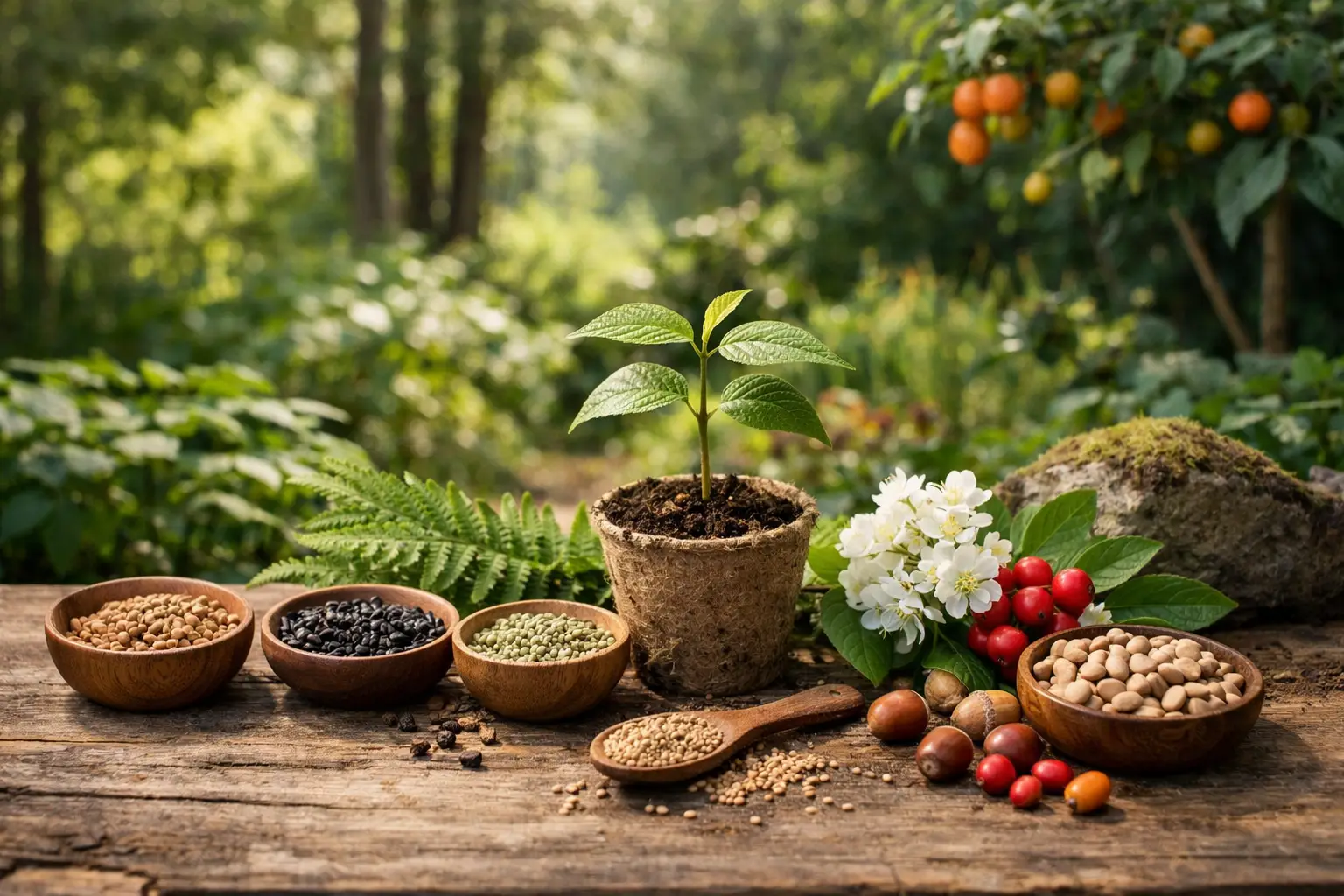
A forest garden is not assembled like a vegetable bed. Its character emerges over years as canopy, shade, leaf litter, roots, and moisture patterns begin to influence one another. Choosing seeds for forest gardens therefore means selecting for relationships as much as for individual plants: a tree that will make light shade, a shrub that fruits at the edge, a perennial that occupies the cool ground beneath it, and a climber that has somewhere appropriate to rise.
For the serious grower, seed offers an unusually rewarding way to establish this kind of planting. It allows room for genetic variation, patient observation, and species that rarely appear in standard nursery inventories. But it also asks for restraint. A beautiful species in isolation is not automatically a suitable forest-garden species, particularly when its mature size, winter hardiness, or behavior beyond cultivation has not been considered.
The most useful seed list begins with a clear reading of place. Observe the site through a full season if possible. Where does winter water settle? Which areas remain exposed to drying wind? What is the existing soil texture, and how quickly does it warm in spring? In a young garden, full sun may dominate for several years. In a mature planting, the same ground may become a dry, root-competitive understory.
Climate is the first firm filter. A species adapted to subtropical heat may be a fascinating greenhouse or conservatory subject in a northern climate, but it cannot serve as the structural canopy of an outdoor forest garden there. Conversely, a hardy temperate tree may thrive outside while a tender edible or aromatic companion belongs in a protected microclimate. Treat hardiness information as a starting point, then account for summer heat, humidity, rainfall pattern, and frost timing.
Native and well-established regional plants deserve particular attention. They are often better matched to local insects, birds, and seasonal conditions than newly introduced species. This does not rule out botanical collecting. It does mean that every non-native addition should be evaluated for mature spread, seed production, and local invasive potential before it is invited into a long-lived planting.
The familiar forest-garden model is useful because it prevents a collection from becoming a crowded assortment of interesting plants. Each layer has a different function, and the boundaries between them should remain flexible. A multi-stemmed shrub can act as a low canopy; a vigorous perennial can become a groundcover only where conditions suit it.
Woody structure determines much of the garden’s future. Seed-grown trees can be especially worthwhile when you want a durable, genetically varied population rather than identical grafted cultivars. However, they require the longest horizon. Ask how tall and broad the tree will be in twenty years, not simply whether it fits a seed tray today.
Choose trees for more than harvest. Consider flowering period, autumn leaf drop, root competition, shade density, and whether the crown can be pruned safely. Trees with open, manageable canopies often permit a broader understory than species that cast dense, persistent shade. Unusual edible trees can be compelling collection plants, but only if their climatic needs align with the site or with a permanent protected growing space.
Shrubs frequently provide the most immediate return in a forest garden. They define sunny margins, soften transitions, offer fruit or habitat, and can shelter slower-growing trees during establishment. Their placement matters. A shrub that is modest in a cool climate may grow much more strongly in a warm, fertile site.
The edge is often the garden’s most diverse zone because it receives light while benefiting from the shelter and moisture of nearby woody plants. This is where thorny fruiting shrubs, aromatic species, and ornamental seed-grown specimens may earn their place. Avoid planting every shrub at identical spacing. Some need air and sunlight to fruit well; others can be used as a loose, layered screen.
The herbaceous layer is where a forest garden becomes botanically rich rather than merely woody. Perennial medicinal, culinary, and dye plants can fill seasonal gaps, support pollinators, and make use of filtered light. Yet shade tolerance is often overstated in seed descriptions. A plant that survives shade may not flower, set seed, or develop the vigor expected in dappled sun.
Valeriana officinalis, for example, is valued for its medicinal history and elegant pale flowers, but it is best treated as a moisture-loving perennial for fertile soil and a bright woodland edge rather than a plant for dry, deep shade. Such distinctions matter. Place species according to their natural preference, not according to a broad label such as “woodland plant.”
Include plants with staggered growth rhythms. Early spring perennials can use light before deciduous trees leaf out, while summer-active species must tolerate the conditions that follow. A forest garden becomes more stable when no single season carries all of its productivity.
Groundcover is not simply empty-space insurance. It moderates soil temperature, reduces erosion, provides living mulch, and can suppress unwanted annual weeds while trees are young. Seed-grown ground-layer plants take time to knit together, so use them in colonies rather than scattering one or two plants across a large area.
Bulbs and short-lived spring ephemerals can occupy the brief, bright interval beneath deciduous trees. Climbers add another dimension, but they are the layer most likely to overwhelm a small system. Reserve vigorous vines for strong supports, established trees that can tolerate them, or dedicated structures. Never assume that a climber will remain decorative because it is young.
A forest garden is a changing sequence of conditions. In the first years, sunlight is abundant and competition is low. Later, roots thicken, shade deepens, and the soil is increasingly covered. The best seed choices acknowledge that movement.
Begin with framework plants and a modest number of companion species. Fast-growing nurse shrubs or short-lived pioneers can provide wind protection and organic matter, but they need a planned exit. If a temporary species is allowed to seed freely or shade every slower plant, it stops serving the design.
Sow or raise understory plants while young trees still allow sufficient light. This is also the period to learn which species genuinely suit the soil. A few test groups, carefully labeled and observed, are more revealing than a large mixed sowing whose failures cannot be traced. Botanical names are indispensable here. They distinguish plants with similar common names and make it easier to record germination, vigor, and provenance accurately.
Many woody and perennial species do not behave like quick annual vegetables. Some require cold, moist stratification; others germinate unevenly over many months. A delayed emergence is not always a failure. It may be the seed’s natural timing mechanism.
Keep each taxon separate at first. Label with the scientific name, sowing date, source, treatment, and any notes on germination. This disciplined approach is especially valuable when working with uncommon material. It preserves the identity of a collection and prevents accidental substitutions when several seedlings look alike.
Direct sowing can work well for species that resent root disturbance or need natural winter exposure. Container sowing offers more control over moisture, predation, and identification. The better method depends on the seed and the site. Large, recalcitrant seeds that cannot tolerate drying should be handled promptly, while dormant temperate seeds may benefit from a deliberately managed cold period.
A purposeful forest garden can still be visually distinctive. Textural foliage, unusual fruit, fragrant flowers, and seasonal bark add pleasure to a system built around food or habitat. The difference is that beauty is considered alongside ecology. A striking specimen should not block access, create permanent shade over sun-demanding crops, or outcompete every smaller plant nearby.
Useful functions to distribute across the planting include nectar and pollen, edible yield, mulch material, mineral cycling, shelter, and seasonal interest. No individual plant needs to perform all of them. In fact, forcing every choice to be maximally useful can produce a narrow, repetitive garden. A few carefully placed ornamental or ethnobotanical species can make the collection more personal and invite closer attention to the garden over time.
The most satisfying forest gardens are not finished when the last seed is sown. Leave openings for later discoveries, keep records of what proves durable, and allow each successful species to reveal where it belongs. Patient selection turns a packet of seed into a living botanical library, shaped by your climate, your observations, and the years ahead.