
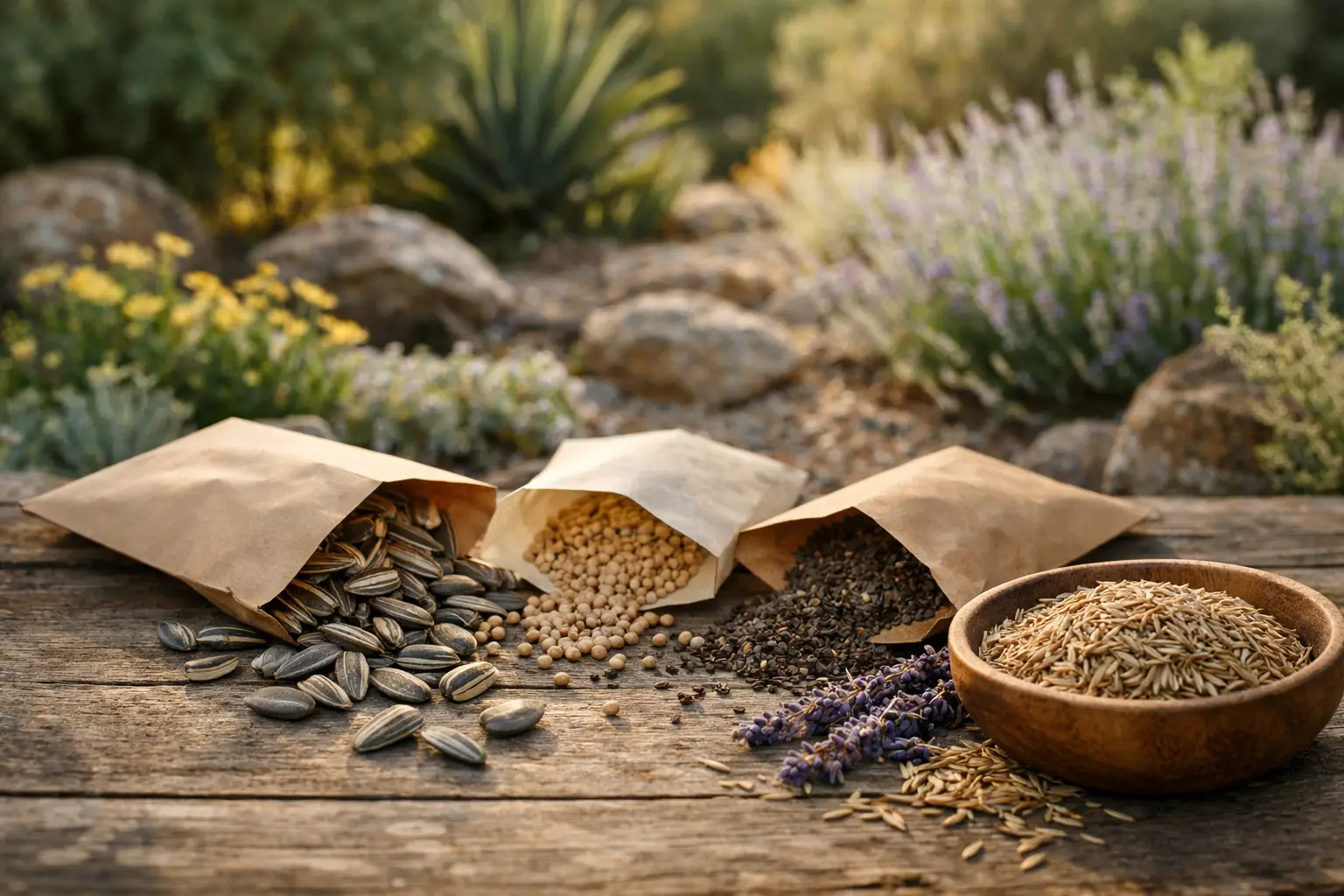
A dry garden is not simply a garden that receives less water. It is a planting shaped by heat, drainage, wind, seasonal rainfall, and the patience to let roots do their work. The best seeds for dry gardens are chosen for that full set of conditions, rather than for a vague promise of drought tolerance on a packet.
For collectors and purposeful growers, this is an opportunity to plant with greater botanical precision. Dry conditions favor plants with character: silver foliage, aromatic oils, deep or spreading root systems, tough bark, small leaves, and a growth rhythm tied to seasonal moisture. They also demand restraint. A seedling from a dry-climate species can fail quickly if it is placed in rich, constantly irrigated soil that never allows its roots to adapt.
“Dry” describes several very different gardens. A Mediterranean-style site may have cool, wet winters and long rainless summers. A high-desert garden can have intense sun, cold winters, and thin mineral soil. A coastal sandy garden may drain rapidly but remain humid. In the American Southwest, heat and reflected light can be as limiting as the lack of rain.
Seed selection begins with these distinctions. Consider when rainfall arrives, how quickly water leaves the soil, the lowest winter temperature, and whether irrigation is available during a seedling’s first season. A plant adapted to a summer-dry climate may resent humid summer rain. A warm-climate tree may tolerate drought beautifully but have no tolerance for frost.
Soil texture matters as much as annual precipitation. Heavy clay can hold enough water to rot the roots of plants evolved for rocky slopes, even in a region with modest rainfall. Sandy soil presents the opposite problem: newly germinated seedlings can dry out before their roots reach a stable moisture zone. Neither condition is inherently unsuitable, but each calls for different species and establishment practices.
Plants do not all conserve water in the same way. Some develop a deep taproot, some create dense fibrous root systems near the surface, and others slow their growth through the hottest part of the year. Looking beyond the phrase “drought tolerant” helps a grower build a more durable collection.
Species from aromatic shrublands are often useful candidates. Their foliage may contain essential oils, a trait frequently associated with reduced water loss and protection from sun. Plants with narrow, gray, hairy, leathery, or divided leaves also deserve attention, although foliage alone is not a guarantee of drought adaptation.
Woody species offer another useful category, especially for gardens intended to mature over years rather than seasons. Once established, a well-sited dryland tree or shrub can shade the soil, shelter smaller plants, and create a more layered planting. This is where botanical identity matters. A seed collection may include unusual trees with compelling ethnobotanical value, but their usefulness depends on climate rather than novelty alone.
For example, Schinus molle, Peruvian pepper, is adapted to warmth, sun, and periods of dryness once established. Its finely textured foliage and broad habit can be striking in frost-free or very mild settings. It is not, however, a universal dry-garden tree. It can be invasive in some regions, can become large, and is poorly suited to gardens with hard freezes. A distinctive species always deserves a local suitability check.
Likewise, marula, Sclerocarya birrea, and cashew, Anacardium occidentale, belong to warm-climate cultivation. Both have considerable interest as edible or ethnobotanical trees, and both may suit dry-season tropical or subtropical conditions. Neither should be treated as an answer to drought in a temperate American garden. Dry tolerance does not replace cold hardiness.
A purposeful seed collection includes plants grown for medicine, food, fragrance, or historical interest. Yet those purposes do not automatically indicate the right garden position. Valeriana officinalis, for instance, is a valued medicinal species, but it generally prefers consistently moist ground and cooler conditions. It belongs near a water source or in moisture-retentive soil, not in the driest exposed bed.
This distinction prevents a common mistake: building a garden around desirable plant names rather than matching each species to its preferred ecology. A varied collection can still include moisture-loving plants, but they should occupy their own conditions.
Many drought-adapted plants need more moisture while germinating than they will need as mature specimens. This apparent contradiction catches growers who try to start dryland seeds in a dry bed and wait for nature to manage the process.
Begin seeds in a clean, free-draining medium and maintain even moisture until germination. The medium should be damp, not saturated. Once seedlings have formed a healthy root system, gradually increase light, airflow, and intervals between watering. The goal is not to stress young plants for the sake of toughness. It is to encourage roots to explore rather than remain dependent on frequent surface moisture.
Direct sowing can be excellent when a species naturally establishes after seasonal rain and the site can be protected from weeds, birds, and drying wind. It is less reliable for valuable or slow-growing seed, particularly where spring weather shifts quickly from cool and wet to hot and dry. Starting a small number of plants under controlled conditions often gives rare seed a better chance, then allows the strongest seedlings to be placed deliberately.
Avoid overfeeding. Fast, soft growth produced by high-nitrogen fertilizer is rarely an advantage in a water-wise planting. Mineral soils amended with modest organic matter are often preferable to deeply enriched beds, especially for species from rocky or low-fertility habitats. The exact balance depends on the plant, but dry gardens usually reward moderation.
A dry garden becomes more resilient when it is designed as a community rather than a collection of isolated specimens. Young trees and shrubs may need supplemental water for one or more growing seasons, but their eventual canopy can reduce soil temperatures and protect lower-growing plants from afternoon sun. Deep-rooted woody plants, low mounding perennials, and self-sowing annuals can occupy different layers without competing in exactly the same way.
Place the most drought-adapted species in the hottest, fastest-draining locations. Reserve pockets with deeper soil or slight runoff for plants that appreciate more moisture. A gentle swale, the lower edge of a slope, or a place that receives runoff from a roof can support a different palette than an exposed gravel berm. This is not excessive intervention. It is an attentive use of the conditions already present.
Mulch also requires judgment. A light mineral mulch of gravel or grit can suit plants that need air around their crowns and benefit from reflected warmth. Organic mulch lowers evaporation and improves soil over time, but a heavy, wet layer held against the base of drought-adapted shrubs can encourage rot. In humid climates, airflow may matter more than adding another layer of mulch.
A dry garden can be rich in texture, scent, seed heads, bark, and seasonal change, but it may not provide the continuous lushness associated with heavily irrigated borders. Some species remain dormant during heat or grow slowly while they establish. Others will look their best only during a particular season. These are not defects. They are signs that the planting is responding to its climate rather than being forced to ignore it.
There is also a difference between reducing irrigation and withholding water indiscriminately. Newly planted seedlings, container-grown trees, and plants facing their first extreme summer need observation. Deep, infrequent watering encourages deeper rooting; shallow daily watering often keeps roots near the surface. But during exceptional heat, a young plant may need support regardless of its mature drought reputation.
Rare seed is most rewarding when its biology is allowed to guide the decision. Seek species whose native habitat, hardiness range, eventual size, and seasonal rhythm resemble the conditions you can offer. Study the scientific name, family, and origin, then give each plant a position that respects those details.
The most memorable dry gardens are not built from plants that merely survive neglect. They are assembled from species that look increasingly at home as the years pass, their roots finding the depth, texture, and rhythm of the ground beneath them.