
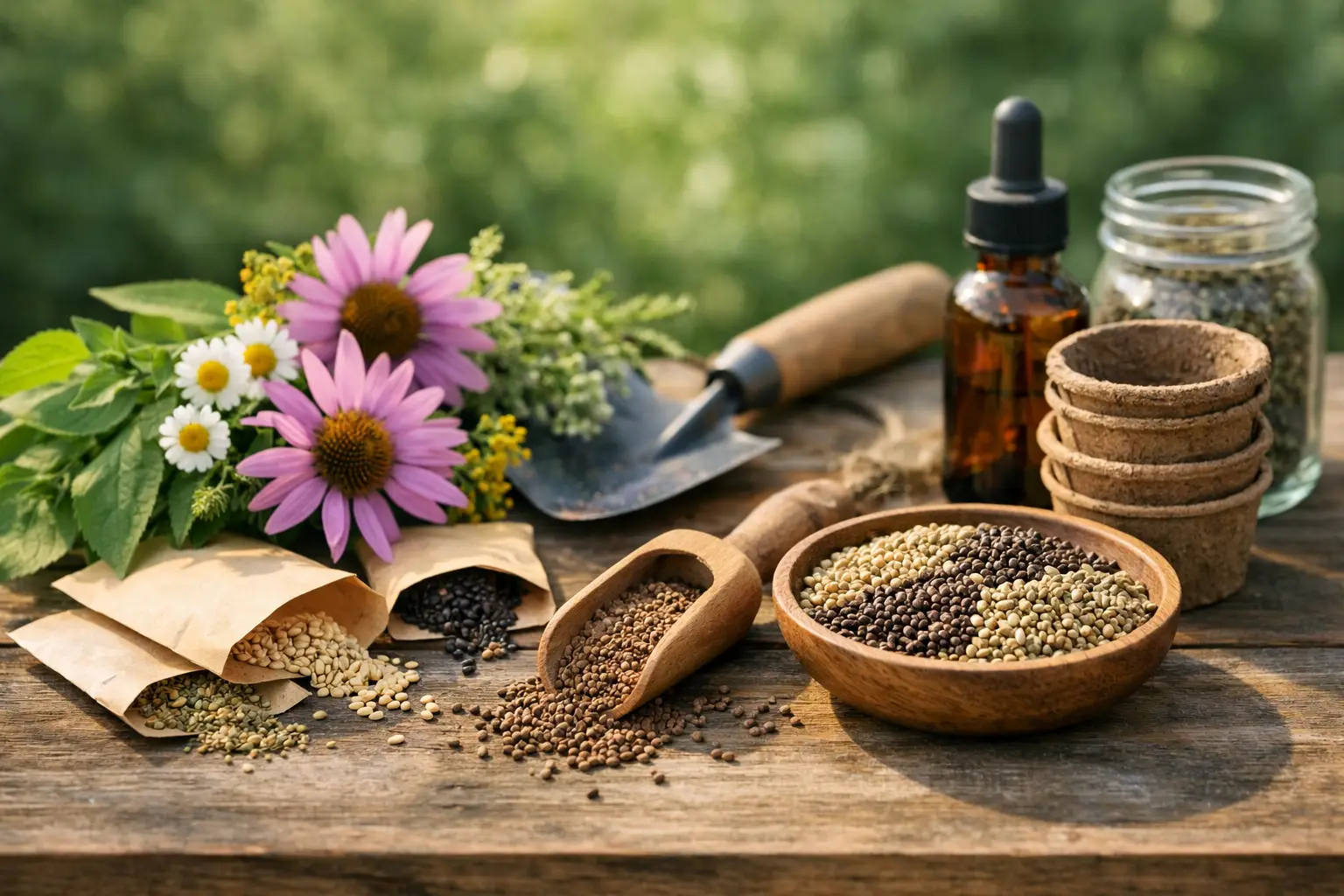
A packet of medicinal plant seeds can represent far more than a future border planting. It may be the beginning of a working herb garden, a carefully documented ethnobotanical collection, or a long-term relationship with a species whose value lies in its roots, leaves, flowers, or cultural history. For the serious home grower, the appeal is not simply utility. It is the opportunity to cultivate a plant with a known identity, a distinct life cycle, and a meaningful place in botanical tradition.
The best medicinal gardens are not assembled from vague labels or broad promises. They begin with species-level choices, realistic growing conditions, and respect for the difference between growing a plant and using it as a remedy.
“Medicinal” is a useful category, but it is not a botanical one. Plants associated with traditional herbal practice occur across many families, growth habits, and climates. Some are compact annuals suited to a sunny raised bed. Others are deep-rooted perennials, moisture-loving meadow plants, or shrubs that need years to become substantial specimens.
That variation is precisely what makes this category rewarding for collectors. Valeriana officinalis belongs to the Caprifoliaceae family and develops as a tall, herbaceous perennial with fragrant flowering stems. Althaea officinalis, marshmallow, is a member of Malvaceae, valued historically for its mucilaginous root and best appreciated as a handsome, soft-leaved garden plant in its own right. Chamomile species, meanwhile, offer a completely different scale and seasonality.
A considered selection starts with the plant itself, rather than a presumed outcome. Look at its native or adapted range, mature size, hardiness, moisture preference, and the part traditionally associated with use. A species grown for roots asks something different of the gardener than one harvested for flower heads or foliage. A perennial intended to remain in place deserves a permanent, well-prepared position rather than a spare corner of the vegetable plot.
The most suitable species is rarely the one with the most familiar common name. It is the one that can live well in your conditions.
Before sowing, consider light, drainage, summer heat, winter cold, and the time you can give to establishment. Many traditional European herbs prefer full sun and reasonably open soil, but that does not mean all medicinal plants thrive in dry, exposed beds. Marshmallow tolerates more consistent moisture than Mediterranean herbs. Valerian often performs well in fertile soil that does not bake dry through summer.
In hot climates, an herb described as full sun may benefit from afternoon protection. In regions with humid summers, spacing and air movement can matter as much as sun exposure. A plant that is perennial in a mild coastal garden may be treated as an annual or overwintered under protection in a colder location. Seed packets cannot replace local observation.
Common names can conceal meaningful differences. “Chamomile” may refer to German chamomile, Matricaria chamomilla, or Roman chamomile, Chamaemelum nobile. They differ in growth habit and garden use. “Valerian” can also be confused with ornamental relatives or unrelated plants carrying the same common name.
Scientific nomenclature is not decorative detail. It allows growers to compare germination guidance, mature dimensions, hardiness, and horticultural behavior with confidence. When building a collection, retain the full name, including the species epithet, in your records. If a seed source provides family information, use that context as well. Related plants sometimes share useful cultural tendencies, though each species still deserves its own instructions.
Seed is living material, not a shelf-stable ornament. Viability changes with age, storage conditions, and species. Small-seeded herbs may remain viable for a useful period when kept cool and dry, while other plants decline much more quickly. Purchase with a plan to sow rather than accumulating packets indefinitely.
For uncommon material, freshness is especially valuable. A modest quantity of viable seed, started carefully and labeled well, is more useful than a large assortment with uncertain storage history. Quinta dos Ouriques approaches seed selection with this collector-minded principle: each species should earn its place through botanical distinction and purposeful cultivation.
Many medicinal species are straightforward from seed, but straightforward does not mean careless. Germination is often where a plant’s native ecology becomes visible.
Fine seed should generally be sown on a level, moist medium and covered only as deeply as the species requires. Some seed needs light to germinate and should be pressed into the surface rather than buried. Others benefit from darkness, a period of cool temperatures, scarification, or a longer and less uniform germination window. Follow guidance for the exact species, not a general rule for herbs.
Use a clean seed-starting mix with enough fine texture to support even moisture. Saturated media can deprive seedlings of oxygen and encourage damping-off, while repeated drying can end germination before it begins. Bottom watering or a gentle mist is often preferable to a strong stream that displaces tiny seed.
Valerian is a useful example of why patience matters. Its seed is small, and germination can be improved by attentive moisture management and appropriate temperature conditions. Once seedlings are established, transplant them before roots become crowded, then allow generous spacing. The mature plant is far larger than its early rosette suggests.
For root-associated species such as Althaea officinalis, consider whether direct sowing or transplanting is the better path for your soil and season. Deep-rooted plants often appreciate minimal disturbance after establishment. In a short growing season, however, an early indoor start can be the practical choice. There is no universal method, only a method that suits the species and the garden.
Label every sowing immediately. Include the scientific name, source, sowing date, treatment used, and number of seeds started. This record becomes valuable when comparing germination between seasons or deciding whether a species merits another attempt. For collectors, documentation is part of cultivation.
A medicinal plant should be grown long enough to be understood. Seedlings can resemble one another, especially among rosette-forming herbs, and a misplaced label can compromise an entire collection. Observe leaf arrangement, stem character, scent, flowering period, and mature form before making assumptions about identity.
Photograph plants at several stages and keep notes beside each accession. Record whether seedlings tolerated transplanting, when flowering began, how the plant responded to drought, and whether it persisted through winter. These details help distinguish a plant that merely germinates from one that genuinely belongs in your garden.
Harvest is also a horticultural decision. Removing leaves, flowers, or roots affects vigor differently. A young perennial harvested too heavily may fail to establish the root system needed for later seasons. If your primary purpose is to maintain a fine specimen or save seed, let the plant complete its cycle. If the garden is intended for modest home herbal use, establish several plants and harvest selectively rather than treating one individual as expendable.
The word medicinal deserves restraint. Historical use, contemporary herbal practice, and scientific evidence are not interchangeable. A plant may have a long record in traditional systems while still presenting risks, interactions, dosage questions, or restrictions for particular people.
Correct identification is essential, but it is only the first safeguard. Never consume a plant because its common name sounds familiar, and do not assume that garden-grown material is suitable for internal use. Some plants with significant medicinal histories are toxic or require professional oversight. Foxglove, Digitalis purpurea, is a classic example: it is botanically compelling but not an appropriate casual home remedy.
Garden conditions also matter. Avoid harvesting from plants exposed to unsuitable pesticides, roadside contamination, pet waste, or polluted soil. Keep ornamental and edible or herbal plantings clearly separated where confusion is possible. For health decisions, consult qualified medical and herbal professionals rather than relying on a seed description or a garden label.
A purposeful medicinal planting need not begin as a large apothecary garden. Start with two or three species that suit your climate and invite close observation. One flowering perennial, one root-centered plant, and one annual or short-lived herb can create a useful contrast in form, timing, and cultivation technique.
As the garden matures, expand by plant family, habitat preference, or historical tradition. You might compare members of the mint family in a dry herb bed, then add moisture-tolerant species to a lower section of the garden. Or you may focus on plants whose flowers, seeds, and roots offer distinctly different seasonal rhythms. The result is more than a collection of labels. It becomes a living record of botanical relationships.
Let each successful sowing make the next choice more discerning. The most satisfying medicinal garden is one where every plant has a clear identity, an appropriate place, and enough time to reveal what it is.